Detroit mayor's race sit-down: Rogelio Landin

Add Axios as your preferred source to
see more of our stories on Google.
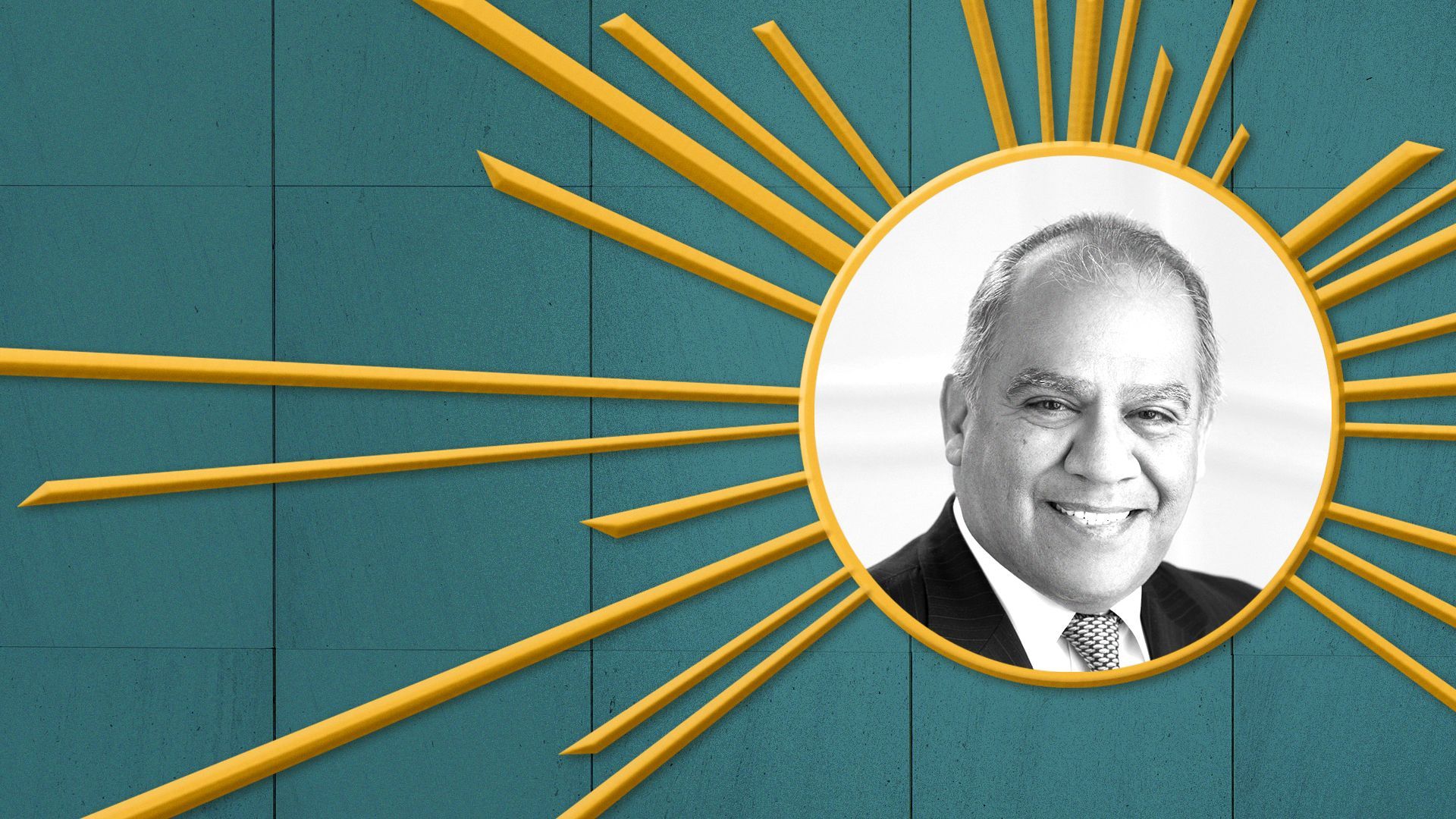
Photo illustration: Axios Visuals. Photo: Courtesy of the Landin campaign
If longtime activist and businessman Rogelio Landin became mayor, he'd plan to assume control of the public school district.
The big picture: Axios' interview with Landin is the latest in our series interviewing mayoral candidates on their policy priorities.
- Landin and other candidates who haven't held elected public office before aim to bring outside energy to city government.
- The race culminates in a primary in August, with the top two candidates facing off in November.
Flashback: Detroit native Landin's history in the city stretches from extensive local and national Latino civil rights work to nonprofit boards, workforce development and consulting with schools on diversity and cultural competency.
- Landin, 71, was part of the New Detroit coalition formed to create change in response to the 1967 uprising when in his early 20s.
- Landin has also been on five neighborhood advisory councils — resident groups that negotiate benefits with big developers — and leads the League of United Latin American Citizens locally.
- He has run for City Council four times between the 1980s and 2000s.
What he's saying: Landin says he decided to run because he has extensive experience in the areas where Detroit needs help: education, housing and workforce development.
- "I have tried everything I know to give people ideas," he says. "I got to the point where none of that has worked, that the only way I can implement these things I've been working on for 20–30 years was to do it myself, on behalf of the people I've dedicated my life to."
State of play: Landin made headlines for his desire as mayor to attempt to annex 28 financially distressed municipalities in Metro Detroit, bring them under Detroit's governance and use the combined resources to solve problems like housing and transit.
- He calls the idea a "long-term, sustainable solution to generating more revenue" and resources from the federal government by becoming a city of more than a million residents.
- Asked why the communities would agree to be annexed, Landin said if they had a way out of their own problems, they would have done it by now.
- "I will take full responsibility for making the economic case of why this works for everybody," he adds.
In another bold stance, Landin wants to use his experience in education and bring the Detroit Public Schools Community District under the mayor's office. It's run separately by a superintendent.
- The idea for the mayor to run the struggling district was floated by former Gov. John Engler in 2017, per the News, but the state and city tried a similar approach in the late 1990s and voters rejected it after a few years.
Between the lines: Landin wants to focus on financial empowerment so Detroiters can afford the housing they want, as opposed to focusing solely on building affordable housing.
- He also wants to consider putting a World Trade Center in the Renaissance Center.
- Also, he wants to develop Detroit's port and improve the city's standing as a major logistics hub for rail, freight, air travel and ground transportation.
Context: One theme of the mayor's race is big business and community — balancing the varied interests and needs of those affecting and affected by how Detroit is evolving. One prominent example of that dynamic is the community benefits ordinance (CBO), a process in which developers receiving a certain level of public resources have to host meetings with a resident council and draft an agreement providing benefits to the neighborhood around their project.
- He says that in CBO processes, corporations looking to take on big projects "didn't take anything from the community," as some critics argue.
- They bring unused sites back into use and use performance-based tax incentives, not "giveaways," he said.
The bottom line: We asked Landin about a quality he would bring as mayor that is different from other candidates.
- "The depth and breadth of my experience," he said, adding that he could convene stakeholders as well as any other candidate.
- He also brought up his coalition-building experience, and that he's the only non-Black candidate. "We have an opportunity to form a national urban coalition between Blacks and Hispanics to address the outcomes of elections in 2028 and moving forward, and that's how we take back our government."
Go deeper: Read our other sit-downs with candidates Fred Durhal III, Mary Sheffield, Saunteel Jenkins, Solomon Kinloch Jr., Todd Perkins and Jonathan Barlow.