Corktown's Michigan Ave. redesign weighs safety, business concerns

Add Axios as your preferred source to
see more of our stories on Google.
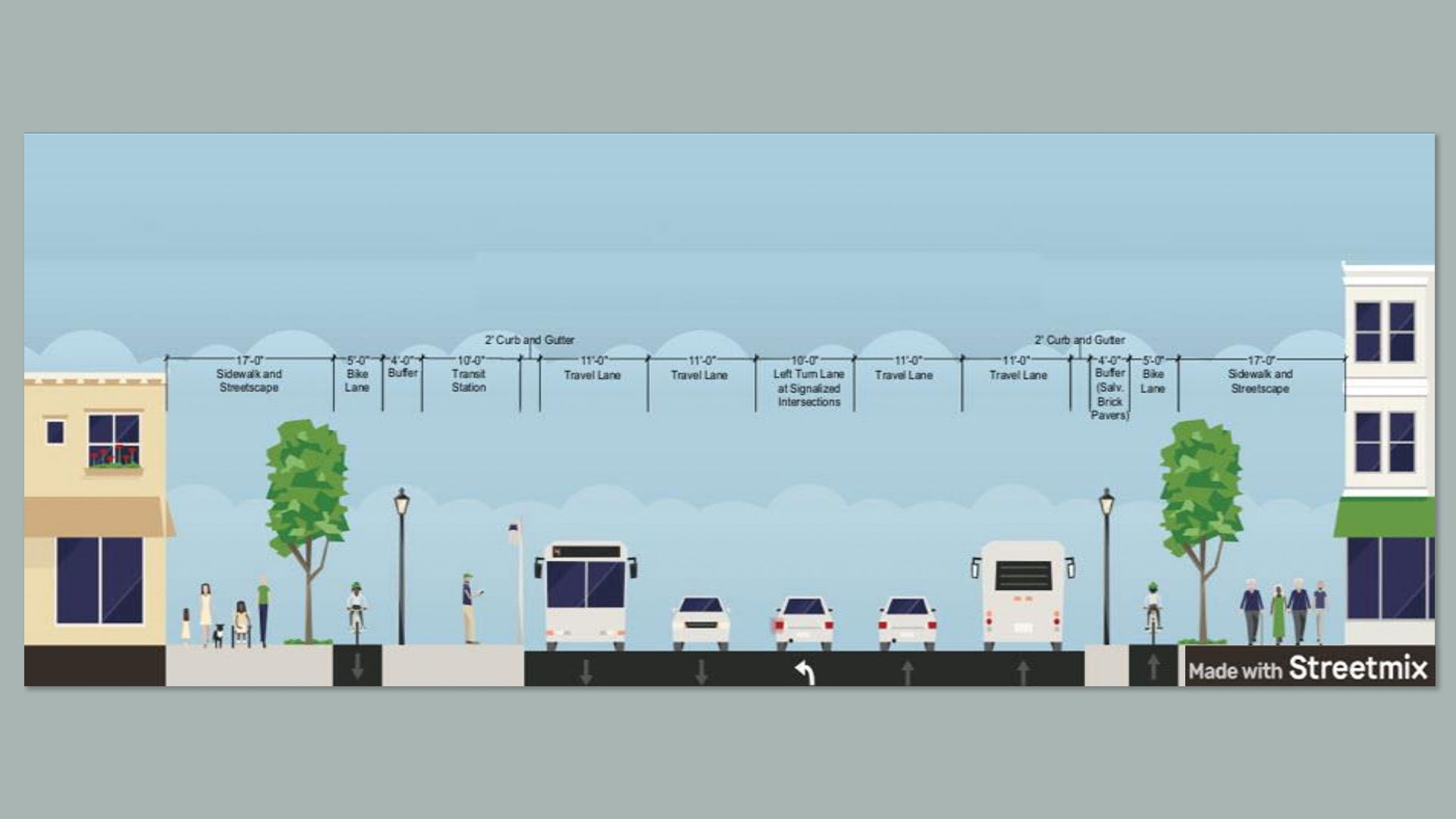
A rendering of MDOT's latest proposed redesign of Michigan Avenue in Corktown. Image: Courtesy of MDOT
The latest design of MDOT's much-discussed Michigan Avenue reconstruction in Corktown was revealed to residents last week.
Why it matters: Michigan Avenue, one of the city's most historic and busiest thoroughfares, needs a major makeover to improve safety for vehicles and pedestrians.
- The street's so wide that one resident recently compared crossing on foot to playing Frogger.
- The design includes protected bike lanes but not the dedicated public transit lane that had been considered.
Between the lines: The project has stirred tensions among residents, for whom pedestrian safety is the top priority, and members of the Corktown business community, who want ample parking and minimal traffic disruptions during construction.
The big picture: The project focuses on a 2-mile stretch of Michigan Avenue from Campus Martius to I-96.
- The cost is estimated at $70 million, with $25 million coming from a federal RAISE grant.
State of play: MDOT's latest redesign includes:
- Shorter crossing distances for pedestrians, achieved via sidewalk bump-outs and mid-block crossing areas.
- Widened sidewalks and bike lanes with four-foot buffers separating them from the street.
- More street parking than previously proposed.
- Two general traffic lanes in each direction would remain.
What they're saying: The latest proposal's removal of a dedicated transit lane was disappointing to some advocates.
- "I think that we live in what is effectively a car-only city, as opposed to a car-dominant city," James Everslage, who lives near Corktown, told the Free Press. "If you want to get around here and you want to do so effectively, essentially, you only have one option right now. I think that Corktown is ripe for a change."
The other side: Paul Thomas of Plum Health on Michigan Avenue told the Freep they could lose patients if street parking is eliminated and new mothers or those with disabilities have to walk longer distances.
What's next: Community engagement will continue into early next year, with a final plan expected by mid-2025.
- Major construction is scheduled for 2026 and 2027.