
Measuring up RenCen's housing bid with downtown growth

Add Axios as your preferred source to
see more of our stories on Google.
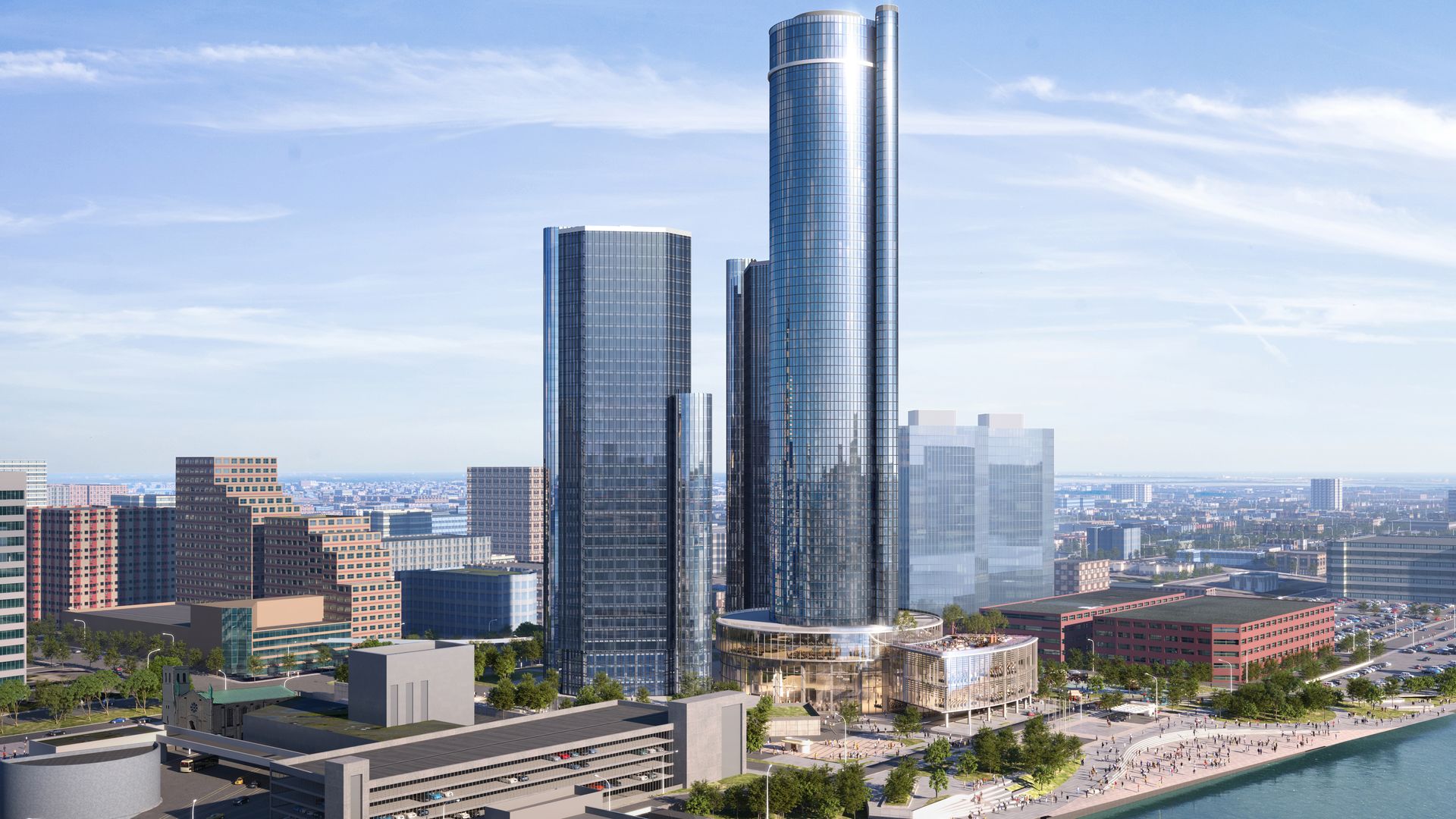
The RenCen redevelopment pictured in a conceptual rendering. Rendering: Courtesy of Bedrock
The proposed redevelopment of the RenCen would include up to 600 riverfront housing units for a downtown that seeks to evolve as a residential destination.
Why it matters: The RenCen apartments would represent an influx of premium riverfront housing in a central business district that has seen sizable growth, though it still has fewer residents than other downtowns in similar metros.
- The city, lacking its pre-pandemic office worker base, aims to build up its reputation as an exciting place to live and play — a goal that requires shiny new housing options.
Yes, but: Experts are mixed on whether downtown will need that large of a housing addition over the next several years.
By the numbers: 600 residences is no small add-on for a downtown with a population of 6,759 as of 2022, according to the Downtown Detroit Partnership's data dashboard, using census figures and estimates. That's a 28% jump from 5,287 in 2010.
- The DDP, which aims to help get downtown to 10,000 residents, estimates the population as of this year is 6,820 and projects slower growth over the next couple of years, to 6,941 in 2032.
Catch up quick: In a vision floated late last month by developer Bedrock and GM, which owns the RenCen, they would demolish two towers while keeping the other three.
- One of the office towers would convert to 300-400 residential units, Crain's reported. The tallest tower would have 200 high-end apartments on top, per the News.
What they're saying: "I think there will be ample demand for us to continue this upward trajectory with residential, and the nice thing about density is it feeds more density," DDP CEO Eric Larson tells Axios.
- "We're continuing to see a strong commitment from the development community to build new units," he says.
- Larson adds that expanding amenities available to downtown residents and Detroit's growing reputation as an alternative to the expensive coasts is making it increasingly attractive.
Between the lines: Downtown has seen success attracting people to move there, Brian Connolly, a U of M professor with expertise in real estate, tells Axios. With high housing prices, even building high-end units can help reduce pricing pressure.
The other side: Jerome Huez, owner of Detroit real estate brokerage The Loft Warehouse, told Crain's that based on downtown's current market, the units aren't needed and could "flood the market."
- The vacancy rate for downtown's multifamily residential buildings grew from 8.6% in early 2022 to 19.3% as of early this year, according to a recent DDP report.
- Larson says much of the vacancy is due to the time needed to absorb the units into the market, not necessarily low demand.
Reality check: There are conflicting opinions on how high-end housing may help or hurt the city that is also in an affordability crisis, with very different housing economies in its neighborhoods versus its core.
What's next: Bedrock and GM say their office-to-residential conversion, and the $1.6 billion total project, hinges on state and local leaders agreeing to provide $250 million in public financing.