Detroit City Council considers neighborhood solar fields

Add Axios as your preferred source to
see more of our stories on Google.
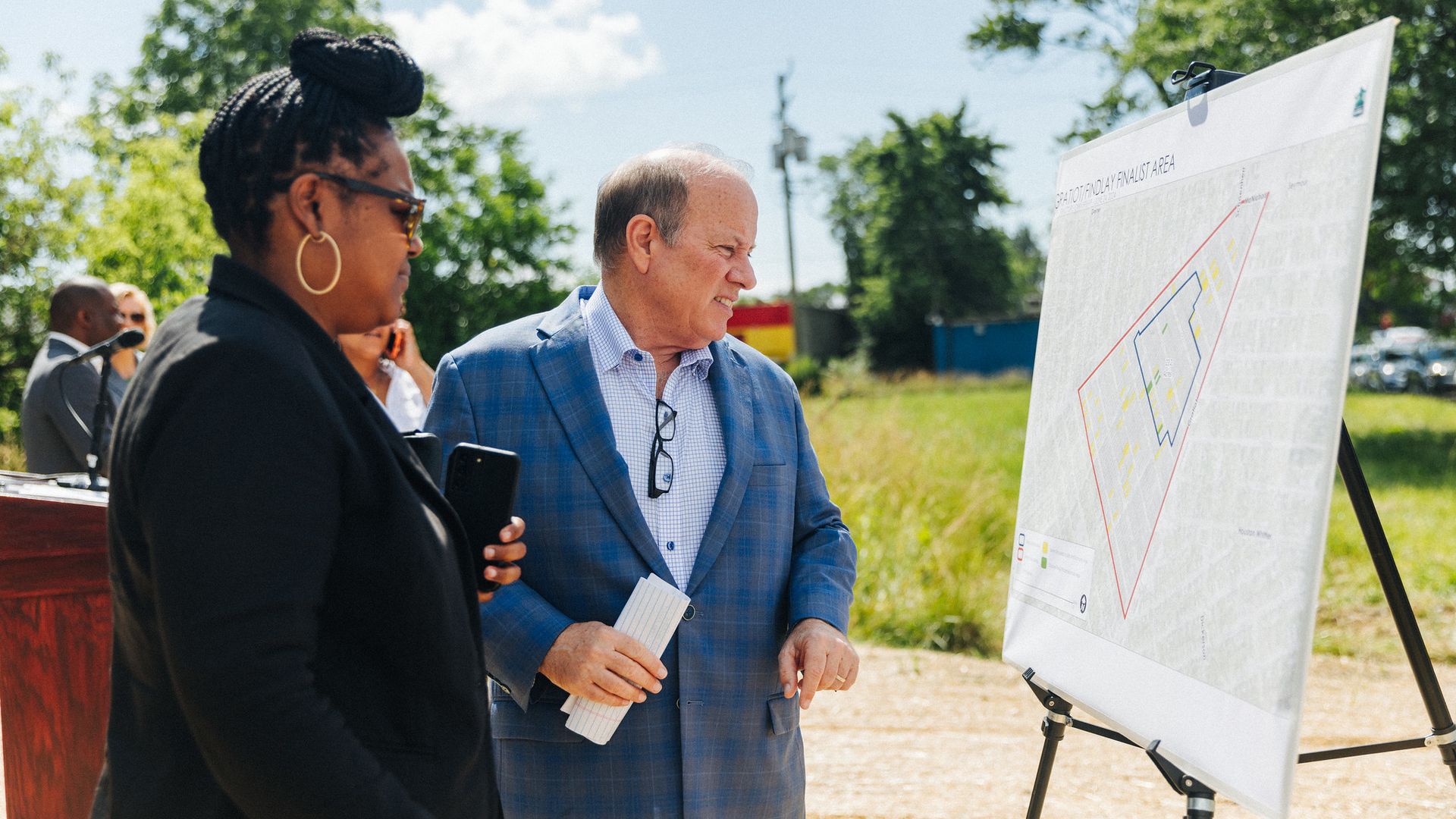
Mayor Mike Duggan is pictured at a press conference announcing the three solar neighborhoods in late June. Photo: Courtesy of the city of Detroit via Flickr
City Council is considering a plan to build ground-mounted solar arrays in predominantly vacant sections of Detroit neighborhoods.
Why it matters: The solar fields program, announced last year, is part of the city's effort to clean up blighted areas, repurpose them and bring them into new uses.
- It also aligns with the city's 2019 pledge to eliminate municipal greenhouse gas emissions by 2050.
However, some residents and council members have voiced concerns that the plan could hamper rather than speed up revitalization efforts.
Catch up quick: Detroit selected three neighborhoods that applied — Gratiot/Findlay, State Fair and Van Dyke/Lynch — to receive solar arrays after months of community engagement including meetings, door-knocking and outreach through designated neighborhood solar partners.
- The city intends to focus on three areas in the initial phase, allocating $14 million for property acquisition, demolition and cleanup.
The latest: After weeks of discussion, a City Council committee is returning the approval items for consideration again next week: a resolution to move the project forward and 35-year contracts with DTE Electric and Lightstar Renewables.
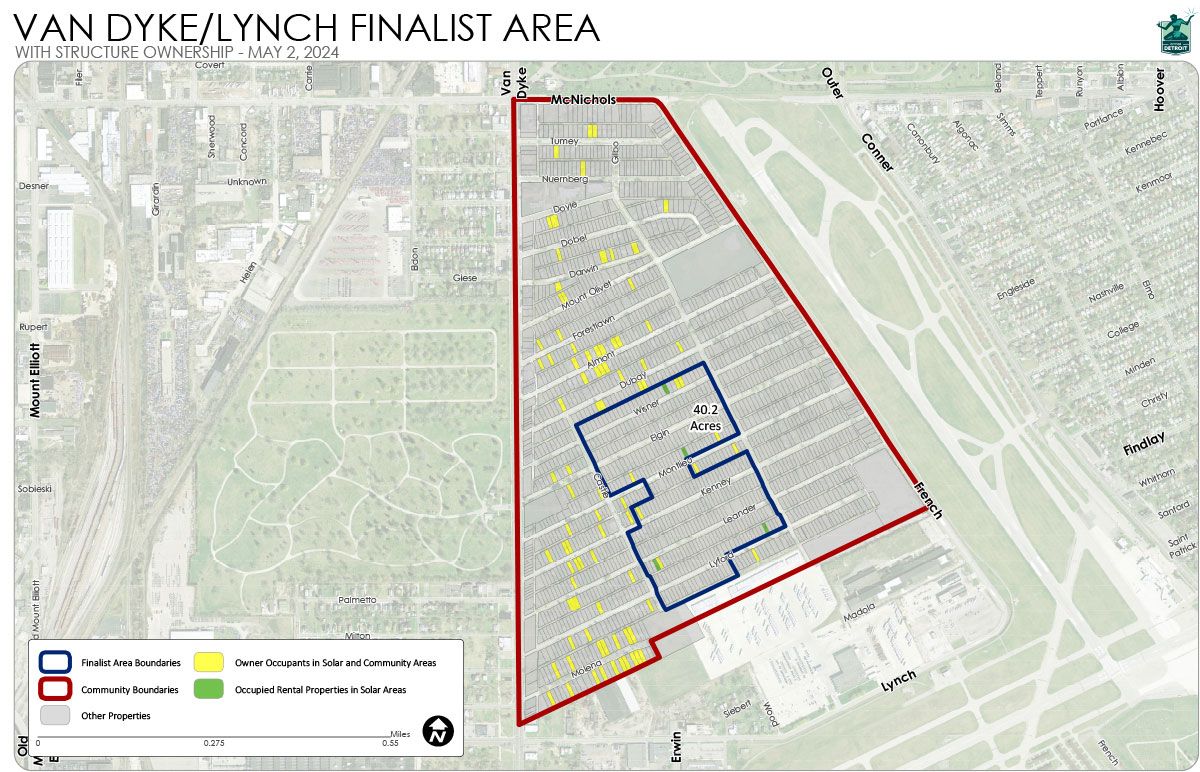
Context: Nearly all of the 104 acres of planned solar use are vacant or occupied by blighted structures — though some buildings are structurally viable, according to city documents.
Between the lines: All 21 owner-occupied households inside the three neighborhoods' proposed solar boundaries have agreed to relocate and signed option contracts. These homeowners will receive double the market value or a minimum of $90,000 for their properties, according to city chief strategy officer Trisha Stein.
- Renters are to receive relocation costs and 18 months' free rent.
- The city also would retain the right to start condemnation proceedings in court to acquire landlords' properties through eminent domain if it can't do so voluntarily, according to city documents.
In exchange for allowing the solar fields in their neighborhoods, 159 homeowners in designated nearby zones will receive $15,000-$25,000 in energy efficiency upgrades to their homes including new windows, smart thermostats or weatherization.
Friction point: Council members, city officials and residents have split opinions about the benefits of this solar project. While some seek to move forward after advocating for these solar arrays in community meetings, others expressed concerns at council meetings.
- Among the concerns are whether the solar arrays might hinder future development by occupying vacant land, potentially driving away population, and questioning if the benefits justify relocating residents.
What they're saying: In a July 1 committee meeting, council member Gabriela Santiago-Romero questioned the city's mass land acquisition for the solar project. She reflected on the demolition of part of Black Bottom for I-375 in the 1950s and '60s.
- "The city, the government have said this in the past, when it comes to 375, and eminent domain … that ended up destroying a neighborhood," she said. "So, how are we keeping this in mind? I understand this is for a public use … but there is a very real concern that if we are able to just take property, where do we leave the public then?"
What's next: Council President Mary Sheffield is requesting an outside legal opinion on the solar project — a process that still requires council approval.
- "These questions involve the use of eminent domain and the city's ability to exempt itself from its own zoning ordinance," she said in a statement to Axios, adding that she "would like to get an opinion from outside counsel on the city's exposure to potential lawsuits and damages if the solar farms are established."