Trial over Aretha Franklin's estate will determine who controls fortune

Add Axios as your preferred source to
see more of our stories on Google.
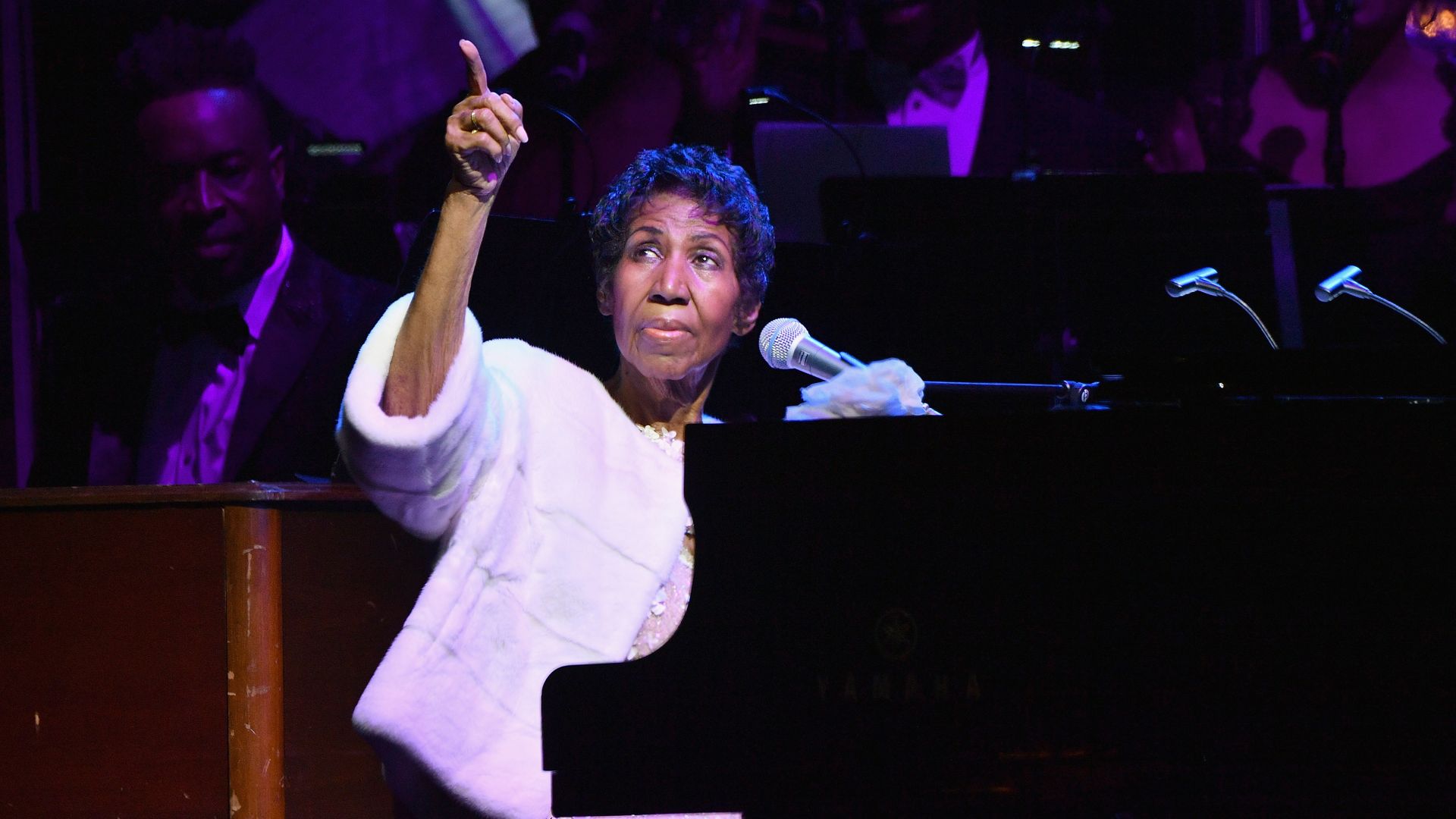
Aretha Franklin performs onstage in November 2017 in New York City. Photo: Dia Dipasupil/Getty
A trail of handwritten documents, including one found in couch cushions, will determine who controls Aretha Franklin's estate.
Why it matters: A jury trial beginning Monday morning at the Oakland County Probate Court in Pontiac will decide who takes ownership of assets worth millions, including real estate, jewelry and royalties from future use of the songs of the Queen of Soul.
- It's hard to estimate how much her catalog is worth, Don Wilson, a Los Angeles attorney who has represented Franklin for the past 28 years, told the Free Press last week.
Catch up fast: Franklin hadn't made a formal will when she died in 2018 at age 76.
- It was thought that her four sons would split the estate until a number of handwritten wills, some of which contradict each other, were found in her Bloomfield Hills home.
- Her son, Ted White II, believes the documents dated in 2010 usher control of the estate, while two other sons, Kecalf Franklin and Edward Franklin, favor a 2014 document, the Associated Press reports.
State of play: The 2010 will lists White and a niece, Sabrina Owens, as co-executors and states Kecalf and Edward Franklin "must take business classes and get a certificate or a degree" to benefit from the estate, per the AP.
- The 2014 will crossed out White's name as executor and lists Kecalf Franklin in his place, without any mention of the business classes.
Zoom in: Aretha Franklin wrote in the 2014 will that her gowns could be auctioned off or go to the Smithsonian Institution in Washington.
- She also wrote that her oldest son Clarence, who lives under a guardianship, must be regularly supported.
Of note: The trial will be presided over by Judge Jennifer Callaghan, who's overseen the case since August 2018.
Between the lines: Michigan law allows for final wishes to be fulfilled through handwritten documents if there is no typewritten will.
- "That's exactly what Aretha did," Pat Simasko, who teaches elder law at MSU's College of Law, told the AP. "She sat there one day, wrote up her wishes and then dated it. It's absolutely perfectly allowed in Michigan."
