Iowa nears 900 plate readers as Flock backlash grows


Add Axios as your preferred source to
see more of our stories on Google.
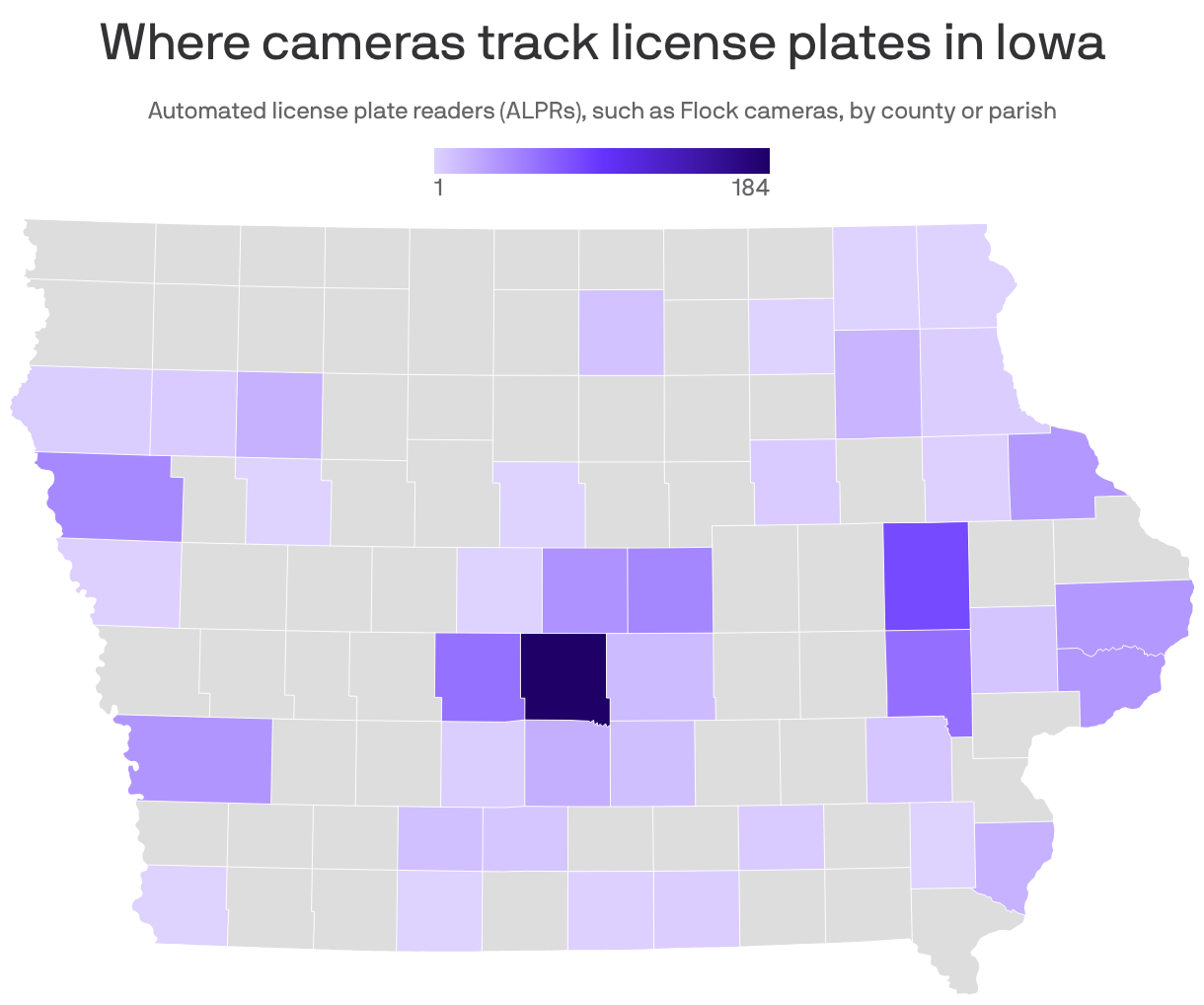
At least 861 automated license plate readers have been documented in Iowa, as growing privacy concerns prompt some communities to reconsider or abandon the technology.
Why it matters: Iowa communities are weighing a crime fighting tool against growing concerns about how closely police can track people's movements.
Driving the news: Waukee and Indianola discontinued using the cameras, and Dallas County paused a planned rollout pending guidance from state lawmakers.
- Ankeny continues to use 16 Flock cameras but is expected to consider their future before its contract expires in 2027.
State of play: The crowdsourced Finding Flock mapping project has documented about 140,000 automated license plate readers in the US.
- That's up from about 1,100 documented in January 2024, though Finding Flock says the surge reflects both increased volunteer mapping and camera deployments.
Meanwhile, Des Moines police use Motorola rather than Flock readers, with 130 of them, primarily in patrol vehicles, according to records obtained by the ACLU of Iowa.
- Those are not among the more than 180 listed in the Finding Flock database for Polk County — more than twice as many as any other Iowa county.
Context: Like Flock, DSM's system automatically records license plate numbers, locations, and time stamps, enabling police to search for past vehicle sightings and to share data across agencies.
By the numbers: The readers are in more than 60 Iowa communities, according to a recently updated investigation by the ACLU of Iowa.
What they're saying: The ACLU says there's uneven transparency and warns that interconnected databases can be used to reconstruct people's movements with minimal oversight.
- Republican Zach Lahn and Democrat Rob Sand, the candidates for governor, have both said they support state safeguards for automated license plate readers.
The other side: The readers can quickly identify stolen vehicles, locate missing or endangered people and generate leads in cases that might otherwise go unsolved, law enforcement and supporters of the systems have said.
- Flock says its cameras improve public safety while protecting privacy, noting that customers control access, searches are audited, and encrypted data is automatically deleted.
The big picture: Elsewhere in Iowa, Osceola and Clarke County terminated their Flock contracts, Coralville canceled its two-camera system, and Iowa City ended an agreement that allowed University of Iowa-owned readers on city property.
- Nationwide, about 100 communities have deactivated Flock cameras, rejected proposed systems or canceled contracts amid the growing backlash, according to DeFlock data cited by NPR.
What we're watching: Whether the Legislature imposes additional statewide guardrails in 2027 — and whether more Iowa communities pull the plug before lawmakers act.