Water Cooler Talk: Who is producing the most nitrates?

Add Axios as your preferred source to
see more of our stories on Google.
Illustration: Allie Carl/Axios
Hello! Welcome to our Water Cooler Talk series, where we answer your questions about our area's water quality concerns.
Driving the news: A question we got from multiple people:
- What is the primary driver of nitrates and water quality pollution, including corporate versus family farms, and urban runoff like golf courses and car washes?
First, let's start with the basics! Nitrates are a naturally occurring form of nitrogen, a basic nutrient that all living things need. Plants use it to grow, which is why it's a key ingredient in fertilizer.
- In small quantities, nitrates are harmless. But when large amounts (often from fertilizer or manure) get applied to farmland, more nitrates are produced than crops can absorb, and they can dissolve and wash into streams and rivers.
- The problem is especially acute in Iowa, because we have an extensive drainage tile system that moves water, and nitrates, off fields quickly.
- We dealt with this earlier this year, especially when we experienced heavier rainfall in the state following drought.
Zoom in: "Currents of Change," a report released last year by Polk County, provided a water quality analysis by 16 scientific experts who spent two years assessing central Iowa's drinking water.
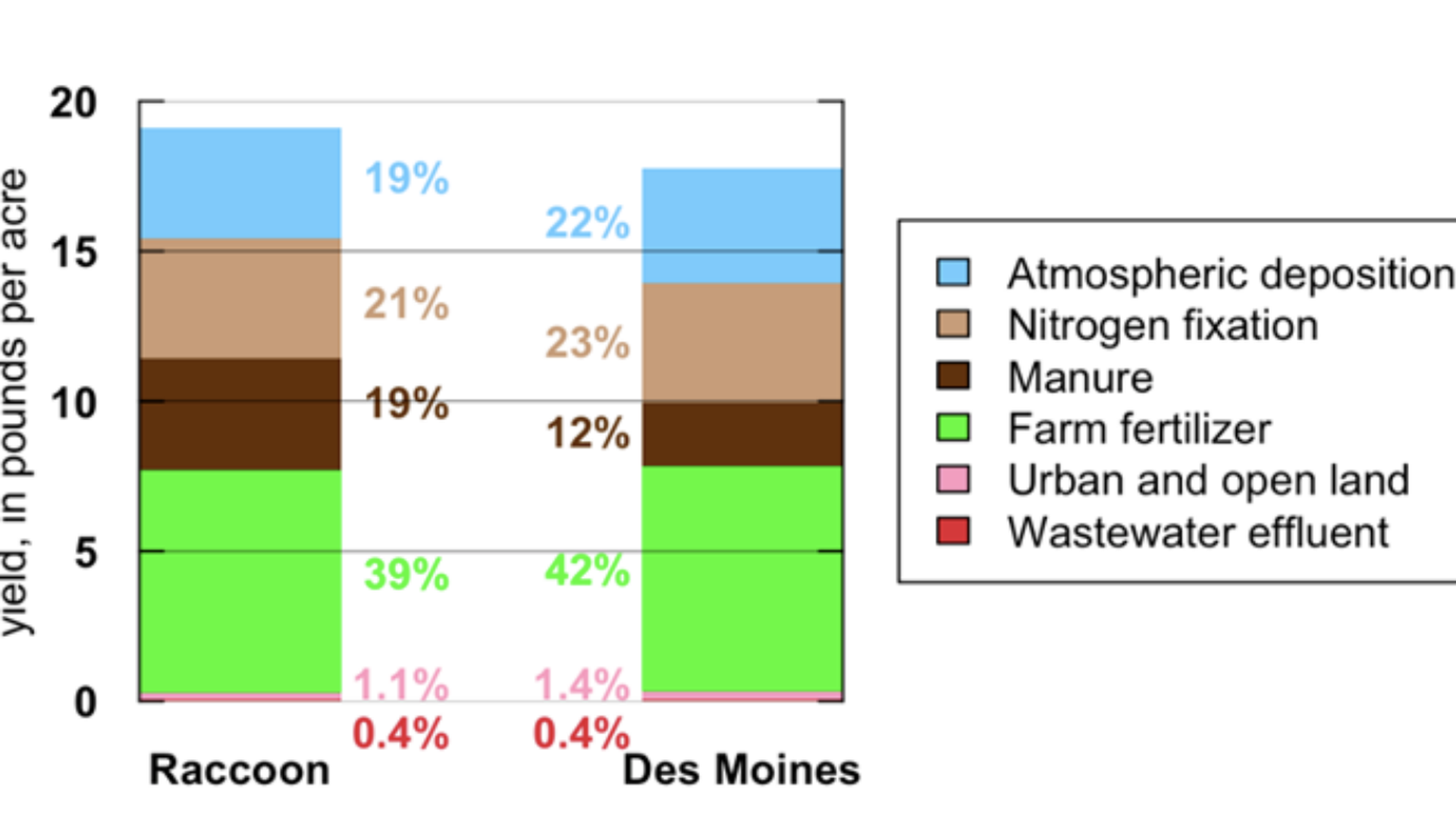
By the numbers: Researchers sorted nitrate entering the Raccoon and Des Moines rivers into six sources:
- Synthetic fertilizer (40%): Fertilizer spread on fields that the crops don't absorb is the biggest nitrate source for both rivers.
- Soybean plants (20%): Soybeans pull nitrogen from the air and store it. When the plants break down after harvest, that nitrogen can wash into waterways.
- Fertilizer/manure evaporation (20%): You know that smell after manure is applied to a field? Some nitrogen turns to gas and drifts into the air, then falls back down in rain or snow.
- Manure (12-19%): The issue is bigger in the Raccoon (19%) than the Des Moines (12%) because of the prevalence of farms in northwest Iowa.
- Cities and towns (1.5-2%): Urban pollution like golf courses and car washes.
What they're saying: While synthetic fertilizer is the largest driver behind our rivers' nitrates, agriculture runoff is also exempt from the Clean Water Act permitting requirements, making it difficult to discern how much fertilizer is being applied on farms, says Michael Schmidt, general counsel for Iowa Environmental Council.
- "That is kind of a black box," Schmidt says, noting the public knows how much gets sold each year, but not where it's going.
As for pollution from family versus corporate-owned farms, we'll note that there are many large family-owned LLC farms.
- There also isn't an easy apples-to-apples nitrate comparison between crop-focused farms versus livestock.
- In general, nonfamily corporate farms own less land than family farms, but they're more likely to specialize in intensive livestock production, according to Iowa State.
- Two-thirds of the state's manure comes from operations with 1,000 or more animal units, based on the Iowa Department of Natural Resources' 2026 Animal Feeding Operations database.
The bottom line: While the state has a strategy to reduce nitrates and farmers are trying their best to properly apply fertilizer, they're also working in a larger system that is incentivizing maximum production, Schmidt says.
- "If we want real change, we need to change those economic incentives and have a way for people to profitably operate without having so much of their fertilizer go downstream," he says.