New app alerts homeowners to rising indoor heat

Add Axios as your preferred source to
see more of our stories on Google.
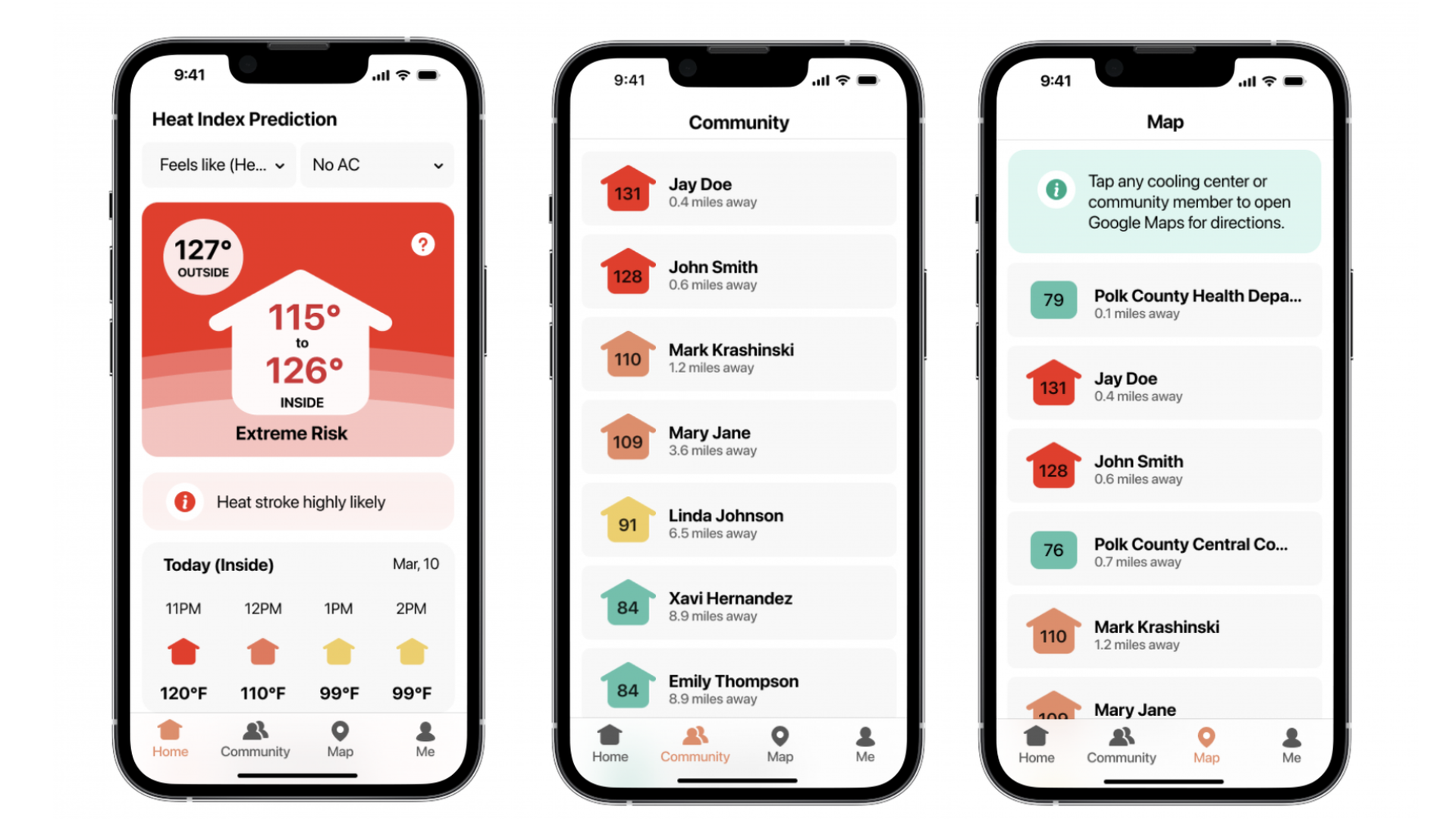
The interface of CommHEAT, an app that shows heat risks. Photo: Courtesy of Iowa State
A pilot project led by Iowa State researchers is helping Des Moines residents predict when their homes could become dangerously hot.
Why it matters: Extreme heat is the deadliest weather hazard in the U.S., and residents living in lower-income and aging neighborhoods are most susceptible to it.
Driving the news: Researchers at ISU have built CommHEAT, a smartphone app that predicts how much a home's indoor temperature will rise and alerts residents if it's expected to reach a dangerous level.
- While outdoor temperatures are easily available, predictive information is lacking for homes' indoor conditions, says Iowa State architecture professor Ulrike Passe, who helped lead the project and assemble researchers.
- That data can be especially helpful for caretakers or public health agencies who want to check in on solitary or elderly people.
How it works: Sensors were placed in 15 Des Moines homes that volunteered to join the pilot this summer. Researchers gathered temperature data and personal feedback from homeowners who dealt with several heat waves this year.
- The volunteers, who lived near the Capitol and had little to no air conditioning, were able to use the app and see the predicted temperature for the next 24 hours.
Catch up fast: More accurate indoor home temperature predictions were available, thanks to nearly a decade of data already gathered by ISU faculty and students studying climate impacts on Des Moines neighborhoods.
- Everything from construction material to orientation towards the sun to tree canopies can influence home temperatures, Passe says.
- In 2017, the Polk County Health Department reached out to Passe and other researchers because they wanted to better identify which homes were too warm in the summer, helping prompt the app idea.
What's next: Now, Passe says they're analyzing the sensors' collected data and working to refine the app with the hope of larger public use someday.
- The project was funded by a three-year $1.2 million U.S. National Science Foundation grant that is coming to an end. Passe says they hope to find more funding to continue their work.