Ethanol's role in Iowa's nitrate crisis

Add Axios as your preferred source to
see more of our stories on Google.
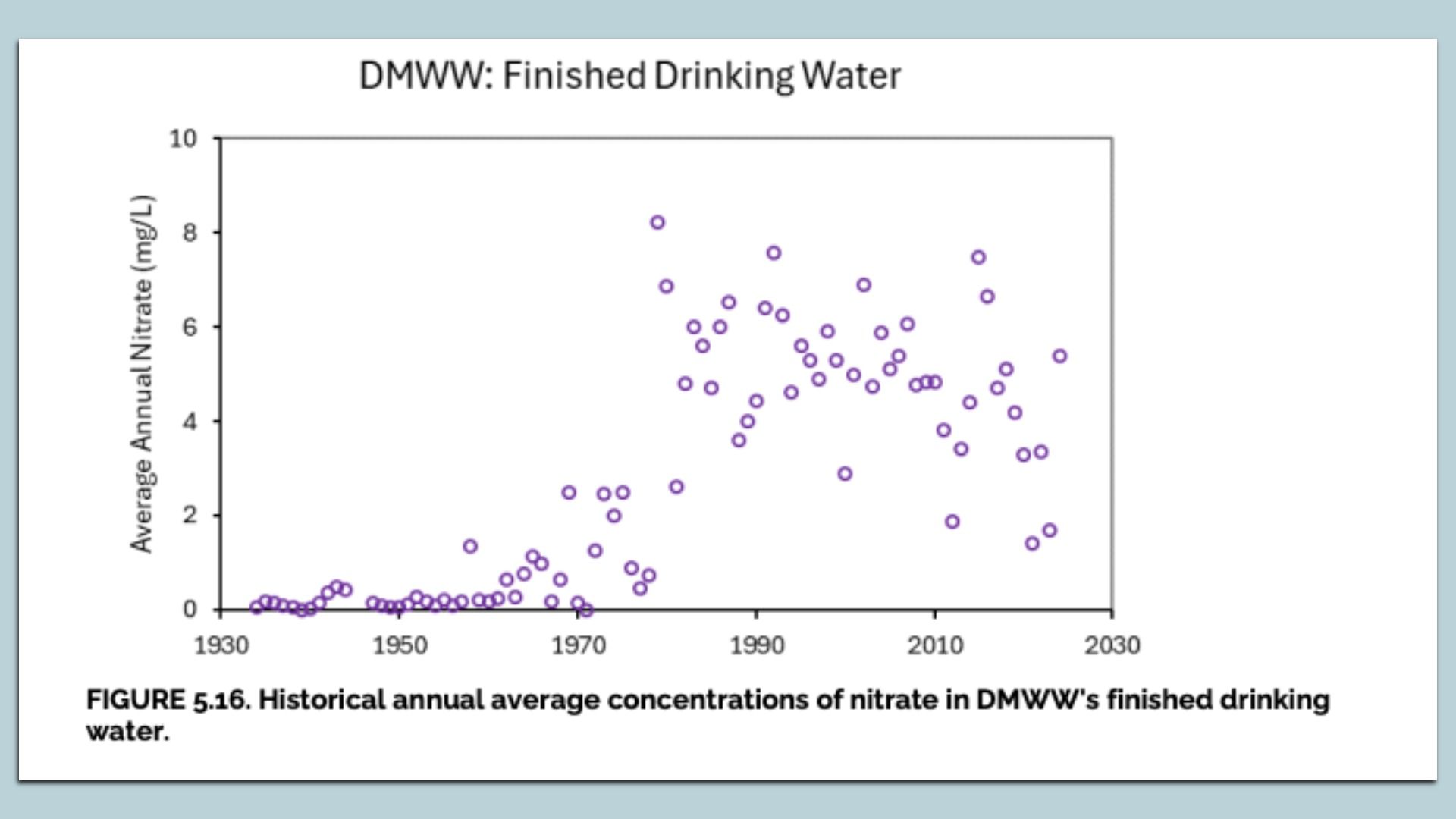
Average nitrate concentrations in Des Moines drinking water were largely below 2 mg/L before 1970 but have exceeded 7 mg/L in recent decades, according to a scientific river report commissioned by Polk County and published this month. Screen grab: Courtesy of Polk County
The state is at a crossroads of having some of the world's best farmland — but also the pollutants that come from working it.
Why it matters: A scientific report commissioned by Polk County and released this month found that 80% of the nitrates entering the Des Moines and Raccoon rivers come from agricultural sources.
State of play: Synthetic fertilizers, livestock manure and soybeans are major nitrate contributors, according to the report.
- Nitrate is an important fertilizer for crops, but it can quickly leach into streams via surface runoff, per Iowa Capital Dispatch.
Driving the news: A buildup of nitrates in farm fields following Iowa's record drought set the stage for an uptick in stream pollution due to this year's heavy rainfall.
- And climate change is expected to continue these extreme events and cause extended droughts as well as flash floods across the Midwest.
What they're saying: Austin Frerick, a local author on agricultural and antitrust policy, believes ethanol has been a major driver of Iowa's polluted waters.
- "You can have clean water or you can have ethanol, but you can't have both," Frerick says.
How it started: The 1996 Farm Bill and 2005 Renewable Fuel Standard (RFS) offered more subsidies for corn and created artificial demand for it through federal ethanol blending mandates, Frerick says.
- That's resulted in an overproduction of corn as farms try to profit, including excessive fertilizer use and nitrate runoff.
- Today, the majority of U.S. corn crops are used for ethanol or alcohol.
The other side: Monte Shaw, executive director of the Iowa Renewable Fuels Association, argues that supporting the ethanol industry helps farmers, which results in improved conservation practices.
- Earlier this month, Gov. Kim Reynolds said she does not believe the state needs to regulate farmers, saying they're already voluntarily using conservation practices, per The Gazette.
- "When farmers are scared of losing the farm, that's when you see bad environmental practices," Shaw says.
Zoom in: Shaw says farmers are planting fewer acres of corn now in comparison to 1930, even with the implementation of RFS.
- Since 1930, the U.S. is producing 20% more corn on 25% fewer acres, due to hybrid corn breeds and improved technology, but also increased fertilizer and pesticide use, per the USDA.
Between the lines: An ISU study published this year shows the total amount of fertilizer needed for profitable corn production in the Midwest has increased by 1.2% annually over the last three decades, due to increased demands from higher yields and wetter springs that wash it out.
- At the same time, farmers have also become more efficient in applying fertilizer, using 0.7 pounds of nitrogen or less per bushel — down from ISU's recommendation of 1 pound per bushel 20 years ago.
- While more efficient practices help reduce excess nitrogen, there's still an overall rise in needed fertilizer.
The bottom line: Despite conservation practices, Frerick argues the pollutants caused by the overproduction of corn outweigh the efforts.
- "You're taking the best farmland in the world, and you're just wasting it," he says. "Instead of growing food, you're wasting it in your car."