More women are working in deathcare, funeral industry

Add Axios as your preferred source to
see more of our stories on Google.
Lanae Strovers helps guide a casket for a funeral. Photo: Courtesy of Lanae Strovers
Lanae Strovers didn't plan to work in deathcare until she lost a close friend and his funeral didn't reflect who he was.
The big picture: More women like Strovers are entering the historically male-dominated funeral industry.
Context: In the 18th and 19th centuries, women played major roles in deathcare, including watching over the dying and laying out their bodies.
- But that shifted when embalming became the norm and deathcare became a more formalized practice, which women were excluded from.
Flashback: When Strovers' close friend died in a single-car accident in 2007, it took three months for his remains to be identified.
- When the funeral finally happened, "it just felt like we were at the wrong place," she tells Axios. Nothing reflected the vibrancy of her friend, who was a Des Moines hairdresser.
- That night, after a couple of glasses of wine, she Googled "how to become a funeral director" and applied to DMACC's mortuary science program. She woke up to an acceptance email.
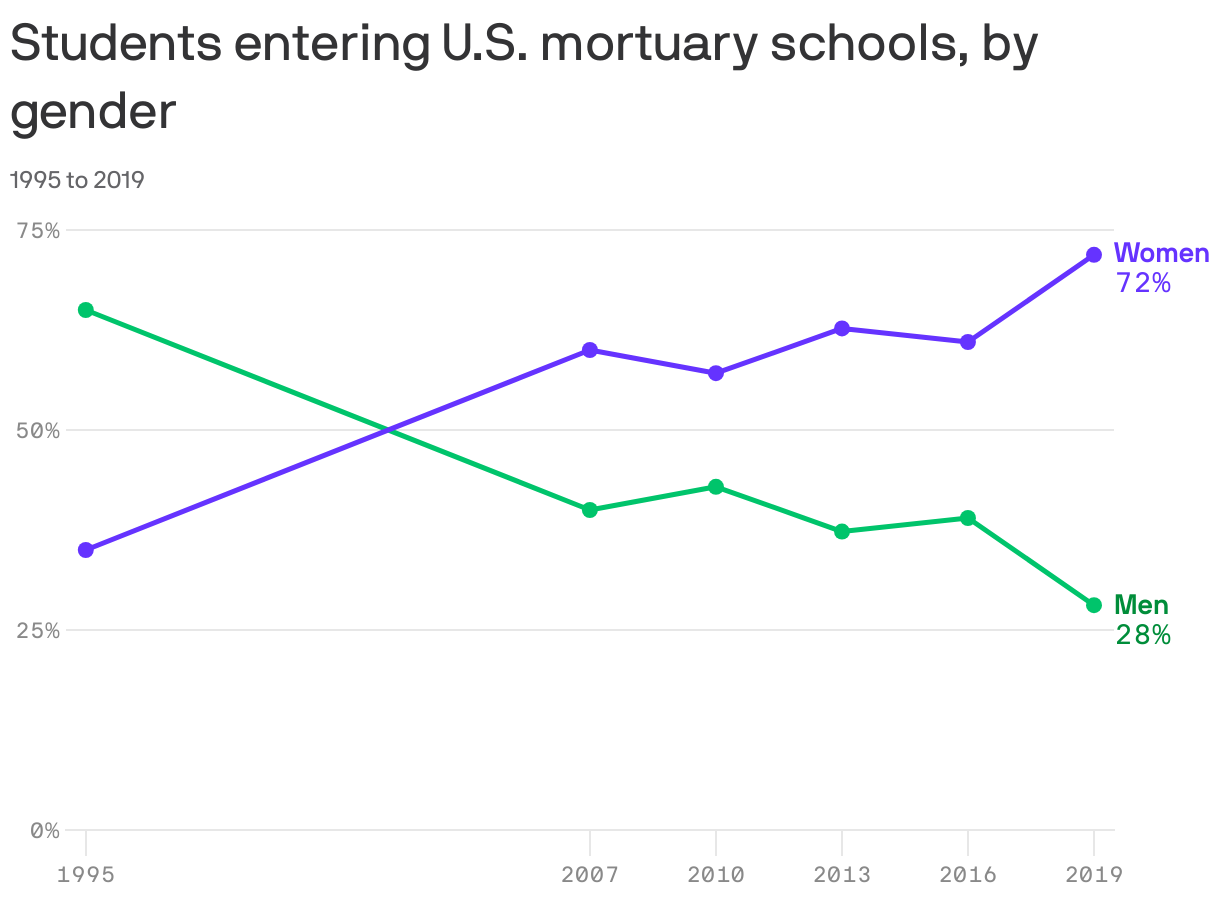
State of play: There's a dated perception that funeral directors are "old white men," but these days, women are outpacing men in mortuary science enrollment, according to the National Funeral Directors Association.
- In 2007, 40% of students enrolling in mortuary science programs were women and 60% were men.
- In 2019, 72% of enrollees were women and 28% were men.
What they're saying: The funeral industry is shifting from traditional services to more personalization, Strovers says.
- It can be as simple as putting out a bowl of grandma's Werther's Original candy or as complicated as designing a funeral to appear like a runway show.
- People are also more open to talking about grief and mental health in recent years, Strovers says.
Yes, but: The industry doesn't have the highest pay, she says. In Iowa, a person with a degree in mortuary science earns an average of $62,138, according to DMACC. But entry pay is lower, typically around $35,000, she says.
The bottom line: "Society as a whole has been so much better about mental health and talking about their feelings, and we're doing so much more aftercare," Strovers says. "Once the family is done with the service, we're not done serving them."