Pew: Fewer Iowans are identifying as Christians

Add Axios as your preferred source to
see more of our stories on Google.
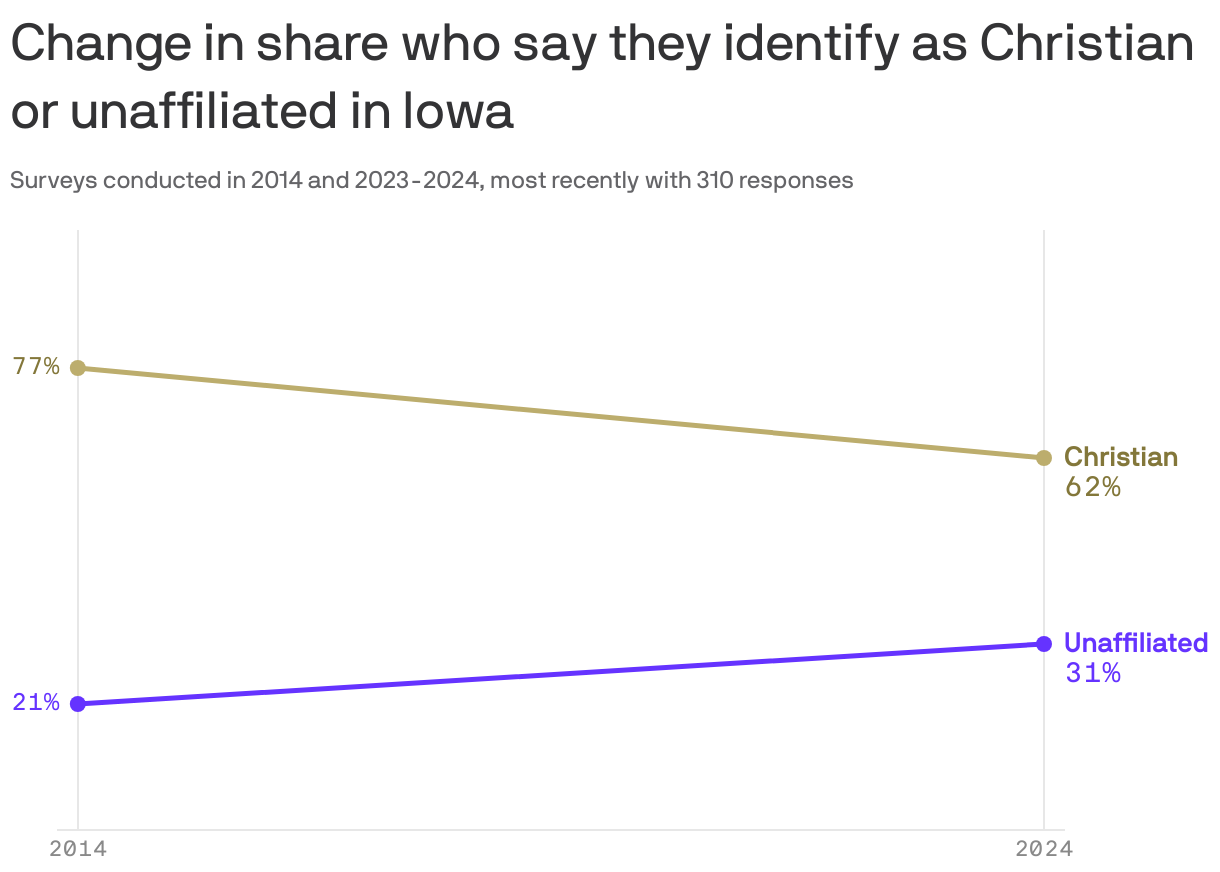
Fewer Iowans are attending church or identifying as Christian, per new 2023-24 Pew Research Center data.
Why it matters: Religion is a part of a "larger social puzzle" that has historically provided a built-in community, Drake University professor Brad Crowell tells Axios.
State of play: Iowans identifying as Christians declined by 20% over the past 16 years, also mirroring the broader national decline.
- Meanwhile, the religiously unaffiliated — atheists, agnostics and those identifying as "nothing in particular" — grew by 16% over the same period.
Zoom out: People under 40 often stop attending church after leaving home and are less likely to seek a new one. They're also more likely than older generations to leave if their church shares anti-LGBTQ+ sentiments.
- The pandemic likely sped up church departures, Crowell says. Many lost the habit of attending weekly or found other online communities that better aligned with their beliefs.
- "It becomes more an ideological thing than a community thing," Crowell says, pointing out that people also have become more partisan.
The intrigue: There are also some unique underlying dynamics in Iowa.
- People identifying as Evangelicals have declined by 7% over the last decade, per Pew. They may be shifting toward contemporary non-denominational churches that are also often conservative, Crowell says.
- Small-town and neighborhood churches are also disappearing in favor of "church shopping," in which people are willing to travel to worship in a place that fits their ideologies — typically larger suburban churches, Crowell says. Someone from Adel may be willing to drive to West Des Moines for church, for example.
- But that also presents its own struggles, Cromwell says, because people may drive 20-40 minutes rather than connect with neighbors down the street.
What's next: The decline in Christianity appears to be leveling off, according to Pew.