Happy Joe's aims for a comeback after struggles and bankruptcy

Add Axios as your preferred source to
see more of our stories on Google.
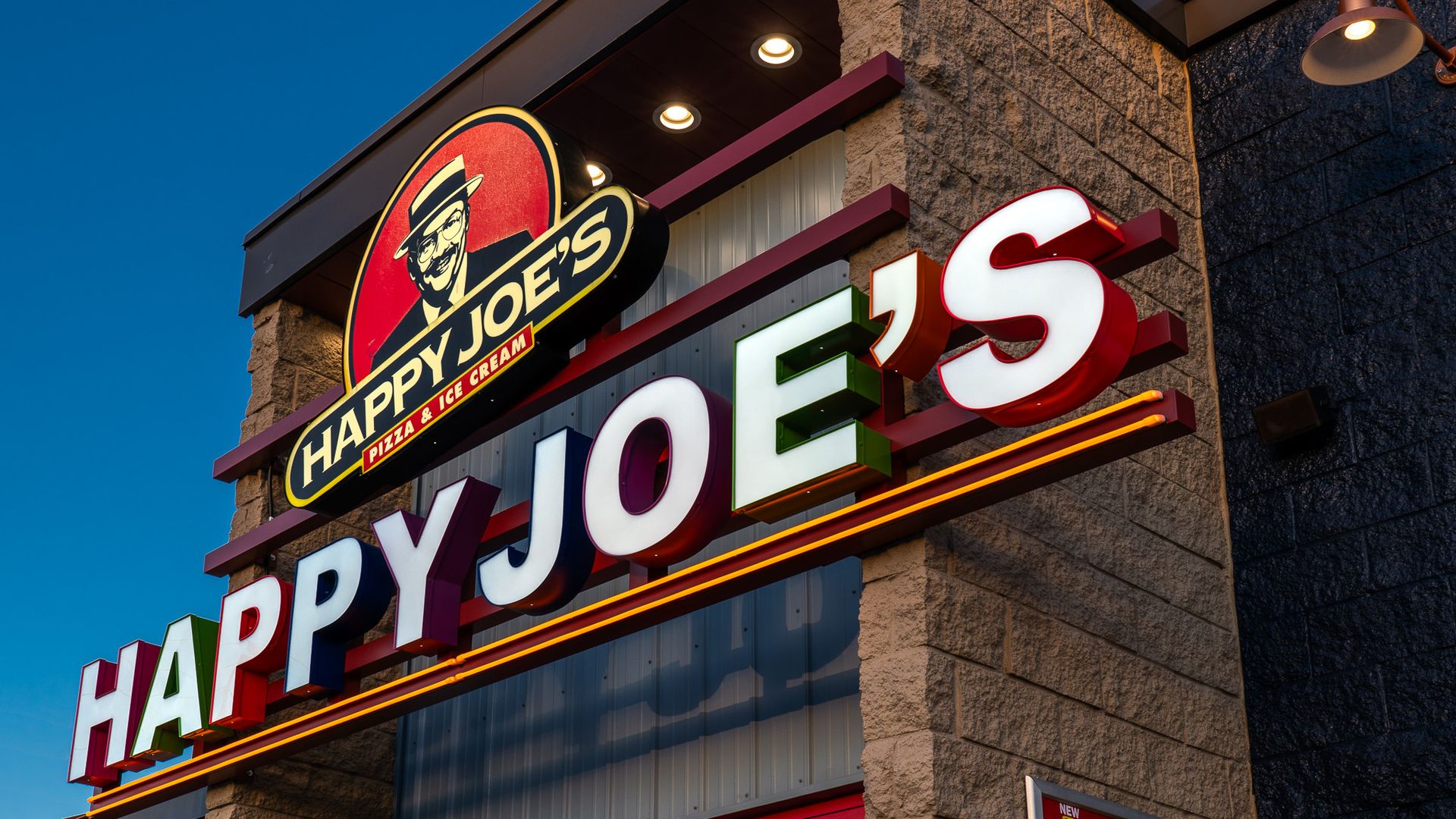
The Happy Joe's storefront in Bettendorf. Photo: Courtesy of Happy Joe's
Happy Joe's used to be known throughout Iowa for its boisterous birthday parties, ice cream bars and taco pizza.
Driving the news: Now, the struggling franchise is trying to make a comeback by recapturing that nostalgia, or "fairy dust," as Tom Sacco, the company's new CEO, regularly calls it.
- The group is also working to modernize and expand with new restaurants in Texas, Florida and the Middle East.
How it started: Lawrence Joseph Whitty first opened "Happy Joe's Pizza & Ice Cream" in Davenport in 1972 with the idea of making the dining experience fun, loud and full of energy.
- His chain became known for its kids' birthday parties, arcade games and electric train sets. Plus: It claims to have invented the taco pizza in 1974.
- At its peak, the restaurant had about 100 locations, primarily in the Midwest, but also in Egypt and Saudi Arabia, The Gazette reports.
- Whitty sold his majority stake in Happy Joe's to a new parent company, Dynamic Restaurant Holdings Group, in 2017. By the time he passed away in 2019, there were 43 locations left, mostly in the Midwest.
State of play: Things were "floundering" a bit in the 2010s, Sacco says. Nearby locations like West Des Moines and Pella closed down.
- The restaurants strayed from the original vision, altering beloved pizza recipes to cut costs, Sacco says.
Now, he says Happy Joe's has returned to its original pizza recipes, which he claims use better ingredients than his competitors — but which also means higher prices.
- "Maybe they can't afford our taco pizza once a week, but I can promise you, on their birthday, they're not going to Casey's, they're coming to Happy Joe's," Sacco says. "They're not going to Hy-Vee."
Plus: Happy Joe's built an app and started using third-party delivery, he says.
Context: While stores have closed over the years, sales at existing locations went up 28% between 2018-22, Restaurant Business reports.
- And while Happy Joe's parent company, Dynamic Restaurant Holdings, declared bankruptcy in 2022, it did not affect the franchises.
What's next: Sacco says he wants to expand to 250 dine-in restaurants in the next 10 years and bring back the experiences families loved, like kitchen windows where kids can watch pizzas being made.
- He's particularly eyeing smaller towns with fewer competitors, like Cascade, Iowa, which welcomed a new franchisee in January — with no nearby Chuck E. Cheese in sight.
- "Happy Joe's fits the niche to those small-town families who don't live in that world that we got to keep up with the Joneses."
A different local approach
While Jeff Reid appreciates the nostalgia of Happy Joe's, he credits his Urbandale location's success to delivering hot pizzas to "people on their couches."
Details: Reid and his wife took over the Urbandale Happy Joe's location in 2021 and own the rights to the restaurant in the Des Moines market. At the time, it was in "shambles" and "probably sold more marijuana than pizza."
What happened: His approach is different from Sacco's dine-in restaurant aspirations. Reid's store only offers delivery and carry-out and is buoyed by the brand's local recognition.
- While the store is old, the restaurant's technology is new and mostly "digitally controlled." Online orders make up 60% of sales, he says.
Zoom out: Reid does plan on expanding in the metro, but he envisions building "a super delivery company." He wants to bring a restaurant to the Ankeny or Altoona area in the next year — places where it's easier to use third-party delivery apps.
- For now, he believes he has the "best consumer product" to sell. But figuring out how to get it to people is another story.
- "I don't want to make a half a million or a million dollar investment in fairy dust," Reid says. "It has to be something a little more predictive than that."
Between the lines: Even though they're inexpensive, Sacco says he's not a fan of the delivery and carry-out restaurants "because we don't make magic there."
- But he says he allows them in "A+ markets" like Des Moines or Cedar Rapids because the brand recognition is already strong and places like the Urbandale store "do great volume."