Des Moines seeks savings in swollen levee budget

Add Axios as your preferred source to
see more of our stories on Google.

Flooding in 1993 damaged large sections of downtown Des Moines. Photo: Brooks Kraft LLC/Sygma via Getty Images
A series of Des Moines levee improvements are almost $35 million over budget, prompting the City Council on Monday to adopt a new evaluation plan to try to reduce costs.
Why it matters: The improvements were designed after floods in 1993 and 2008 caused billions of dollars in damages.
- While the potential for savings is appreciated, there's concern about whether the levee systems can safeguard against future disasters, Mayor Frank Cownie said during a council workshop Monday.
The other side: The semi-quantitative risk analysis (SQRA) evaluation may provide a better understanding of flood risks at specific points in DSM's levee system, Patrick Beane, the city's clean water program administrator, told council members.
- Operations and maintenance could provide better protection and reduce the need to build some levees as high, Beane said.
Catch up fast: More than 15 miles of levee systems surround DSM. Many were built between 1963 and 1972, with segments that were unable to withstand the flooding of recent decades.
- The Army Corps in 2010 updated flood frequency estimates, which resulted in a $65 million, eight-phase plan that focuses largely on raising DSM levee heights.
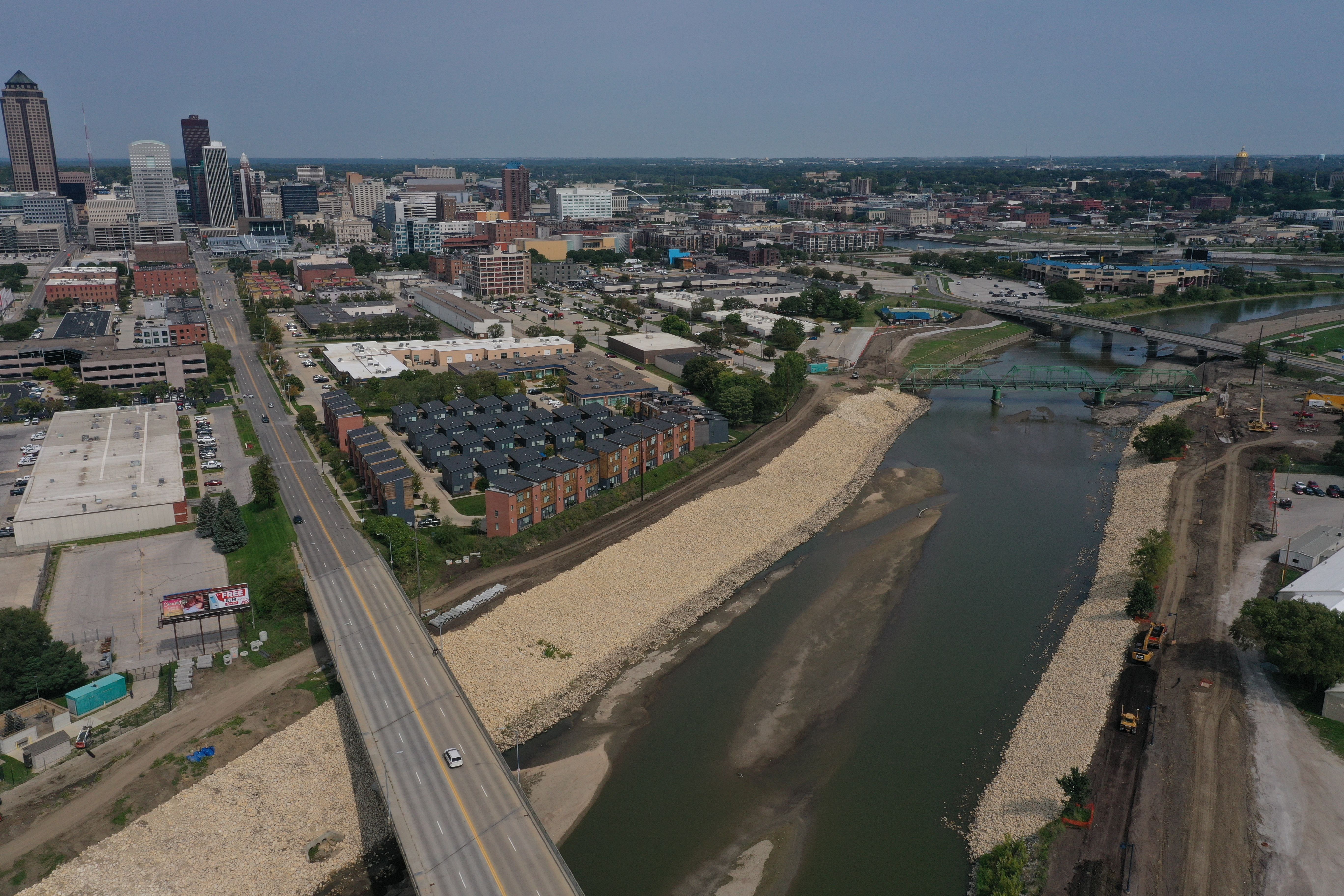
State of play: Construction started in 2019. One phase is completed, one is almost done and another started this spring.
- The other phases are all downstream of Southeast 14th Street on the DSM River and are in design phases.
What's happening: The price tag has increased since the 2019 estimates because of a rise in labor and material costs after the pandemic as well as previously unidentified factors that require additional work, Beane said.
- Under Monday's agreement, the city will spend just over $572,000 to conduct the SQRA with the Army Corps.
- The savings could exceed $9 million, Beane told the council.
Of note: Kansas City recently used an SQRA and mitigated potentially $250 million in costs and scheduled risks, according to the Army Corps.
What's next: DSM's evaluation will take 12 to 18 months.
- Completion of some of the phases may be extended beyond 2028 as a result, Beane said.