Council chides controversial Alameda redesign

Add Axios as your preferred source to
see more of our stories on Google.
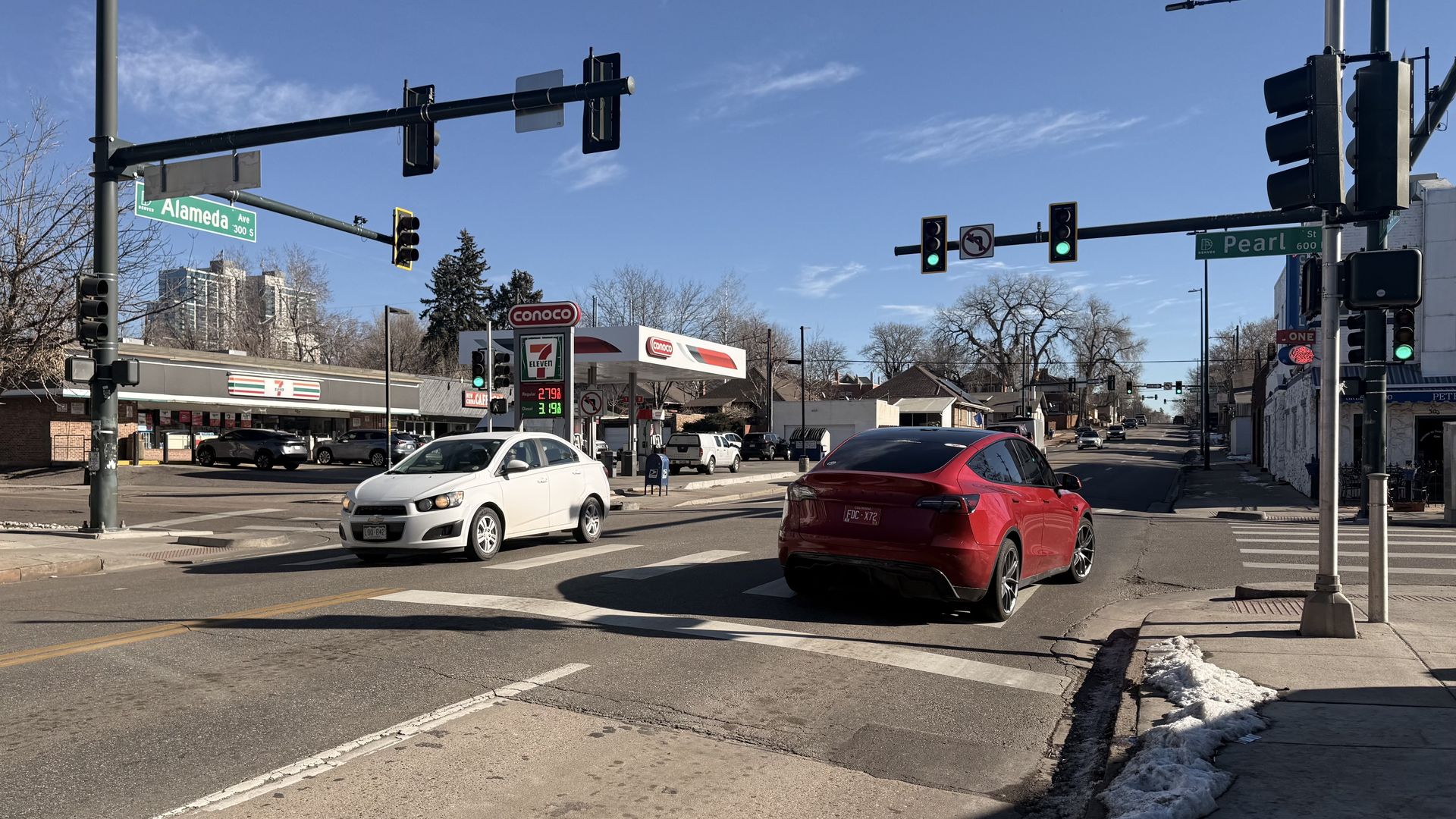
Cars on Alameda Avenue and Pearl Street in Denver. Photo: Esteban L. Hernandez/Axios
Alameda Avenue is stuck in a logjam.
The big picture: Denver's decision to change an initial plan for the roadway last fall, after a wealthy resident launched an opposition campaign, angered some community members and advocates who preferred the original design.
- The controversial move prompted Denver City Council on Wednesday to question and criticize the Department of Transportation and Infrastructure (DOTI) over its revised plans.
Why it matters: Council's pushback signals many members are siding with Denverites fed up with a road system whose traffic deaths last year skyrocketed to its highest total in at least 12 years.
- It reignited a conversation over how the city may move forward with the redesign.
State of play: For years, the public has called on the city to improve Alameda to make it safer, with an initial plan developed over the last five years resulting in shrinking the corridor from four travel lanes to two.
- The plan focuses on a stretch between Pearl and Franklin streets. The revised plan keeps four lanes, with one westbound lane working as a dedicated turn pocket at intersections.
Driving the news: Councilmembers criticized DOTI for taking too long to develop and implement projects, not adequately considering public feedback and lacking transparency.
- "It doesn't seem like there's a focus on pedestrian safety — there's a focus on the car-centric aspect of this," Councilmember Shontel Lewis said about DOTI's latest plan, introduced last November.
Friction point: Critics and community members say the new proposal won't improve safety for pedestrians, the primary reason the city sought to redesign the corridor.
- Alameda Avenue is part of the city's high-injury network — busy thoroughfares where most serious and fatal traffic crashes occur. The project area had 255 crashes over the past five years, 9News reports.
What they're saying: "We absolutely have a shared vision about safety," Amy Ford, DOTI executive director, told councilmembers about its commitment to Vision Zero, the overarching strategy to eliminate traffic deaths.
- "This project falls very much in line with that," Ford added.
What's next: Ford says DOTI plans to host a temporary demonstration of some of the proposed traffic realignments to measure their effectiveness at reducing crashes, though a timeline wasn't provided Wednesday.
- The demonstration will help the city make a decision on a final design, Ford said.