SCOTUS clears path for more crude trains through Colorado

Add Axios as your preferred source to
see more of our stories on Google.
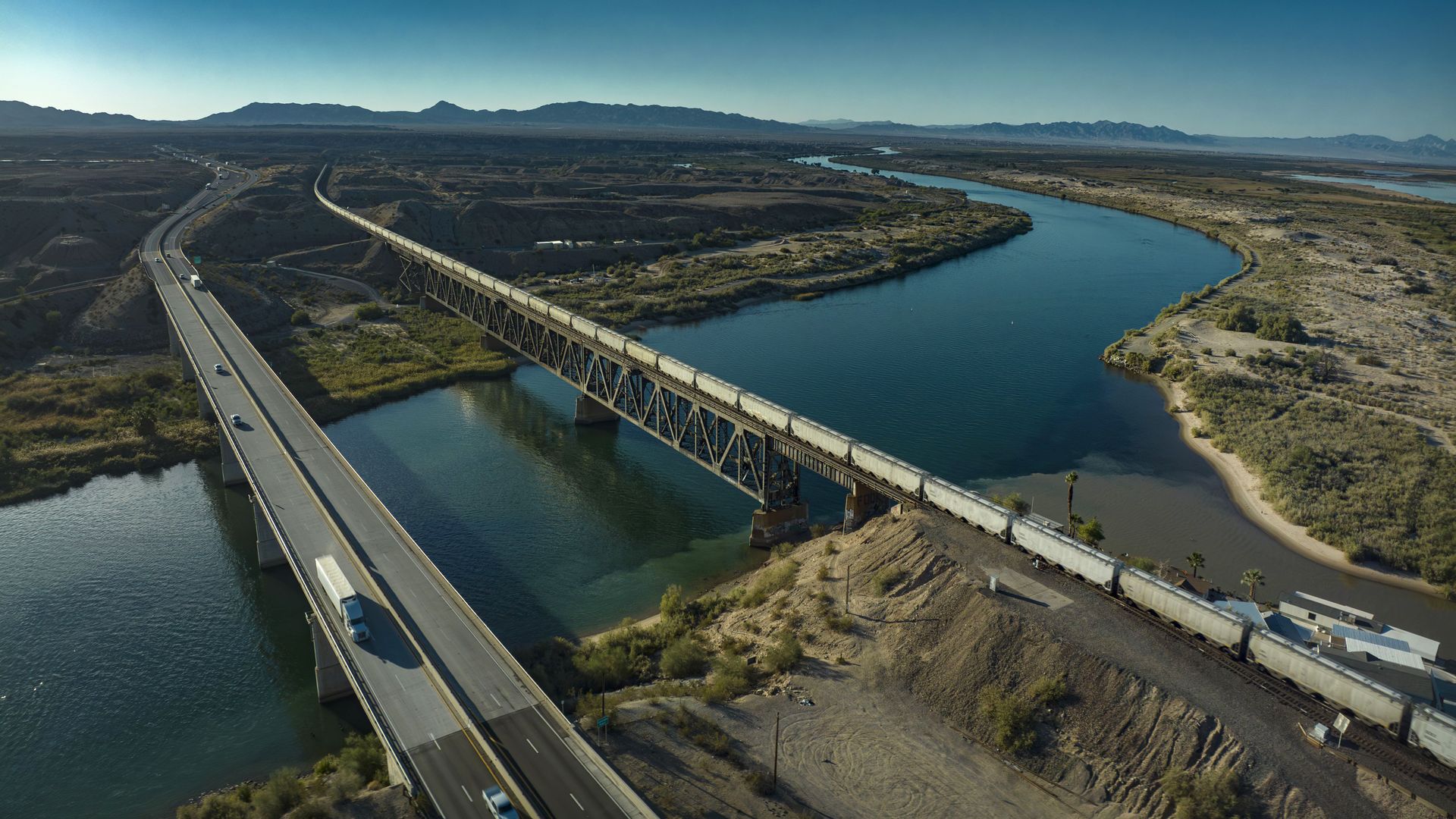
A railway and highway cross the Colorado River in Needles, California. Photo: Visions of America/Joe Sohm/Universal Images Group via Getty Images
The U.S. Supreme Court on Thursday unanimously ruled that federal agencies aren't required to consider broader environmental impacts of infrastructure projects they don't directly control.
Why it matters: The decision greenlights construction of the controversial 88-mile Uinta Basin Railway, which would carry thousands of barrels of crude oil through western Colorado, and beyond, along the Colorado River — the nation's most endangered waterway — toward Gulf Coast refineries.
State of play: The high court sided with Utah's Seven County Infrastructure Coalition, overturning a lower court ruling that had favored Colorado's Eagle County and environmental groups.
- The federal Surface Transportation Board approved the railway in 2021 after conducting a review that resulted in a 3,600-page report.
- Eagle County and environmental groups sued, arguing the report failed to adequately account for potential environmental risks — including oil spills and wildfire-causing sparks — as required under the National Environmental Policy Act (NEPA).
What they're saying: "Simply stated, NEPA is a procedural cross-check, not a substantive roadblock," Justice Brett Kavanaugh wrote for the court. "The goal of the law is to inform agency decisionmaking, not to paralyze it."
The other side: Environmental advocates and Colorado Attorney General Phil Weiser blasted the ruling.
- The "risky scheme" poses "major risks" to Colorado Western Slope communities, Weiser said in a statement, adding the court's opinion "allows agencies to ignore the upstream and downstream environmental harms of projects."
The intrigue: Justice Neil Gorsuch recused himself from the case after concerns were raised over his ties to Colorado billionaire Philip Anschutz, who owns oil wells in Colorado and Utah.
- Neither Anschutz nor his companies are parties to the case, but the proposed project could benefit his business interests, the New York Times reports.
What's next: With the Supreme Court's decision, the railway has a clear path forward — at least legally. But opposition at the local level isn't over.
- Weiser said his office will "remain vigilant and deploy every tool available under the law to protect Colorado's land, air, and water."