Coloradans are sticking to remote work

Add Axios as your preferred source to
see more of our stories on Google.
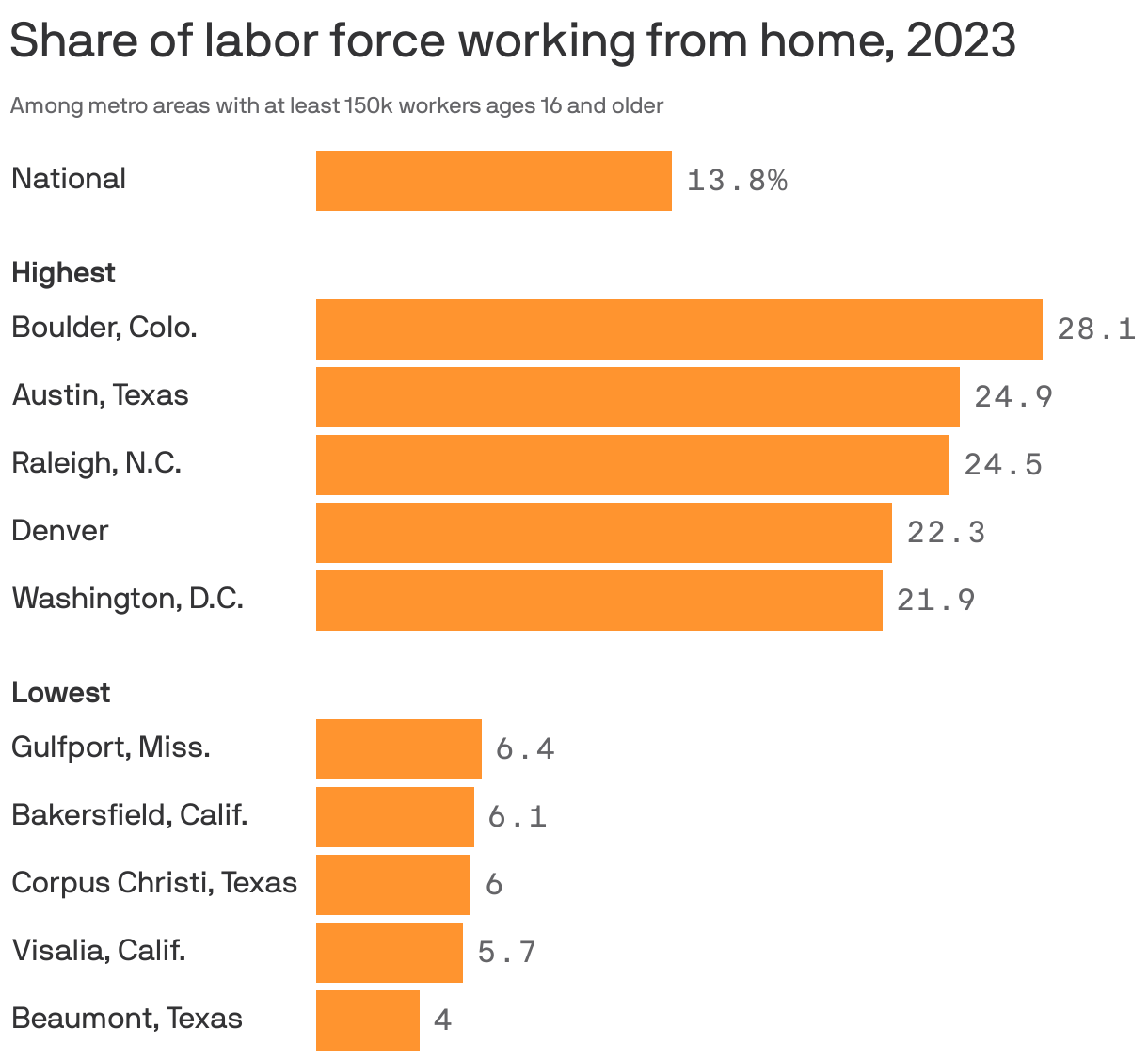
Many employees in metro Denver still work from home — even as the practice loses ground nationwide.
Context: People in Denver and Boulder worked remotely at significantly higher rates than other U.S. cities as of 2023, the latest available data from the Census Bureau.
- Boulder topped the list with at least 150,000 workers.
Why it matters: The metro area's trend suggests working from home remains a desirable option locally, and companies appear willing to keep the practice.
By the numbers: Nearly a quarter of workers in Boulder (28.1%) were working from home, while Denver (22.3%) wasn't far behind.
- Both cities are far above the national rate (13.8%).
State of play: Economist Tatiana Bailey, of Data-Driven Economic Strategies, told "Marketplace" last year workers seeking flexibility are drawn to Colorado's rich outdoor scene, sunny weather, and recreational activities like skiing.
The big picture: Nationally, the trend has been the opposite, with most places seeing a slow but steady return to the land of cubicles, water cooler chitchat and harsh fluorescent lighting.
- Many workers enjoy a hybrid schedule, splitting their workdays between home and the office. More broadly, companies' big return-to-office push is a sign that employers are gaining more leverage over workers, Axios' Emily Peck writes.
The intrigue: One estimate suggests more than 50% of businesses in the state have staff completing their work outside Colorado, the state's largest workers' comp insurer told the Colorado Sun this year.
What's next: The incoming Trump administration is likely to push the country's federal workforce back into the office — largely to trim headcount.
- That could especially affect Washington, D.C., another top WFH city. Nearly 40,000 federal employees work in Colorado, per the Congressional Research Service.