Club Q victims file lawsuit seeking "accountability and justice"

Add Axios as your preferred source to
see more of our stories on Google.
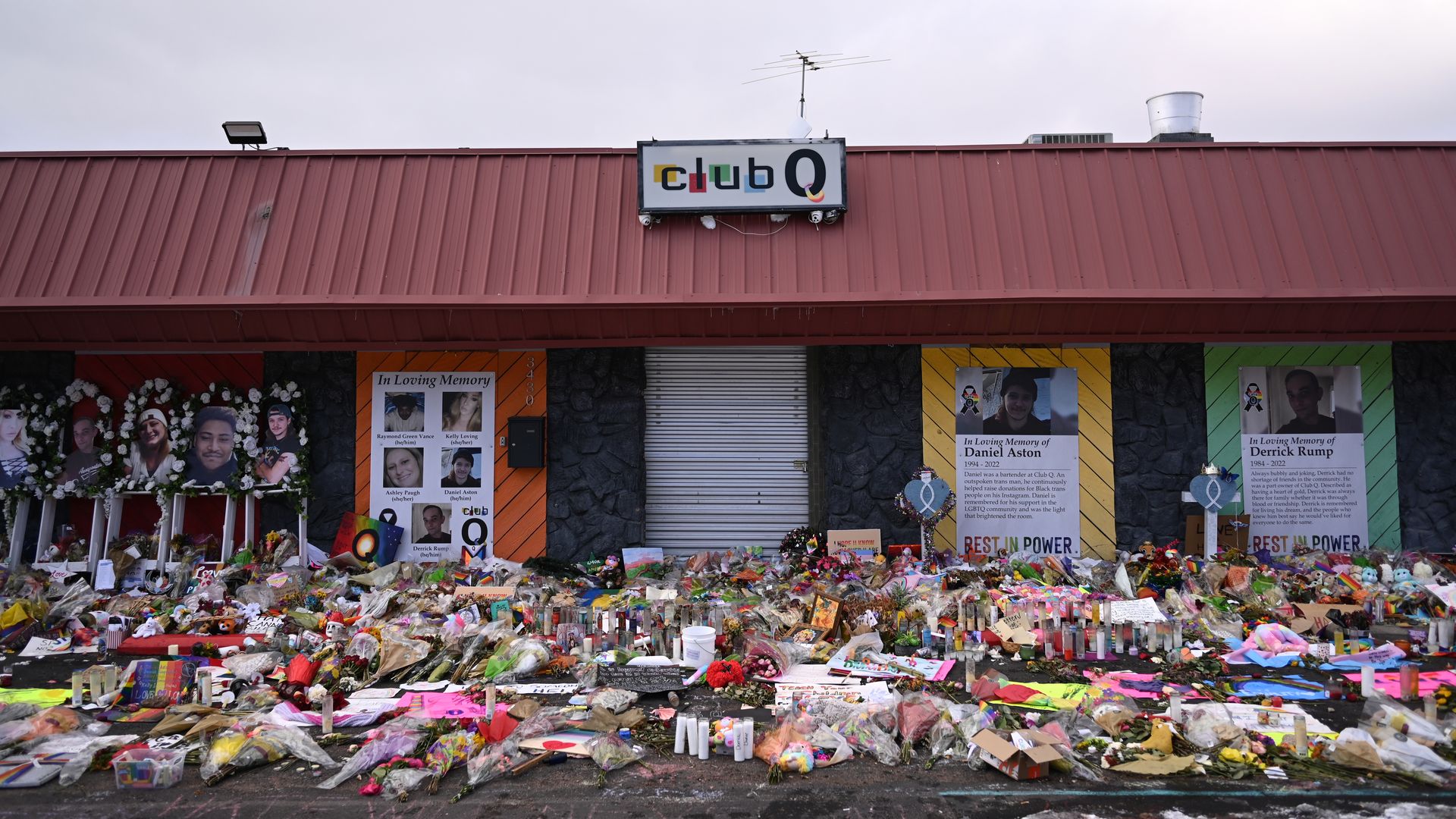
Club Q and the memorial for the victims on Nov. 29, 2022. Photo: Hyoung Chang/The Denver Post via Getty Images
On the two-year anniversary of the Club Q shooting in Colorado Springs, victims and their relatives announced a far-reaching lawsuit seeking financial damages, and "accountability and justice."
Why it matters: The 70-page civil complaint, filed in U.S. District Court in Denver, outlines the systemic missteps of law enforcement and Club Q's owners who they say failed to stop what plaintiffs allege was a preventable mass shooting.
Driving the news: El Paso County, former Sheriff Bill Elder, Club Q and its owners are named as defendants in the lawsuit filed by eight survivors and the families of three deceased victims, Raymond Green, Kelly Loving and Derrick Rump.
The claims against the government and sheriff revolve around the failure to use the state's red flag law to remove the convicted gunman's weapons after credible warnings about his desire to commit violence ahead of the Nov. 19, 2022 attack that killed five and injured 25 others.
- The county "failed to act on clear, credible warnings about the shooter's violent intentions, choosing to prioritize political opposition to the red flag law over public safety," attorney Patrick Huber said at a briefing Tuesday.
Club Q and its owners are named because they allegedly failed to provide adequate security despite known risks to the LGBTQ venue and had reduced security ahead of the attack.
- The club did not have enough security or metal detectors, the lawsuit alleges. In fact, it reduced security to one guard, who also worked behind the bar. In previous years, there were at least five guards present.
- "Club Q advertised itself as a safe space, but that was a dangerous illusion," attorney Sarah Raisch said.
What they're saying: "There must be accountability and justice and this can never happen again," said Ashtin Gamblin, one of the plaintiffs who worked at Club Q.
The other side: A spokesperson for El Paso County declined to speak about ongoing litigation.
The intrigue: Chicago-based law firm Romanucci & Blandin, which has represented victims in a handful of mass shootings, including the Pulse Nightclub in Orlando, is leading the legal claim.
- Colorado Springs firm Bufkin & Schneider filed a separate suit for victim Barrett Hudson.
Context: Colorado's red flag law took effect in 2020 but conservative counties like El Paso rejected it as an infringement on the Second Amendment right to carry firearms and passed a resolution declaring itself in opposition. The sheriff also vowed to not use the law.
- The gunman, Anderson Aldrich, threatened to blow up their mother's home in 2021 and authorities discovered a stockpile of weapons and explosives. He allegedly said at the time he would become a "mass killer."
- Neither the sheriff's office nor Aldrich's family sought a protection order to remove the weapons at the time.
- Aldrich pleaded guilty to state and federal murder and hate crime charges and was sentenced to multiple counts of life in prison.