How Colorado's melanoma cases compare nationwide


Add Axios as your preferred source to
see more of our stories on Google.
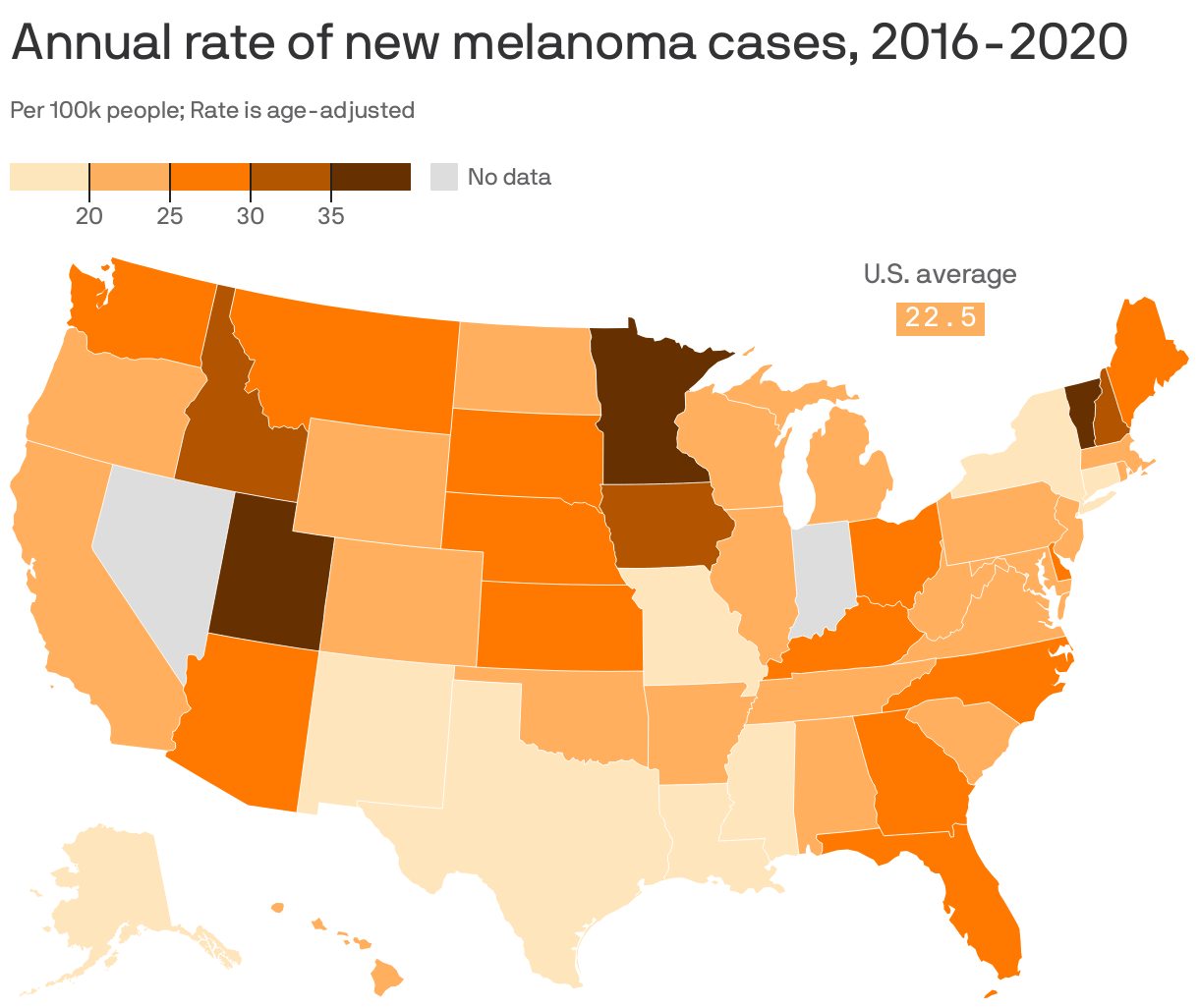
Melanoma cases in Colorado may be lower than the national average, but many people here are still being diagnosed with the disease at a rapid rate.
Why it matters: Although melanoma accounts for about 1% of skin cancers nationwide, it's responsible for the majority of skin cancer deaths, according to the American Cancer Society (ACS).
By the numbers: Colorado's rate of new cases is approximately 21 per 100,000 people each year, in comparison to 23 cases nationally.
- ACS estimates that across the country about 100,640 new cases of melanoma will be diagnosed in 2024.
Zoom in: Melanoma cases are highest in El Paso, Jefferson and Arapahoe counties, according to Colorado Central Cancer Registry data from 2000 to 2020.
The big picture: Skin cancer is the most commonly diagnosed type in the U.S.
- New cases of melanoma rose 2-3% annually between 2015 and 2019, Axios' Tina Reed reports.
- The ACS estimates that new cancer diagnoses of all types in Colorado are expected to hit 29,430 this year — up from 28,290 in 2023.
What they're saying: "People who get periodically sunburnt frequently tend to have a higher risk of developing melanoma," says Henry Lim, dermatologist at Henry Ford Health in Detroit and former president of American Academy of Dermatology.
- And sun exposure has a clear connection to basal cell and squamous cell skin cancers.
Yes, but: "More sun exposure" isn't the only possible reason for the uptick in melanoma diagnoses.
- Other factors: More effective skin cancer detection and the fact that many Americans are living longer, says Shanthi Sivendran, ACS senior vice president of cancer care support.
Threat level: Using sunscreen is helpful for preventing skin cancer, but experts say it shouldn't be the only thing you do.
- Wearing protective clothing like a hat or UV-blocking shirt, and staying in the shade also make a difference.
Go deeper: How to pick a "safe" sunscreen