Help us settle a debate: Where is "Central Ohio?"

Add Axios as your preferred source to
see more of our stories on Google.
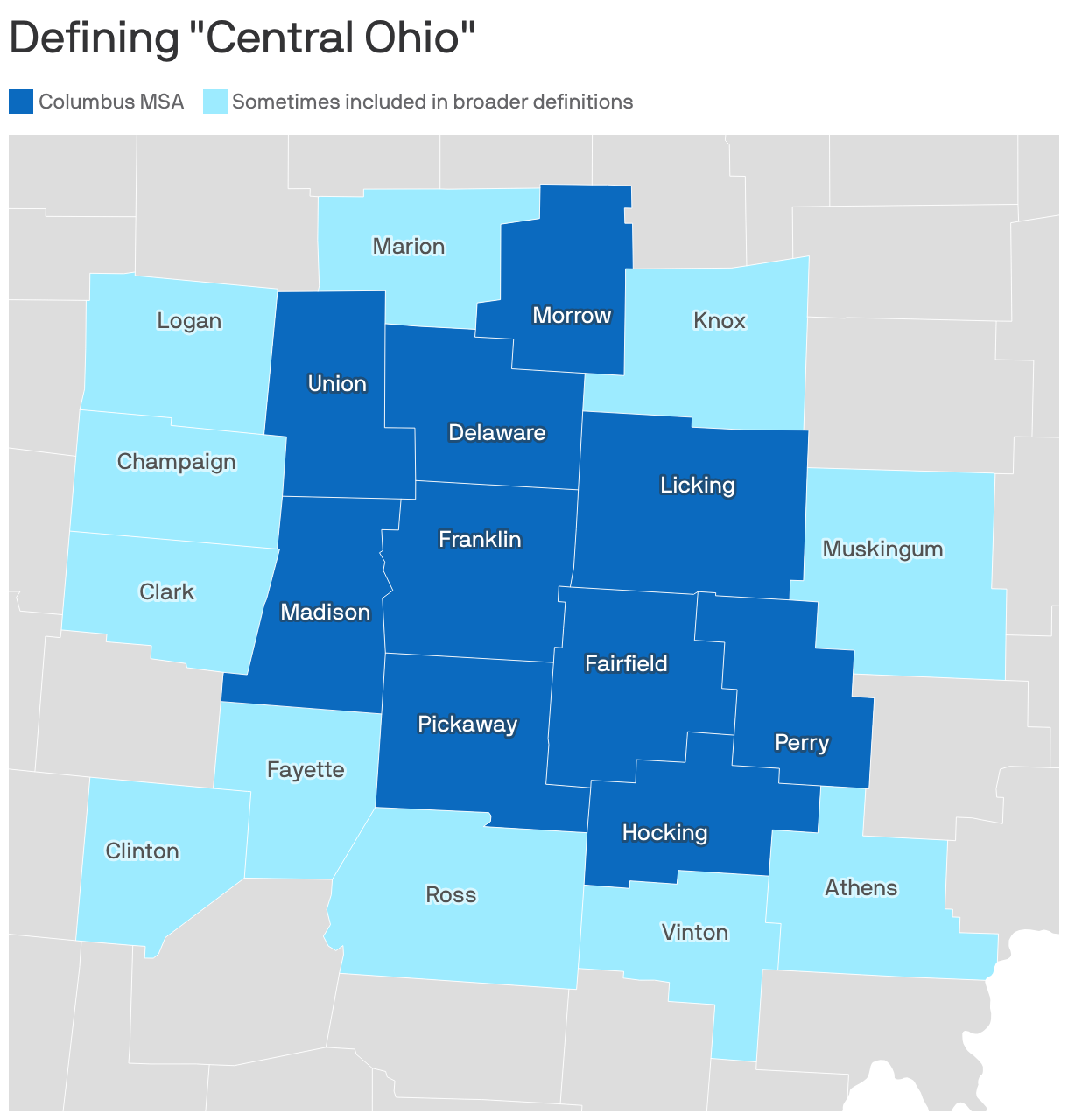
We say "Central Ohio" all the time. But try drawing its borders on a map and things can quickly get complicated.
Why it matters: Columbus' identity has always been a little fuzzy, and decades of explosive growth have only made it less clear where our metro area begins and ends.
- Those boundaries can affect which communities are included in discussions about the region's future and needs.
Case in point: Even the federal government's definition of the Columbus Metropolitan Statistical Area has expanded over time.
- It started with just Franklin County in the '50s, and by 1983, it had grown to include all six counties that touch it.
- Today, it's 10 counties, with Hocking and Perry joining in 2013.
How it works: Criteria have evolved, but under today's rules, a county can be added if at least 25% of its workers commute to the metro's more urban counties or if at least 25% of its jobs are held by people who live in those counties.
Yes, but: Vibes matter too. Does a weekend trip to Hocking Hills really feel like you're still in Central Ohio?
So who's in? It depends who you ask.
📍 Mid-Ohio Regional Planning Commission members span a 15-county region stretching north to Marion and Knox counties and south to Fayette and Ross.
- Ross, Logan and Perry joined in 2016.
💰 The Columbus Partnership leads economic development in an 11-county area. That doesn't include Hocking and Perry counties, but it does include Knox, Logan and Marion.
🏡 Columbus Realtors' home-listing network extends across 20 counties.
🚌 The Central Ohio Transit Authority, despite its name, primarily serves Franklin County.
🩸 The Red Cross' Central Ohio chapter serves Vinton County, but not Licking.
The intrigue: While not clearly defined, the term "Central Ohio" isn't new. It's referenced in the Dispatch's earliest editions, dating back to 1871, per a Columbus Metropolitan Library archive.
- At that time, the "Central Ohio Fairgrounds" were located in Champaign County, about 30 miles west of Columbus.
The bottom line: Over 150 years later, we're still figuring out what "Central Ohio" means.
📬 Help us settle the debate: How do you define our region? Which communities are definitely in and which don't make the cut? Email [email protected] and we'll share our favorite responses in a future newsletter.