Columbus women feel safer than men, survey finds

Add Axios as your preferred source to
see more of our stories on Google.
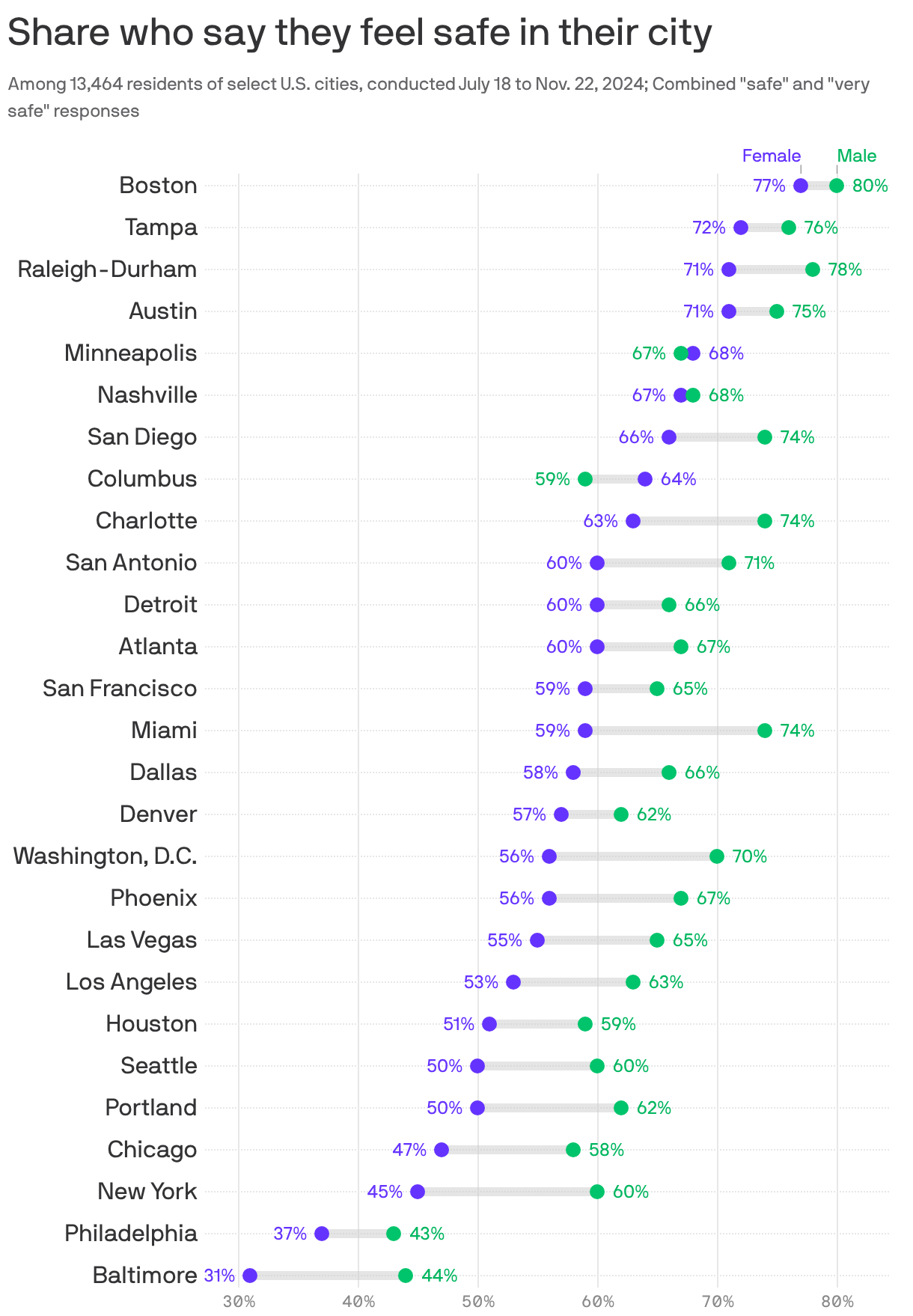
Women feel less safe than men in most major cities across the country — but not in Columbus.
Why it matters: We're a glaring outlier among 27 select cities, and researchers aren't sure why.
The big picture: City Pulse 2025: The Magnetic City, published by design and architecture firm Gensler's research wing, examined residents' attitudes about a variety of issues in their home cities.
- About 13,500 residents were surveyed between July and November 2024.
Zoom in: Almost across the board, significantly more men than women said they feel safe in their cities — in some cases, the gap is as large as 15 percentage points.
- Conversely, 64% of Columbus women feel "safe" or "very safe" and just 59% of men feel the same.
- The only other city with a lower percentage of men than women was Minneapolis, separated by just 1%.
- Columbus women feel safer than all but seven of the cities surveyed.
Between the lines: Researchers aren't quite sure what to make of Columbus' outlier data.
- Sheryl Schulze, managing director of Gensler Columbus, doesn't have a definitive explanation, but she has some theories.
- Those include Central Ohio's fragmented downtown structure, differences in safe feelings by race, lack of public transportation and public spaces that feel less than welcoming.
What they're saying: Schulze's broadest theory is that this data set highlights a problem that isn't unique to Columbus — a "lack of civil trust and social connection" stemming from our disconnected, social media-fueled existence.
- "People have a tendency to interact and be more social with their phones than they are with others," she tells Axios.
- "Does that create some disparity here, where men aren't forming the meaningful relationships that they could, as opposed to women, who have a tendency to be more social than men?"
The bottom line: This data isn't an indication of how safe Columbus actually is.
- It "captures perception, not incident rates," Schulze notes.
Editor's note: This story has been corrected to note Sheryl Schulze is the managing director (not editor) of Gensler Columbus.