Ohio lawmakers grappling with how to regulate AI


Add Axios as your preferred source to
see more of our stories on Google.

Illustration: Sarah Grillo/Axios
Some Ohio lawmakers are embracing AI, while others — including one Columbus Democrat — are working to limit harm done by the technology.
Why it matters: Confusion and indecision persist on how AI should be regulated, and who should do the regulating.
Driving the news: A recent poll on artificial intelligence found the majority of Ohio General Assembly members are using AI in their work as legislators and believe the technology allows them to work more efficiently.
The big picture: The Gongwer-Werth Legislative Opinion Poll is a recurring anonymous survey of the Ohio General Assembly gathering pulse-check data about how members view major policy issues of the day.
- A March 2 survey asked six questions about AI usage and policy. Forty members responded.
What it found: Despite wide levels of personal adoption, uncertainty dominates.
- 38% of respondents are "undecided" about whether AI should be used more in government operations.
- 39% are undecided about whether students should be using AI to assist with schoolwork.
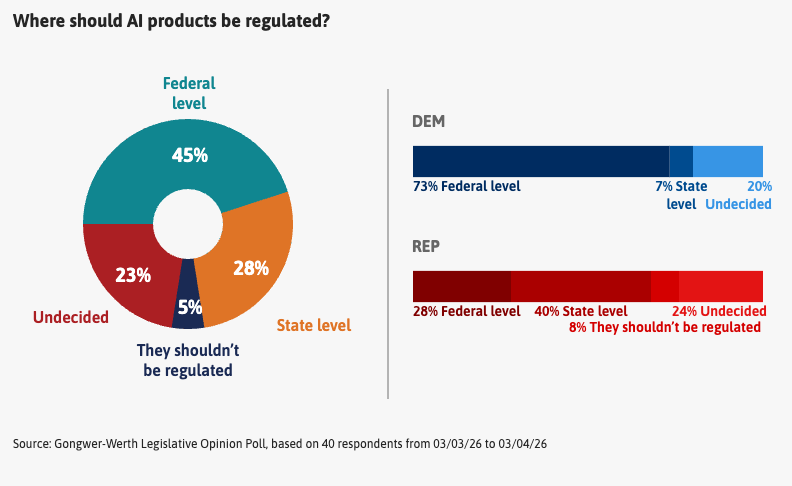
Between the lines: A partisan divide between Democratic and Republican respondents became pronounced in questions about regulation.
- Among Democrats, 73% believe AI should be regulated at the federal level and 7% at the state level, while 20% are undecided.
- Among Republicans, the figures are 28% for federal regulation, 40% for state and 24% undecided. Another 8% think AI shouldn't be regulated at all.
The bottom line: The overwhelming impression from the poll is that state lawmakers view AI as a positive technological advancement that will save time in work and life.
- Only 10% responded that their primary view of AI is one of job displacement. Only 3% said they believe AI should be avoided.
The latest: At his final State of the State address last week, Gov. Mike DeWine waded into the AI conversation.
- He asked lawmakers to make it illegal to possess, create or distribute child pornography created by AI.
- And he told legislators to "hold tech companies accountable" for allowing AI platforms to "encourage, assist, endorse or instruct" anyone to harm themselves or others.
Context: Bills related to both those topics are in the works.
Senate Bill 163, sponsored by Sens. Louis Blessing III (R-Colerain Twp.) and Terry Johnson (R-McDermott), would prohibit "simulated child pornography" and AI identity fraud, and require watermarks on AI-generated content.
- The bill is being considered by the Senate Judiciary Committee.
House Bill 524, sponsored by Reps. Christine Cockley (D-Columbus) and Ty Mathews (R-Findlay), would impose penalties for developing or deploying AI models that encourage harm.
- The bill is currently with the House Technology and Innovation Committee.
- It's supported by the Ohio Suicide Prevention Foundation.