Cooper Stadium's future could take a cue from Indy

Add Axios as your preferred source to
see more of our stories on Google.
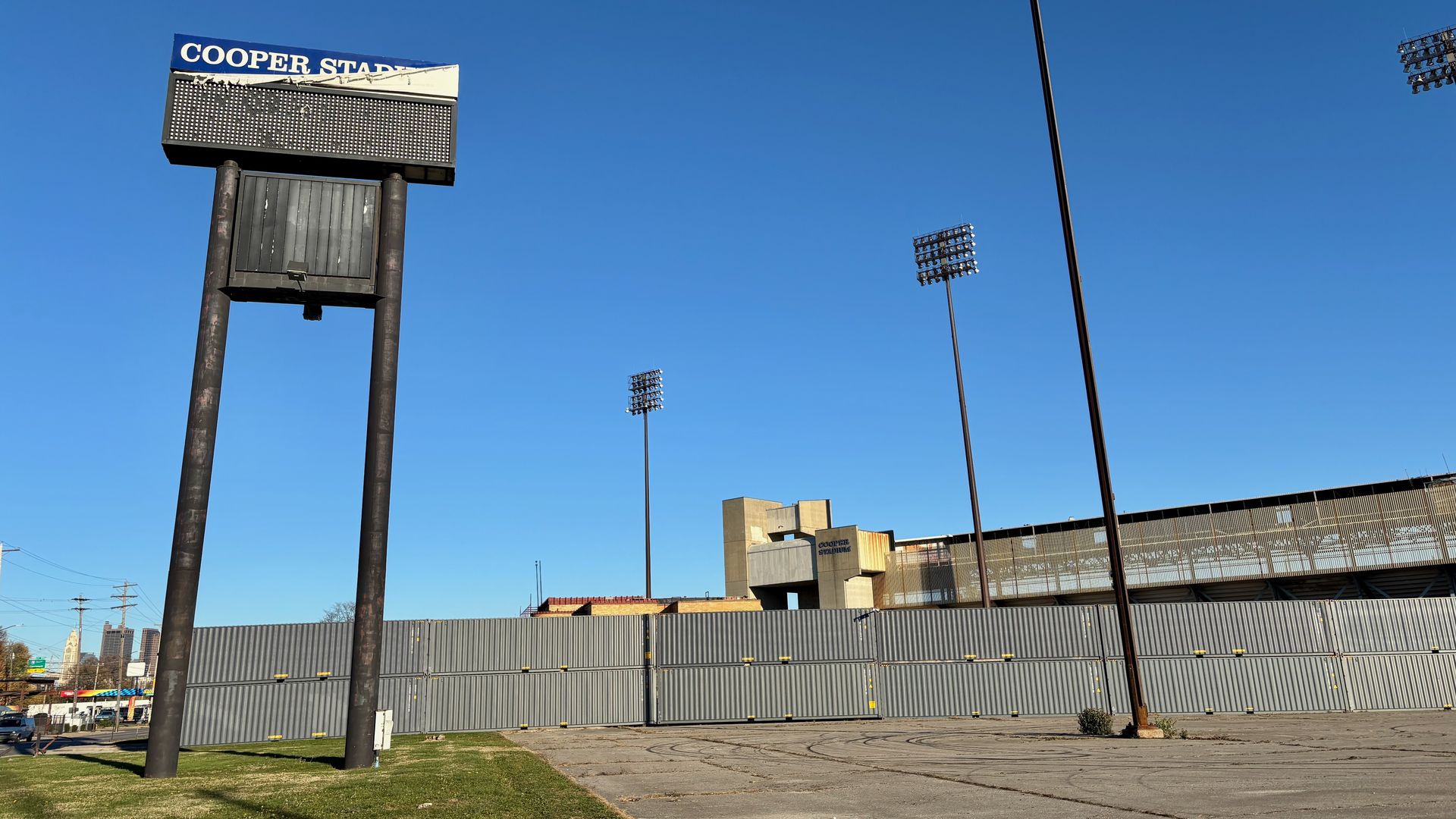
The defunct Cooper Stadium is now surrounded by shipping containers. Photo: Alissa Widman Neese/Axios
With another redevelopment plan for Cooper Stadium in the news, a success story in Indianapolis offers a glimpse of what could be.
Why it matters: It's been 17 years since the Clippers played in Franklinton, and it's easy to lose hope that the partially demolished ballpark will ever become more than an eyesore.
- But another restoration shows it's not too late for a comeback.
Flashback: Indianapolis' Stadium Lofts were the country's first ballpark-turned-apartments when they opened in 2013.
- The former Indianapolis Indians stadium was abandoned near downtown when the minor league team moved to a new park in 1996.
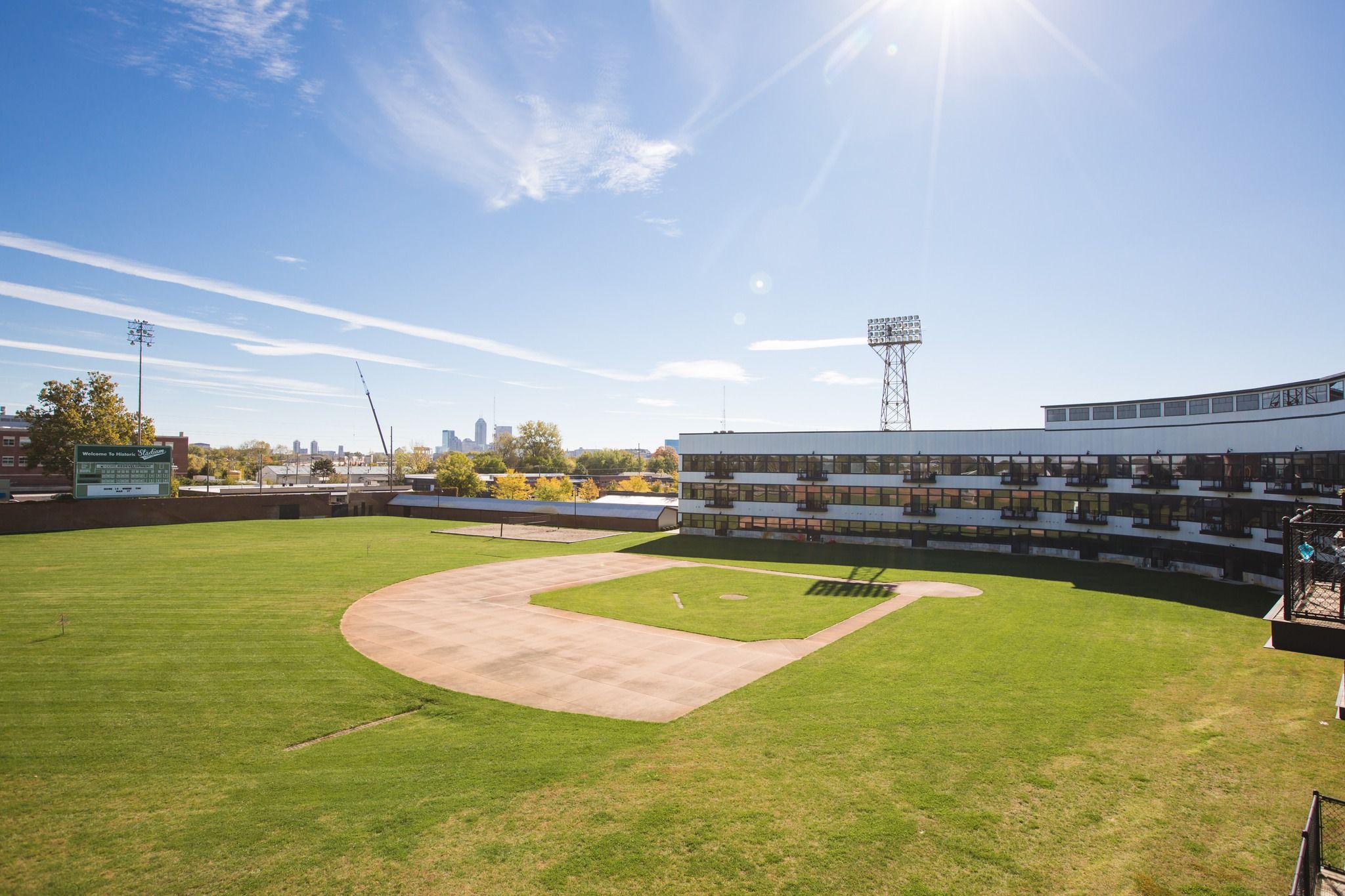
- It was a run-down, overgrown "cash for clunkers" junkyard when Core Redevelopment bought it for $1 in 2011.
- "Initially, people thought that we were crazy," developer Michael Cox told CNBC's "Make It" after the story went viral last year.
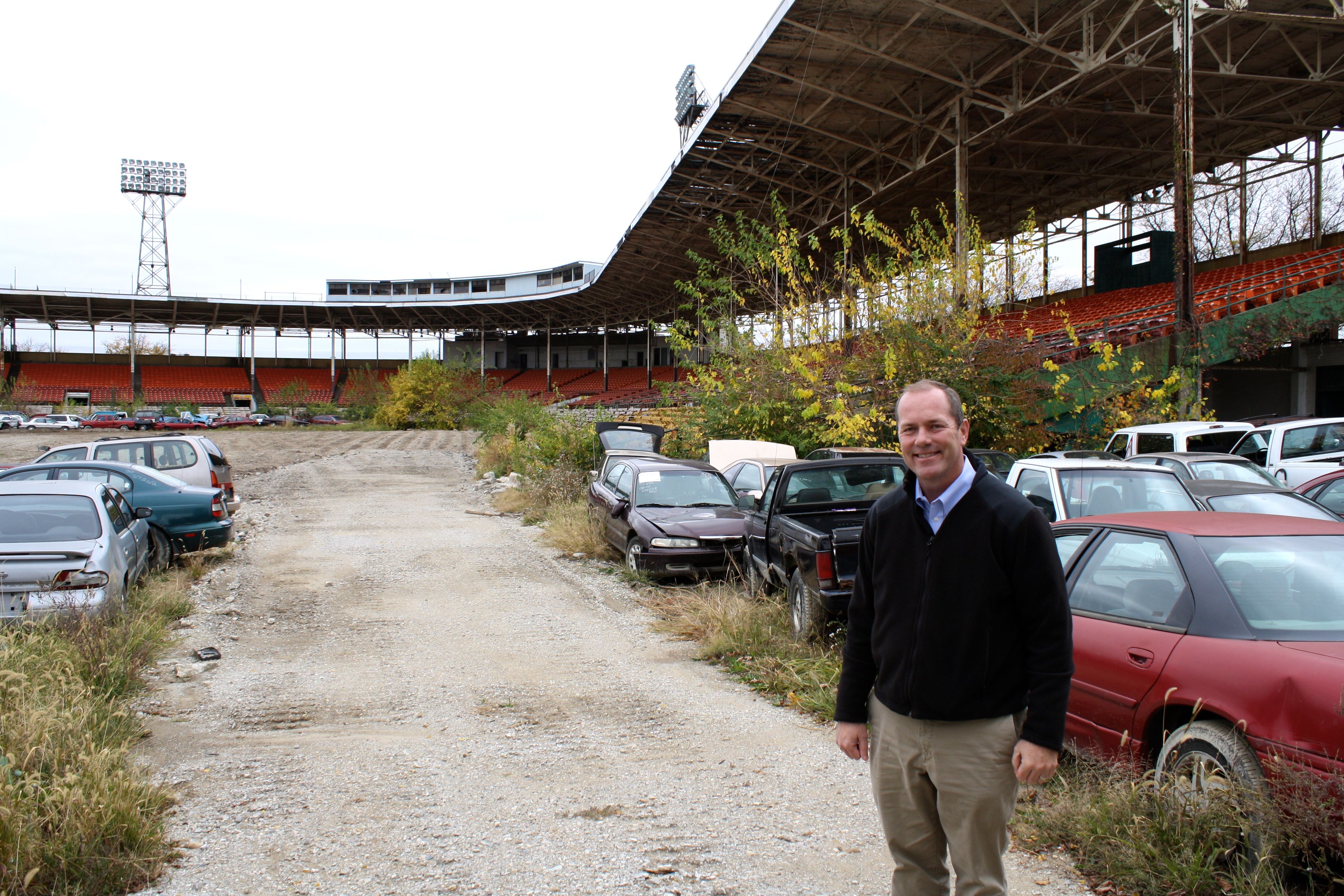
Today, 138 apartments curved like a grandstand overlook a concrete baseball diamond.
- Much of the stadium's infrastructure is restored and intact, including the lights, brick outfield wall, press box, ticket windows and scoreboard.
- The city chipped in about $5 million for the $14 million project that spurred nearby development in an underutilized area.
What they're saying: "It took a little vision by the city to think, 'this project could be transformative,'" Core Redevelopment CEO John Watson tells Axios, "and it has been."
Zoom in: Cooper Stadium has a shot at a similar future if the latest plan from owner SPARC Holding LLC, an Arshot Investment Corp. affiliate, is realized.
- It would feature a four-story, 213-unit apartment complex called Cooper's Outlook, plus retail buildings and a parking garage with a pickleball court on top.
The intrigue: What's left of the grandstands and field could become event space.
- The plan includes expanding nearby Green Lawn Cemetery into the former parking lot, with a buffer wall.
The latest: Columbus City Council's zoning committee approved changes Monday night to accommodate the proposal, updating zoning approved in 2023.
Reality check: SPARC has floated other proposals since purchasing the site in 2012 — from a test track for driverless cars to other mixed-use projects — and none have come to fruition.
- Columbus hasn't committed any money to the site, Department of Development spokesperson Christine Reedy tells Axios.
- Arshot hasn't responded to local media inquiries for a while, including one from Axios last week.
The bottom line: If you build it, they will come proved true in Indianapolis. Now it's our turn.
Some Columbus baseball history
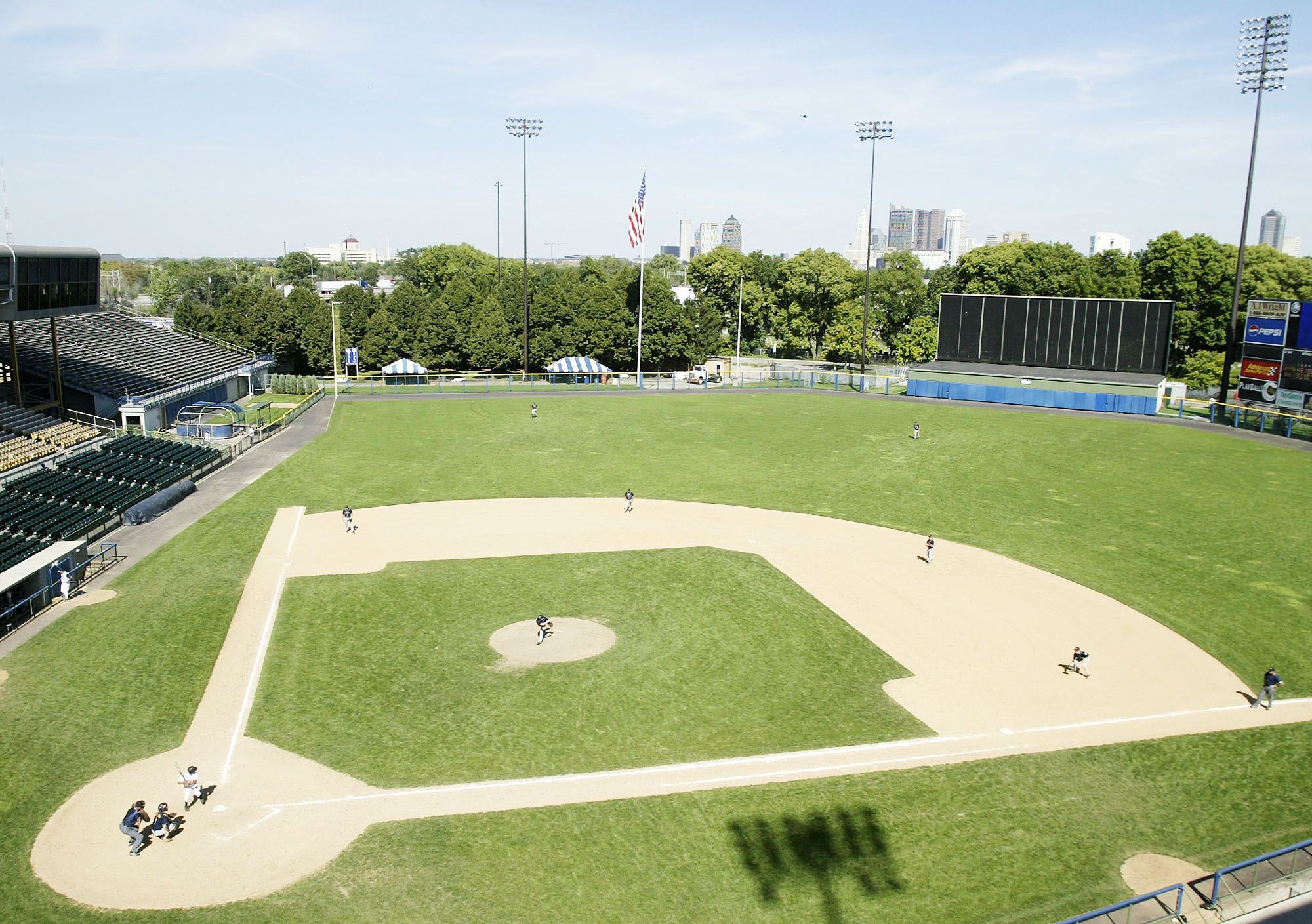
Cooper Stadium is defunct and surrounded by unsightly shipping containers, but it is also home to 76 years of rich history.
Threat level: Columbus Landmarks named it an endangered site in 2017.
Catch up quick: The ballpark was renamed in 1984 for former Franklin County Commissioner Harold Cooper, who helped renovate it and bring the Clippers to town in 1977.
- He's honored with a statue outside Huntington Park, the stadium that led to his namesake's demise.
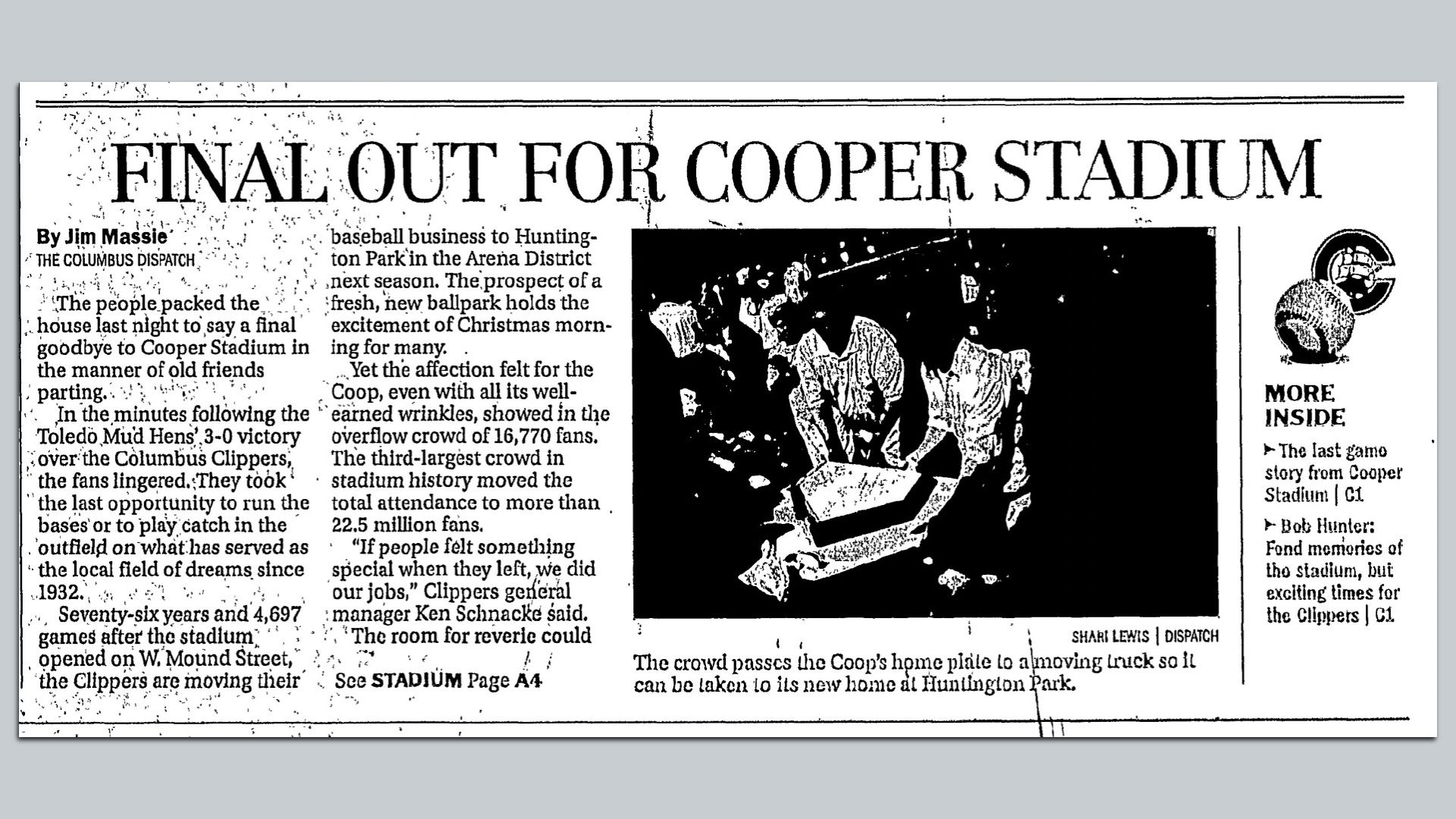
The intrigue: Cooper Stadium underwent several name changes over the decades and hosted more than minor league games.
- In 1932, the year it opened, that's where Franklin D. Roosevelt kicked off his first presidential campaign.
- The ballpark also hosted Negro League games, a Billy Graham crusade and Aerosmith, Rush, Bob Dylan and Garth Brooks concerts.
Coinciding with team changes, it was Red Bird Stadium from 1932-54 and Jet Stadium from 1955-1970.
- After the county bought it, it was Franklin County Stadium from 1977-1984.
Fun facts: Columbus had two other, older stadiums. Western League Park near Parsons Avenue was home to the Columbus Senators from 1896-1899.
- Neil Park off Cleveland Avenue followed as the first baseball park built using steel and concrete.
- The Senators moved to Cleveland in 1900 and became the present-day Guardians.