Pair of Ohio passenger rail plans pick up steam

Add Axios as your preferred source to
see more of our stories on Google.

Illustration: Lindsey Bailey/Axios
Tracks have been laid for new passenger railways across Ohio — but a long and uncertain path still lies ahead.
Why it matters: Ohio has the fourth-highest mileage of train tracks in the country, but a woefully underdeveloped passenger rail network, a transit option that residents want expanded.
Driving the news: The Ohio Rail Development Commission (ORDC) submitted a proposal last month for two passenger rail developments as part of the Federal Railroad Administration's (FRA) Corridor ID Program.
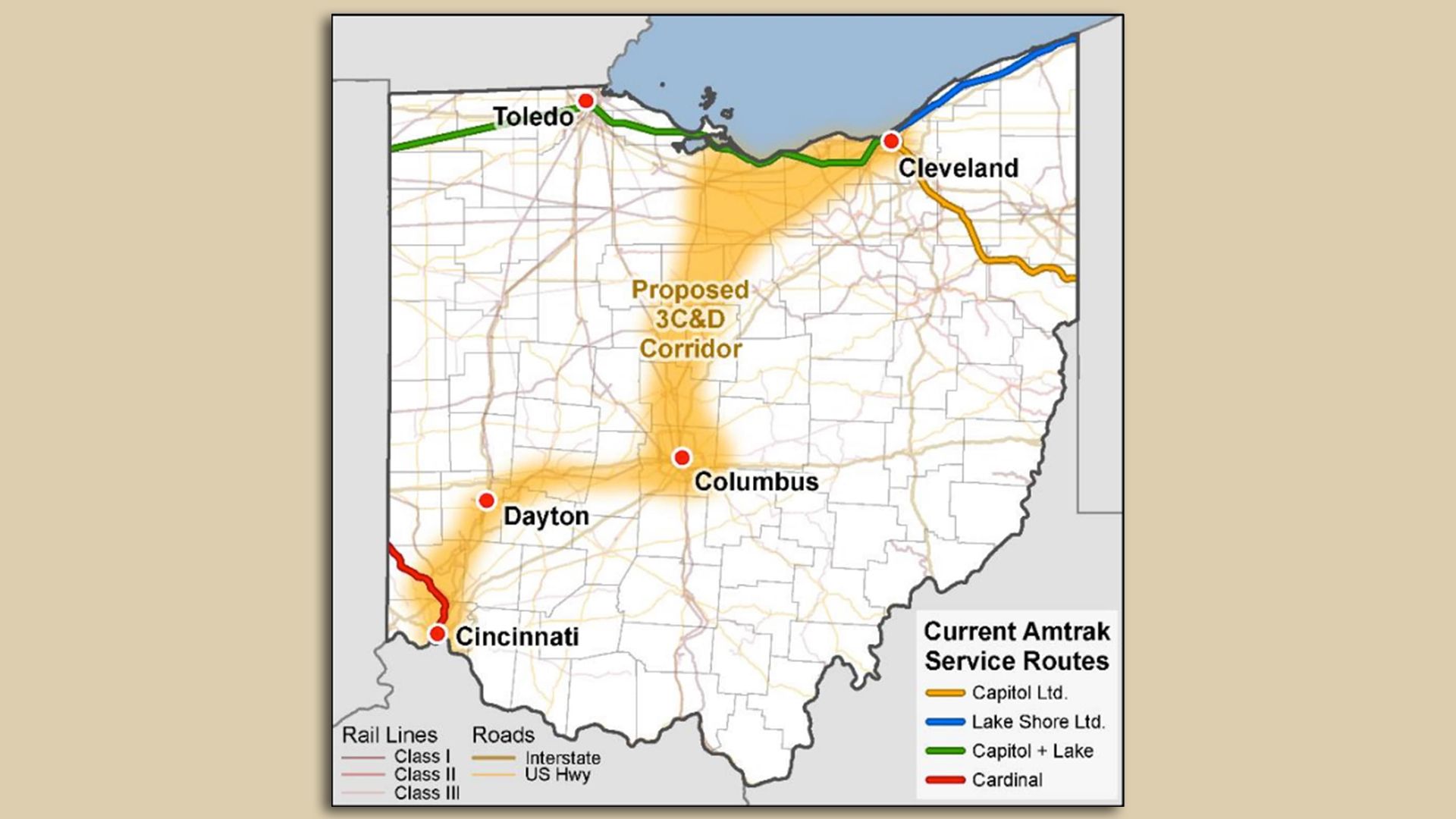
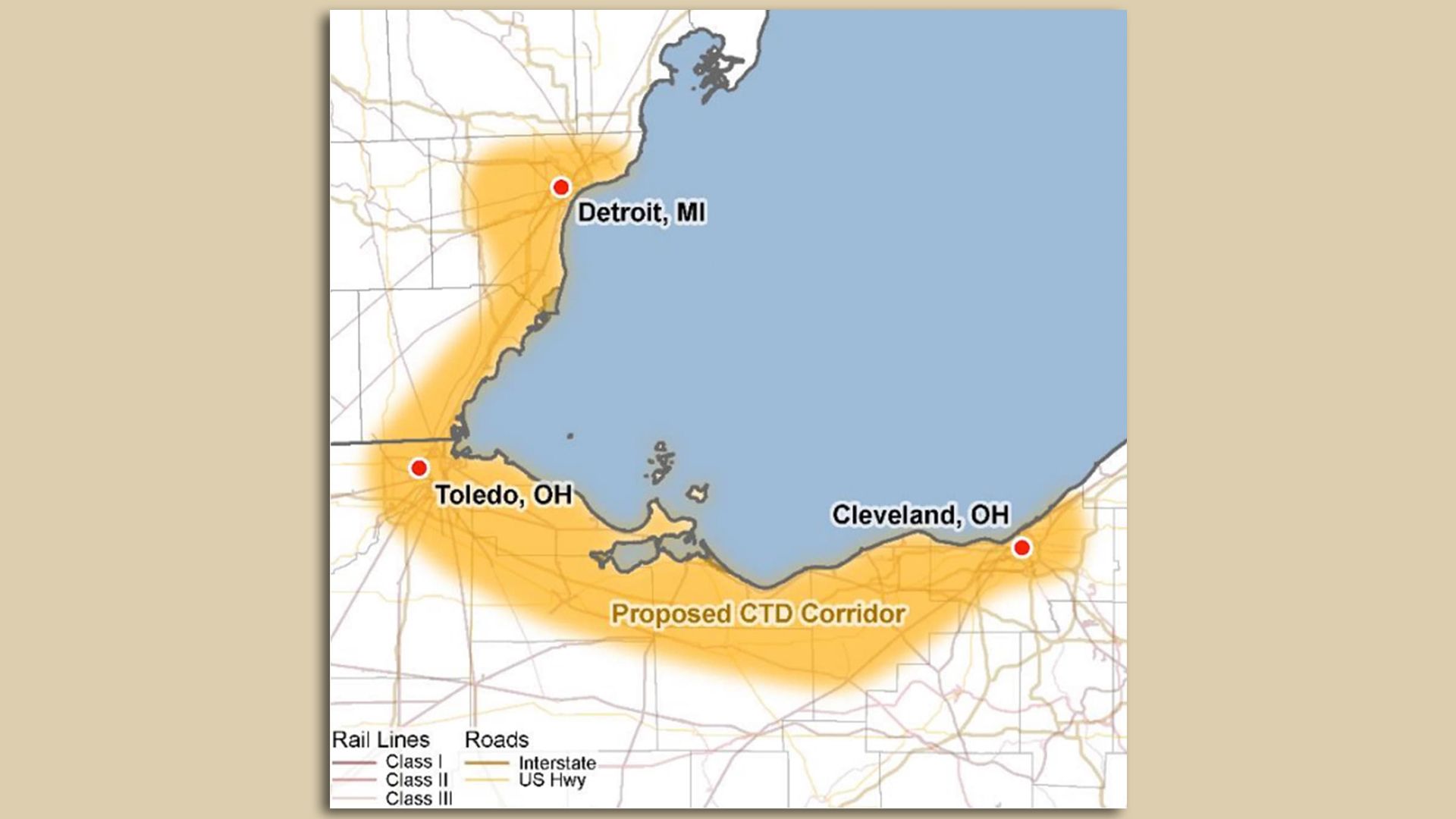
- The proposal focuses on two corridors — one between Cleveland, Toledo and Detroit, and one between Cleveland, Columbus, Dayton and Cincinnati (known as 3C+D).
How it works: The Corridor ID Program, launched in 2022, earmarked $7.2 billion "to carry out planning and development activities" for passenger rail plans from across the country.
- Distributed funds must be matched locally.
State of play: It's taken years of talks to get to this point, and the costly, complicated process still has several more steps.
- If the ORDC receives federal approval to proceed, a more in-depth "service development plan" would still need to be drafted, approved and implemented, followed by substantial infrastructure and planning work.
Questions remain: How long will those steps take? How will the FRA decide which corridors move forward? How many proposals will be accepted? No one is sure.
- At a minimum, it will take several years before any new passenger trains hit the tracks.
What they're saying: "It's a new process that was developed, and until we get the guidance from the FRA, we're unclear of the next steps," ORDC executive director Matthew Dietrich tells Axios.
- That process was complicated by about 10 months without an FRA administrator until David Fink was confirmed last week.
- FRA spokesperson Warren Flatau was not able to answer specific questions ahead of federal furloughs.
Does passenger rail have the support?
The big picture: Passenger rail is expensive, and each step requires an increasing amount and share of financial commitment from the state.
- That means extra buy-in from state legislators each step of the way.
State of play: Ohio leadership hasn't always been supportive, but advocates are optimistic as plans grow more tangible.
- "Here in Central Ohio, our people are pretty much on board — pun intended," advocacy group All Aboard Ohio executive director John Esterly tells Axios.
- He says he's heard bipartisan support from state Reps. Christine Cockley (D-Columbus) and Munira Abdullahi (D-Columbus) and Sens. Hearcel Craig (D-Columbus), Bill DeMora (D-Columbus) and Michele Reynolds (R-Canal Winchester).
Case in point: Even those "less interested" in trains like state Rep. Brian Stewart (R-Ashville) are starting to see the economic benefits of passenger rail, showing signs that they're at least willing to explore the possibilities, Esterly says.
- "(Stewart) has come from being a vocal detractor to almost curmudgeonly OK with it. If we can get him there, I'm happy with that."
Follow the money: The 3C+D line alone could contribute tens of millions in annual economic impact, according to a 2023 study commissioned by All Aboard Ohio.
- "You see a real economic boon from having opportunities for people to come into their region other than in a car," Esterly says. "If the question is, 'Is this thing going to generate money?' I think the answer is yes."
Between the lines: Dietrich says the ORDC is just focused on providing policymakers "the most accurate information" possible — but any progress appears to be a good sign.
- "We wouldn't have begun this exercise if there wasn't an interest to at least get information."
Reality check: These steps are in the right direction, but Dietrich worries people "maybe underappreciate how long all this takes."
- "I think some people got so excited when we applied, they were like, 'Ohio is going to have a train on the tracks in five years.' No. Hopefully, in five years, Ohio will have a study which will say how much and give all the details about what a train on the track is, and then the policymakers will make a decision about whether we want to continue on through that process."