The penny's days are numbered


Add Axios as your preferred source to
see more of our stories on Google.
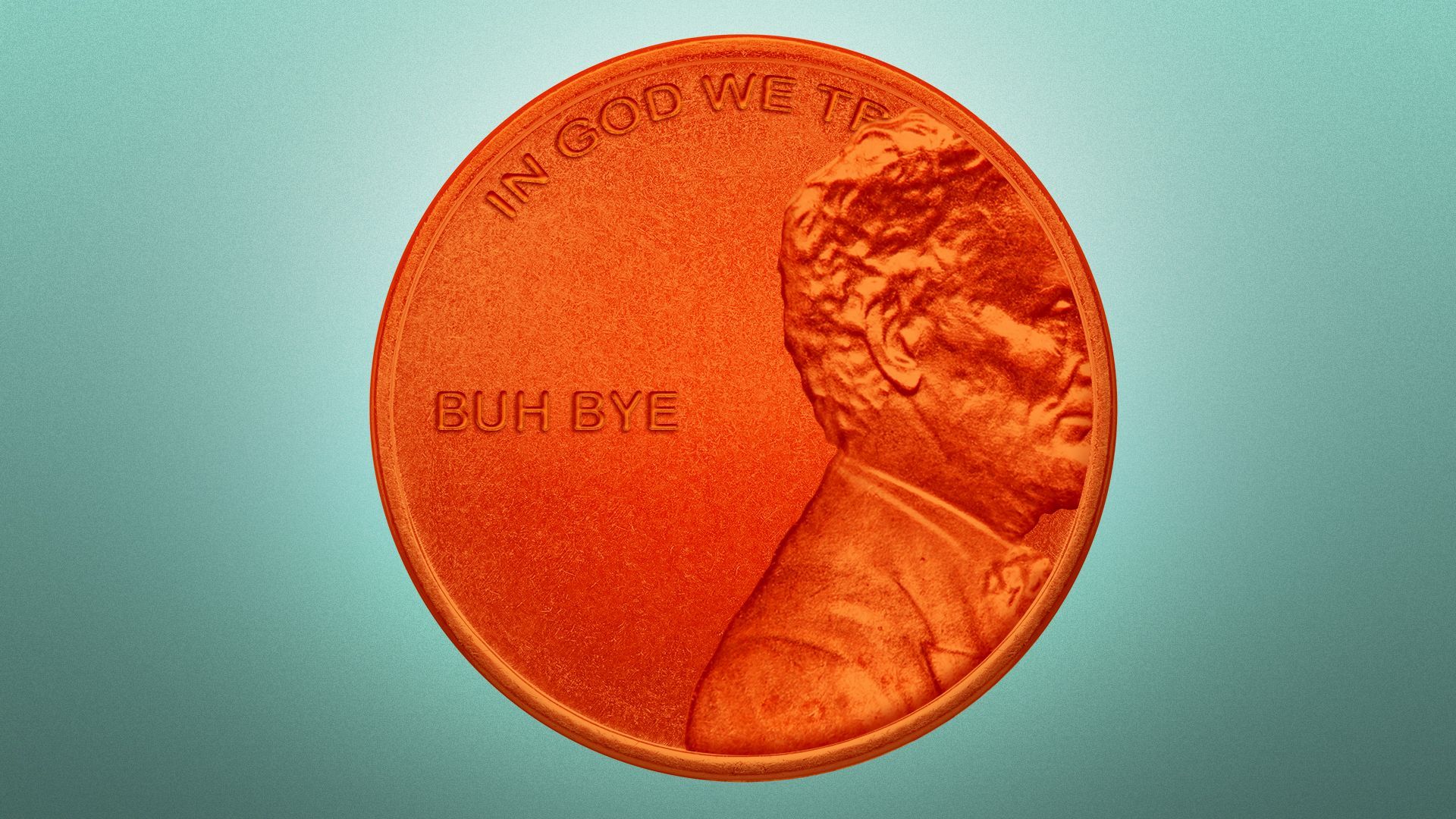
Illustration: Sarah Grillo/Axios
The federal government is phasing out the penny to save money — and while change is hard, an Ohio business leader tells us losing the cents makes sense.
Why it matters: The coin's demise means prices for cash transactions will need to be rounded, impacting business' pricing strategies and consumers who rely on cash (typically older and lower-income Americans).
Catch up quick: The U.S. Mint will stop making the coins early next year. The Treasury Department placed its final order for blank templates last month.
- Stopping production will save the government $56 million a year in reduced material costs, a Treasury spokesperson said. Production costs have risen from 1.3 cents to 3.69 cents for every penny over the past decade.
The big picture: For similar reasons, Canada discontinued its penny in 2012 and Australia and New Zealand stopped producing their lowest-denomination coins decades ago.
How it works: The Treasury told the Wall Street Journal businesses will need to round up or down to the nearest 5 cents once there aren't enough pennies to use in everyday cash transactions.
- Cashless transactions will still be priced at exact change.
Zoom in: "I haven't heard a thing from our members about it," Ohio Chamber of Commerce president and CEO Steve Stivers tells Axios.
- Typically, mandates concerning whether businesses can or can't take cash — like a state bill introduced in January — are more controversial, he says.
- Local businesses are increasingly going cashless, including major institutions like sports arenas, the zoo and amusement parks.
- Stivers said he will be paying attention to the rounding logistics as they play out.
Flashback: A former U.S. representative, Stivers sponsored legislation for pennies to be made of steel, rather than copper, zinc and nickel, to cut costs.
The intrigue: A 2022 Federal Reserve report found $14 billion — about 60% of actively circulating coins — is sitting in jars and not flowing in the economy.
- Just 16% of U.S. payments were cash in 2024, per the reserve's Diary of Consumer Payment Choice.
The bottom line: "As we move to a more digital world, it's less and less important whether there is a coin to back something up," Stivers says.
- "Every time I get change and go home and clear out my pockets, where does it go? Right in the coin jar."
📬 A penny for your thoughts? Email [email protected] and tell us what you think of the change.