Where you can raise backyard chickens

Add Axios as your preferred source to
see more of our stories on Google.
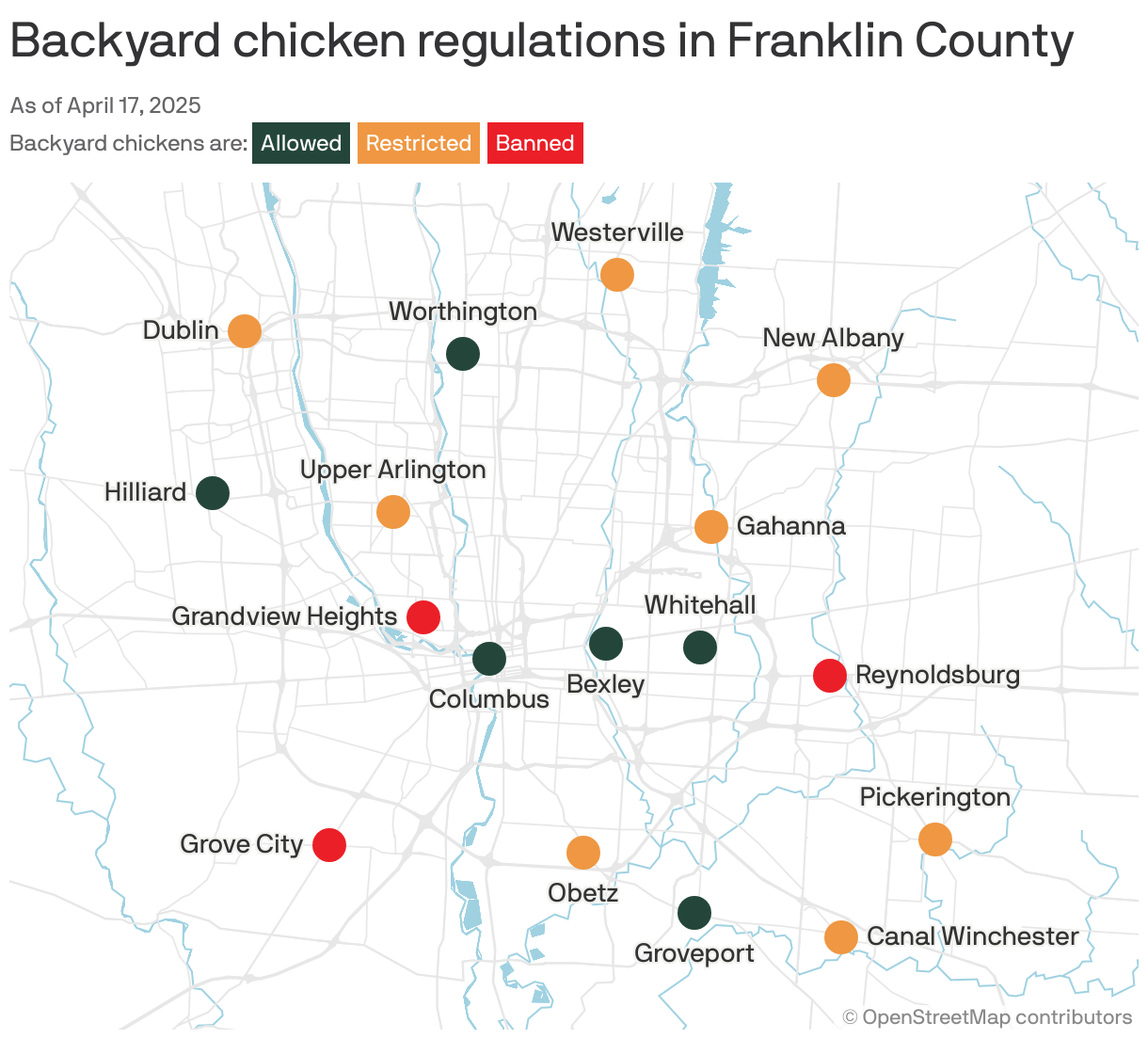
More people are flocking to backyard chickens amid high egg prices, but raising them can be expensive — and in much of Franklin County, you'll need land the size of a football field to legally do it.
Why it matters: A confusing, changing patchwork of local regulations has many aspiring owners scrambling for answers on what's allowed.
- We combed through city zoning codes to help make sense of it.
Zoom in: Columbus, Bexley, Hilliard, Whitehall and Worthington are among the most chicken-friendly cities, with specific ordinances allowing backyard poultry.
- There are bird limits and space requirements, but they're generous.
- But Homeowners Associations and landlords could have their own rules, and in most cases, permits are still required.
The other side: Chickens are explicitly banned in Grandview Heights, Grove City and Reynoldsburg. Typical concerns are noise and sanitary issues.
- Reynoldsburg may reverse course, though, based on recent resident feedback.
- Roosters, which are notoriously noisy, are prohibited almost everywhere, unless you own lots of land.
Between the lines: Complicating matters is that many suburbs effectively prohibit raising poultry — even if a chicken ban isn't officially on the books — by restricting the practice to larger properties (1-5 acres), which aren't common.
- Franklin County has its own zoning rules allowing chickens on unincorporated properties over a half-acre.
Caveat: Townships can set their own, stricter zoning rules or default to Franklin County's.
Reality check: Ultimately, raising chickens at a small scale isn't a cost-saver.
- A decent coop ($500) and food and upkeep for two birds over six months ($120) would produce four to seven dozen eggs, an expert told Axios' Carly Mallenbaum.
- That many eggs cost an average of $25-44 at the grocery store in March.
Yes, but: Proponents say backyard chickens are fun, educational companions that give owners control of their food sources.
- Ohio State University Extension started offering a $25 backyard poultry certificate course last year due to the increased demand, educator Tim McDermott tells Axios.
The bottom line: "One of my first slides, if not my very first thing that I say, is: 'Check the regulations for your city or municipality before you buy any birds,'" McDermott says.
💬 What readers are saying
💸 Juliet K.: I've been convinced by friends and the online crowd that owning chickens wouldn't actually save any money (because I would certainly spoil them).
- I asked ChatGPT to do the math based on how I would realistically treat them and it was giving me like 80 cents an egg, which is like $9.50 a dozen.
- If you have the space to have a lot of chickens there are economies of scale, but in my small urban plot I could only get away with having four.
👀 Bev L.: We don't have backyard chickens but my husband would like to. Homeowners Association says no, we have three cats and a dog … and, well, it's also a no from me.
- I work in D.C. and am only home on weekends. I would not be surprised if he is hiding chickens somewhere.
🦆 Steph S.: Instead of chickens, backyard ducks! Ducks, on average, are better, more consistent layers and their eggs are higher in omega-3 fatty acids. The eggs are also bigger and make baked goods fluffier and richer.
- Plus, they're just more fun to watch swim around! I pick up my day-old ducklings in May!
🙅 Nicholas P.: I don't own backyard chickens, but my neighbors own front-yard chickens, something I'm not too thrilled about as a set-in-his-ways old millennial who identifies as a boomer.
- There's a time and place for raising livestock and growing row crops, and a residential setting in any incorporated area is not it.