How federal cuts to Medicaid and SNAP could affect Ohio


Add Axios as your preferred source to
see more of our stories on Google.
Illustration: Sarah Grillo/Axios
Proposed federal cuts could slash funding to Medicaid and the Supplemental Nutrition Assistance Program relied upon by hundreds of thousands of Central Ohioans.
Why it matters: Cuts could put the programs at risk while potentially costing Ohio tens of thousands of jobs and hundreds of millions in tax revenue.
Driving the news: The U.S. House of Representatives' latest budget resolution calls for more than $1 trillion in combined cuts to programs overseen by the House commerce and agriculture committees, which include Medicaid and SNAP, known previously as "food stamps."
Zoom in: Those programs are federally funded and administered locally via the Franklin County Department of Job and Family Services.
- Director Michelle Lindeboom says the agency works with 406,000 Franklin County residents on Medicaid and 178,000 on SNAP.
Threat level: Lindeboom tells Axios her staff and the people they serve are feeling "very uneasy" about the funding uncertainty.
- "We are talking about the most vulnerable population at a certain poverty level," she says. "We're trying to deal with uncertainty and making people feel safe that they will still have benefits."
Follow the money: Medicaid and SNAP cuts won't just put vulnerable populations at risk — they're projected to be economically detrimental.
- New analysis from the Commonwealth Fund and the George Washington University Milken Institute School of Public Health sought to estimate the economic consequences of the cuts.
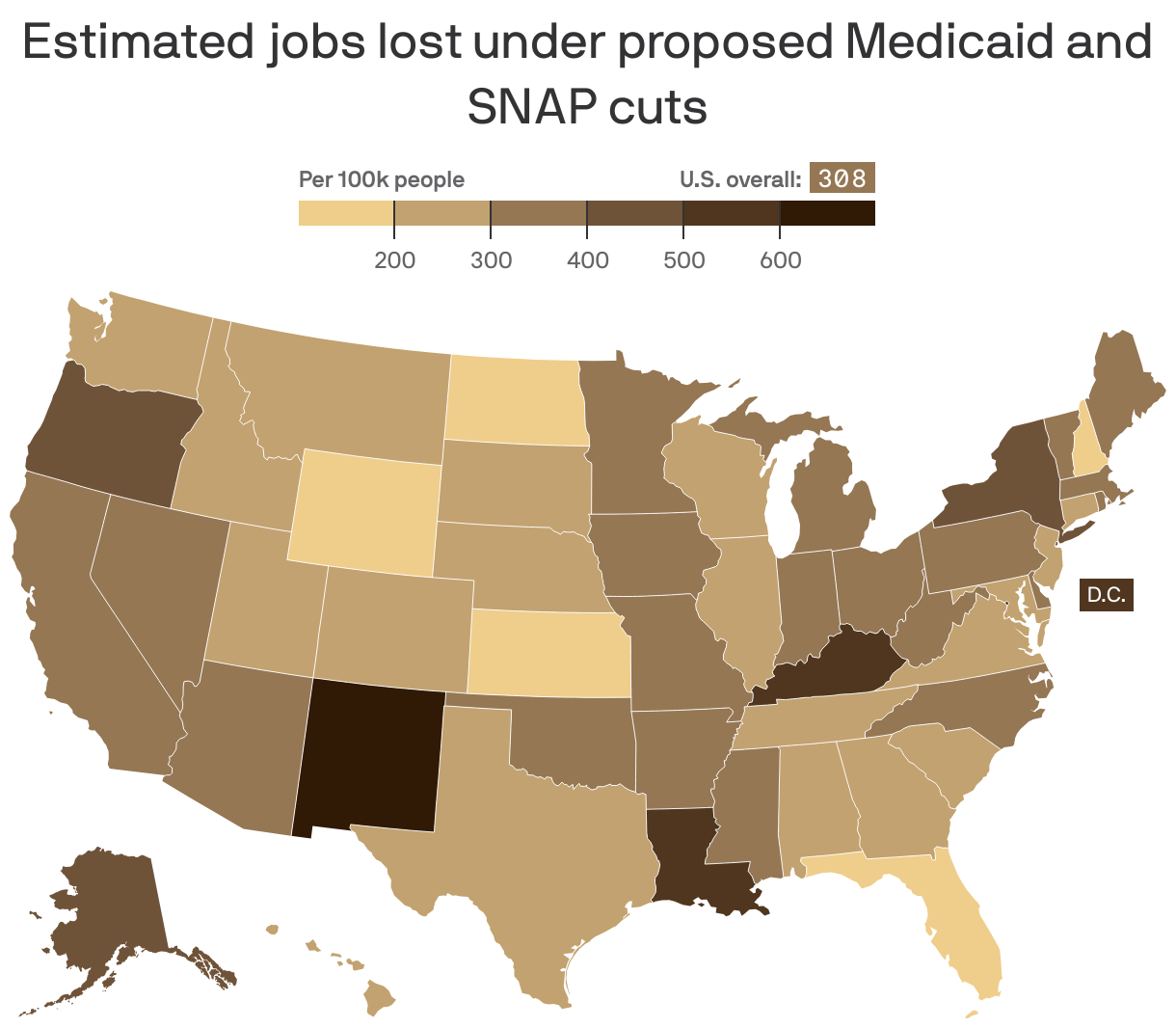
What they found: The report found that cuts could lead to a loss of 43,000 jobs, $4.4 billion in economic output and $323 million in lost tax revenue for Ohio.
What they're saying: "Some have argued that Medicaid or SNAP budgets can be cut harmlessly by eliminating 'waste or fraud,'" researchers write.
- "But as we've shown ... drastic reductions in federal funding will necessarily have major financial repercussions, because they shrink the flow of dollars into states' economies."
The other side: House Speaker Mike Johnson defended the proposed cuts as necessary to curb "fraud, waste and abuse" in the "hugely problematic" Medicaid program.