Report: Most Ohio bridges are in "good" shape


Add Axios as your preferred source to
see more of our stories on Google.
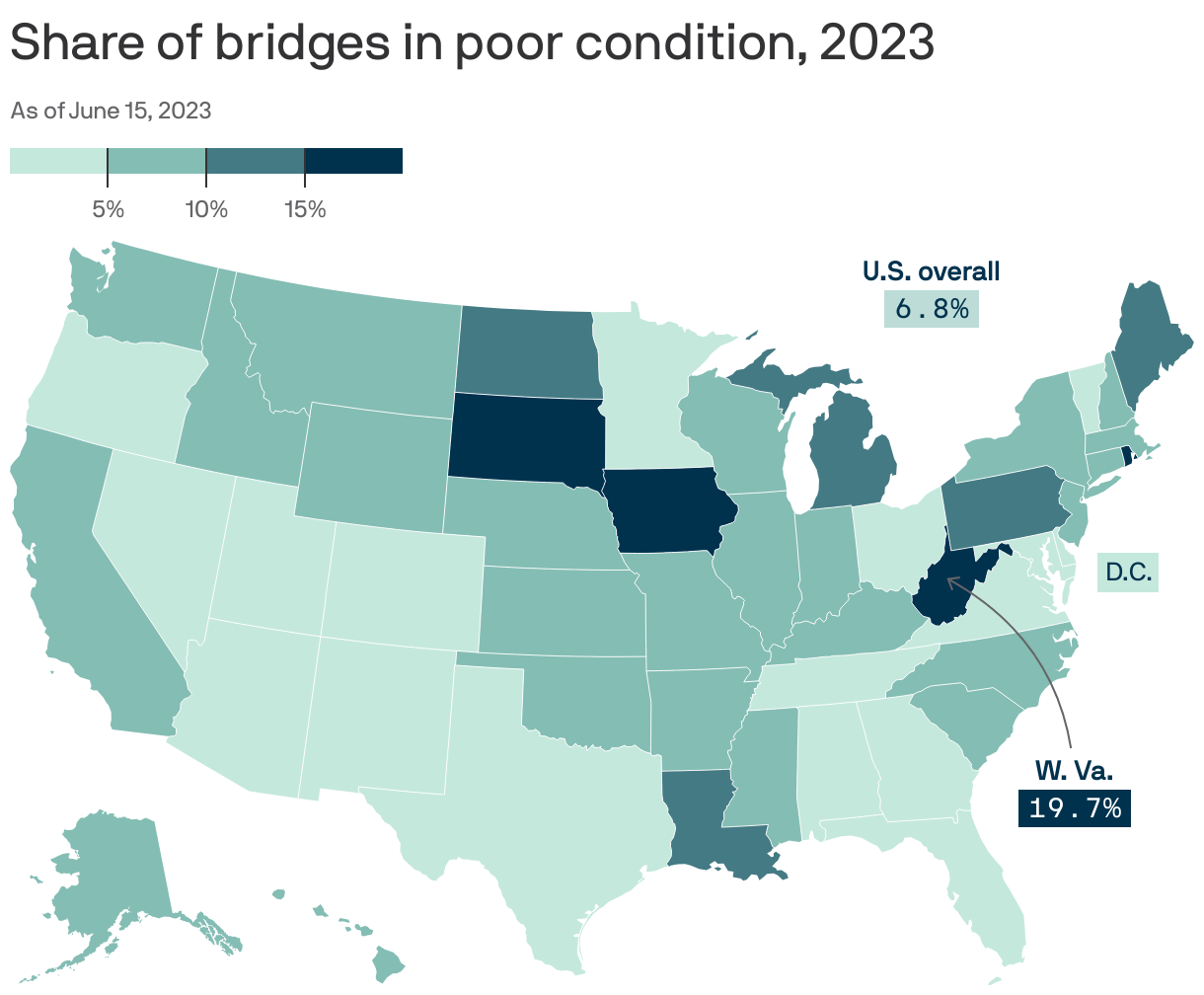
Although the bridge collapse in Baltimore last month was due to a series of unlikely accidents rather than crumbling infrastructure, the incident has renewed focus on the vulnerability of bridges across the U.S.
The big picture: The U.S. Department of Transportation considers 6.8% of the over 600,000 bridges it tracks and rates to be in "poor" condition.
- That doesn't sound too bad on a percentage basis, but it's over 40,000 bridges in total.
- The trend nationwide is nonetheless headed in a positive direction, with the percentage of bridges in poor condition cut in half since 2000.
Breaking it down: West Virginia, Iowa, South Dakota and Rhode Island fare the worst, with 15% to 20% of bridges in each state rated "poor."
- Georgia has the highest percentage of bridges in "good" condition (75%), while in Arizona, Nevada and Texas, just 1% of bridges are rated "poor."
Zoom in: 61% of Ohio's 26,960 bridges are "good" and just 5% "poor," per the 2023 ratings.
- That amounts to 1,251 bridges statewide considered to be structurally deficient, most of which are located in rural communities.
- A few dozen bad bridges are along interstates and highways that see a combined 1.4 million vehicle crossings per day.
What's happening: One of those is the I-70 bridge over the Scioto River, which dates back to 1975 and has over 61,000 daily crossings.
- Its replacement is part of the ongoing I-70/I-71 reconstruction project.
What to watch: The federal bipartisan infrastructure law sets aside $40 billion to further repair and rebuild the nation's bridges, but that will take years to go from ink to concrete.