High costs strain Ohio restaurants

Add Axios as your preferred source to
see more of our stories on Google.
Illustration: Shoshana Gordon/Axios
Rising food and labor costs are seriously eating into restaurants' profits, operators across Ohio reported in a recent industry survey.
Why it matters: High costs put a strain not just on owners' pocketbooks but customers', too.
Driving the news: The Ohio Restaurant Association has conducted quarterly "business impact" polls of operators since the beginning of the pandemic.
- The latest was taken between Oct. 17-Nov. 16.
Here are a few takeaways from the survey and our conversation with ORA president and CEO John Barker:
🍔 Customers are also paying the price
Nearly all restaurateurs report facing higher food and labor costs (95% and 88%, respectively) compared to the beginning of 2023.
The big picture: Inflation has hit restaurants and consumers hard in recent years, with a stream of supply chain disruptions, global conflicts and high energy costs contributing to higher food prices.
What they're saying: "It's still a very stressful period for operators, particularly mom-and-pops and smaller restaurants that don't have as much scale," Barker tells Axios.
Between the lines: Most restaurants (60%) say they're raising menu prices this quarter to mitigate higher costs.
- Plus: Some restaurants now charge "inflation fees," and Barker says he recently dined at a High Street restaurant that charged a "health care fee" to pay for labor benefits.
❌ Businesses will fight a minimum wage increase
Few operators (16%) support a proposal to raise the state minimum wage to $15 per hour.
State of play: Ohio's minimum wage gradually increases each year, currently sitting at $10.10 per hour for non-tipped workers and $5.05 for tipped workers.
What's happening: Raise the Wage Ohio, which argues the minimum wage isn't increasing fast enough, proposes a constitutional amendment to raise the hourly minimum wage to $15 by Jan. 1, 2026, and eliminate the lower tipped wage by 2029.
- The group is gathering petitions to place it on the November 2024 ballot.
The other side: ORA will publicly campaign against the amendment if it gets placed on the ballot, Barker says, adding that operators see a tipped wage "as foundational to their business models."
😬 It's bad news when the Bucks lose
Fans like to keep the party going when Ohio State wins a big football game, but often cut it short after a heartbreaker:
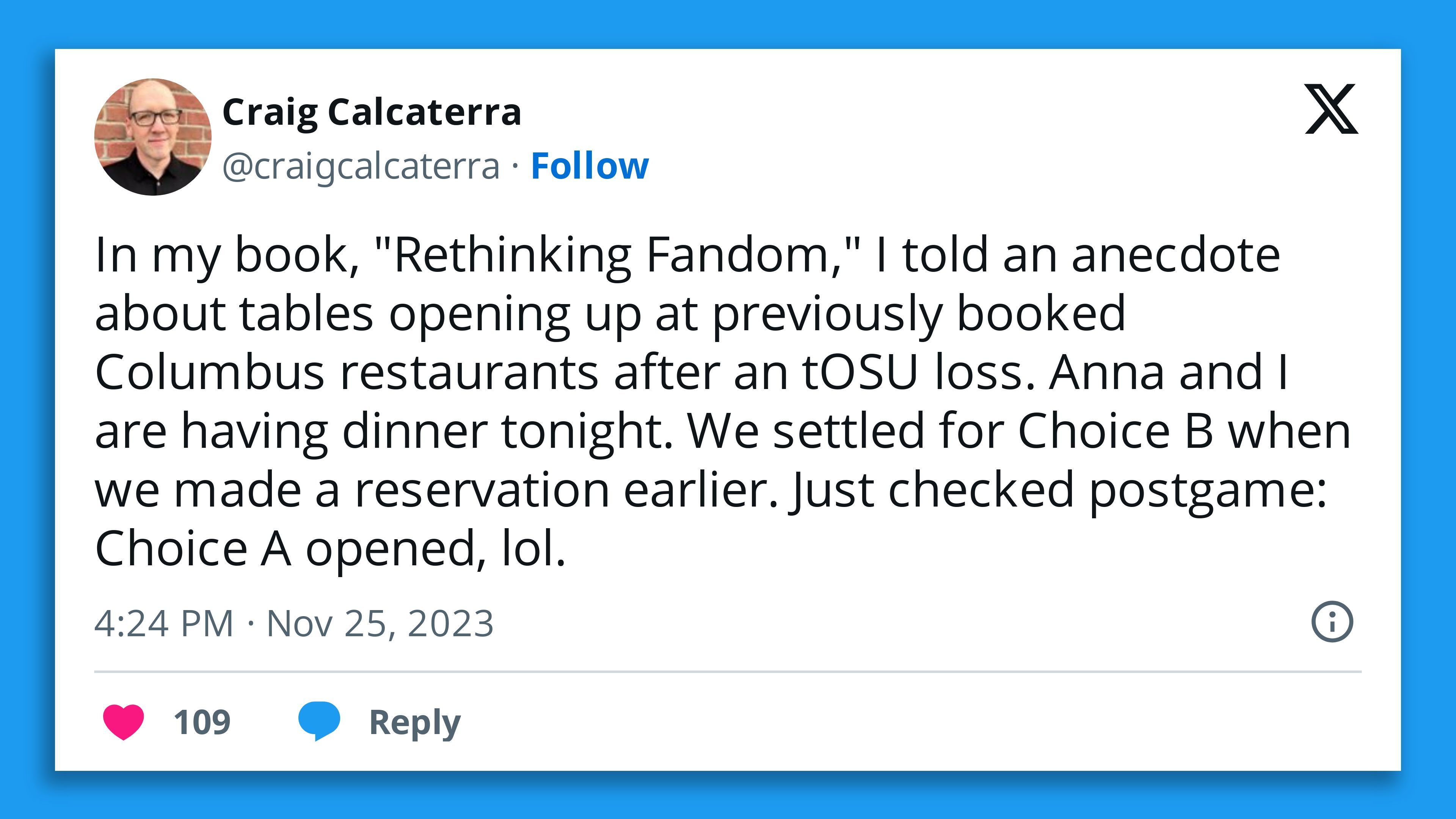
The intrigue: "This tracks," Barker says, though he thinks it's probably more true for casual dining and bars.
- "I'd say the higher-end the restaurant, the more they'll continue to go to it" after a loss.