Ohio's poverty rate is up for the first time in years

Add Axios as your preferred source to
see more of our stories on Google.
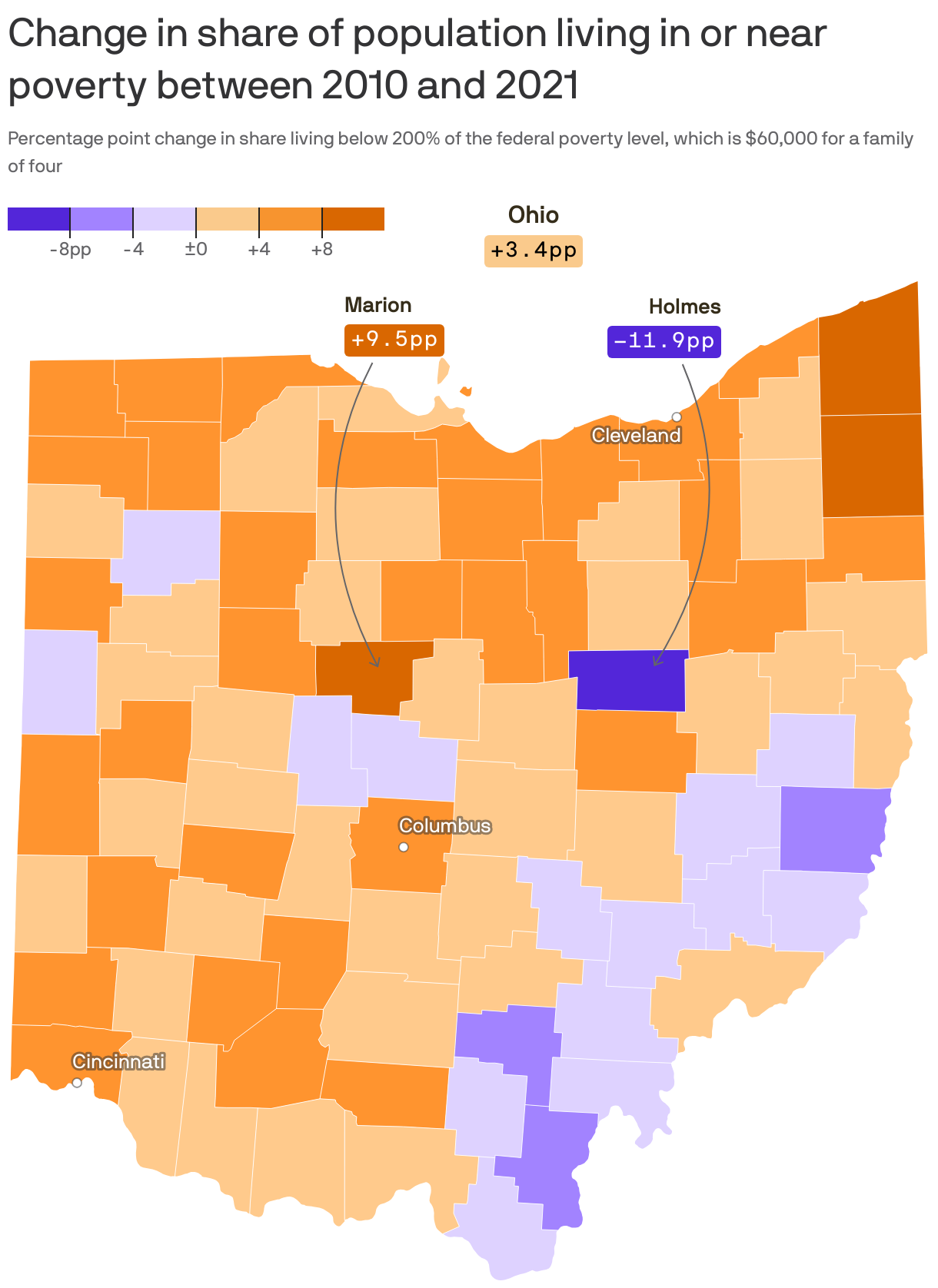
The percentage of Ohioans living in poverty increased year-over-year for the first time in more than a decade, from 12.7% in 2020 to 13.4% in 2021, according to the Ohio Association of Community Action Agencies (OACAA) annual poverty report.
Why it matters: Without a financial safety net, families are more vulnerable to unexpected life disruptions like a job loss, medical emergency or major expense, like a car breakdown.
- Meanwhile, many pandemic-era safety net programs are set to end soon, creating further financial instability, Axios' Caitlin Owens reports.
By the numbers: Ohio's statewide poverty rate (its share of families living at or below the federal poverty level) trends higher than the 2021 national average of 12.8%.
- Franklin County's 2021 rate (14.3%) was higher than the state average.
- Delaware County's was lowest (4.1%) and Scioto County's was highest (23.9%).


What's happening: OACAA's report focuses on three big challenges Ohio families have recently been facing — pandemic-related learning disruptions, a shortage of mental health care providers and a lack of public transportation.
Zoom in: One example, a "scenario written from anecdotal accounts," highlights a Franklin County couple with three young children and a household income of $64,000, just under the county median.
- Both adults worked day shifts, one commuting to Columbus' West Side and the other to Fairfield County. When one of their two cars broke down, the family couldn't afford the repair.
- The father started walking 3 miles to the bus stop nearest to home, while the mother used the remaining car to juggle her job, errands and day care trips.
- Eventually, the mom was fired for decreased work performance and tardiness, plunging the family's income below the federal poverty level.
Of note: The federal poverty level, which is set by tripling the amount for a basic food budget, is $30,000 for a family of four.
- A full-time minimum wage worker in Ohio makes $21,000 annually.
Yes, but: The report notes that a "self-sufficiency wage" — which also accounts for clothing, housing and utilities — would be $56,000-$63,000 in Ohio.
What they're saying: OACAA calls for more state investment in transportation, mental health and education.
- "We often say that poverty is caused by people's poor choices … but more times it is caused by the choices of us as a society," executive director Phil Cole said at a news conference last week.