Ohio's woeful anti-tobacco spending


Add Axios as your preferred source to
see more of our stories on Google.
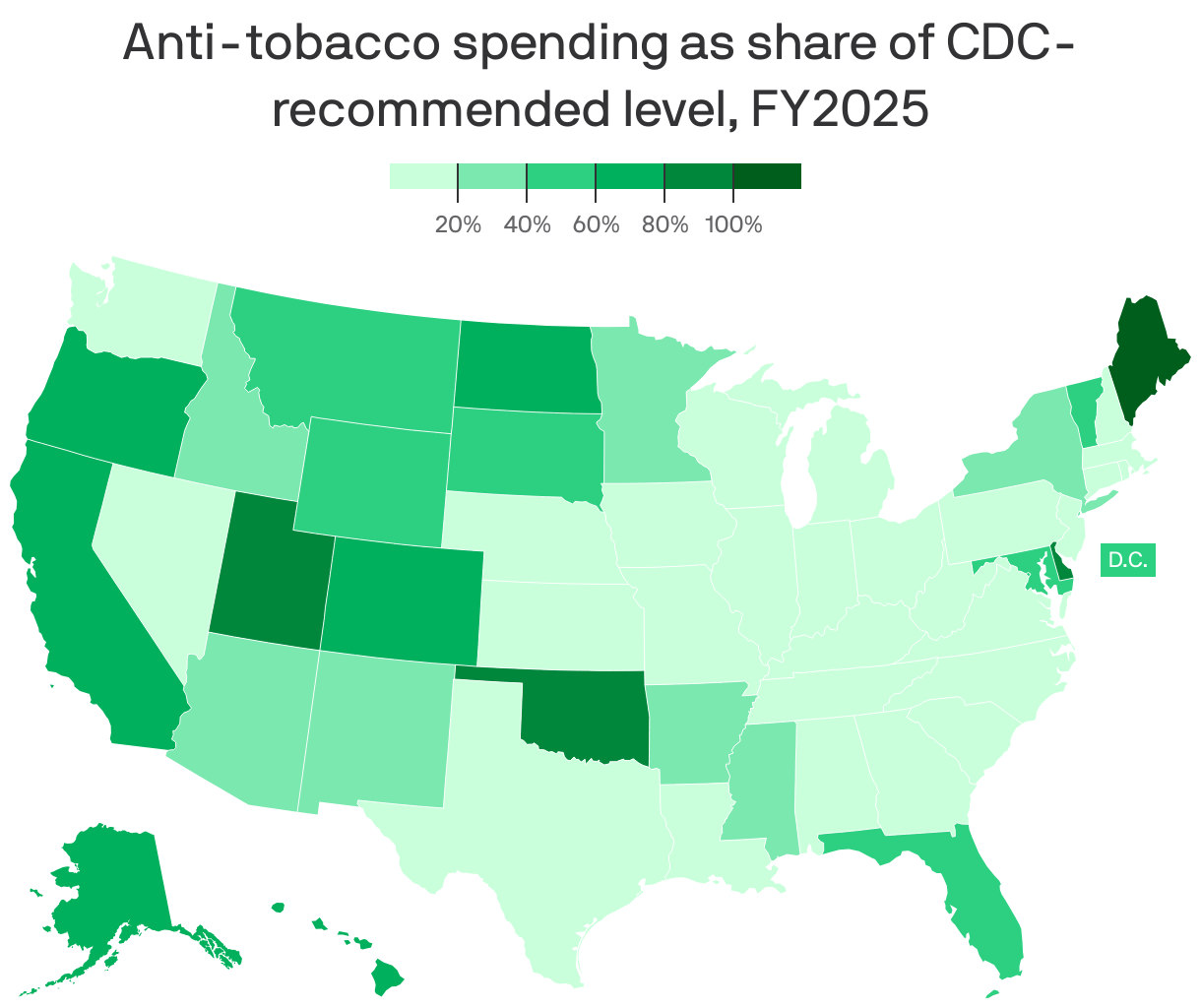
Ohio has budgeted about $8 million toward tobacco control programs in fiscal year 2025.
Why it matters: That's a tiny fraction of the $132 million that the Centers for Disease Control recommends Ohio should spend on smoking prevention and cessation.
Driving the news: That glaring discrepancy, one of the highest in the nation, has earned Ohio an "F" from the American Lung Association in its new report card on the state of tobacco control.
The big picture: Cigarette smoking has faded significantly over the past few decades but remains the country's leading cause of preventable deaths — and causes 1 in 5 of all U.S. deaths, according to the CDC.
What they found: Maine (107.4%), Utah (90.2%) and Oklahoma (89.8%) lead the nation in meeting or exceeding the CDC's recommended funding levels.
- Texas (3.6%), Georgia (4%) and Tennessee (4.8%) are furthest from their CDC-recommended levels.
- At 7.8%, Ohio is eighth-worst.
How it works: The CDC's recommendations vary from state to state based on several factors, including statewide tobacco use, the share of the state population living in poverty, and the local cost of media outreach.
- In Ohio, the CDC recommends allocating the bulk of funding to state and community interventions, plus tobacco use treatment.
Zoom in: 35% of adults in Cleveland smoke cigarettes — more than triple the national average.
- Cleveland's Coalition to End Tobacco Targeting and the city's Department of Public Health had been lobbying the City Council to ban flavored tobacco and menthol products, which disproportionately affect Black smokers.
- But state lawmakers worked to prevent local governments from regulating the issue.
State of play: Gov. Mike DeWine's proposed budget includes more funding for tobacco cessation outreach and tax increases on various tobacco products.
- Under his plan, the cigarette tax would rise from $1.60 per pack to $3.10.
The big picture: At the state level, the tobacco industry spent 2024 seeking "to protect specific tobacco products from taxation and to pass legislation that would result in state governments pursuing penalties against smaller competitors that sell e-cigarette products illegally in the U.S.," the Lung Association report says.
What they're saying: In a statement, the association president and CEO Harold Wimmer pointed to recent data showing that youth tobacco use is at a 25-year low as a big win — but added that "the number of middle and high school students who still use tobacco products — 2.25 million — is too high."
- "In addition, 36 million adults in the U.S. still smoke cigarettes."
What's next: President Trump ran in part on a "Make America Healthy Again" agenda but also stressed business deregulation and a hands-off government approach — a combination that makes it hard to predict how his administration will treat the tobacco industry.