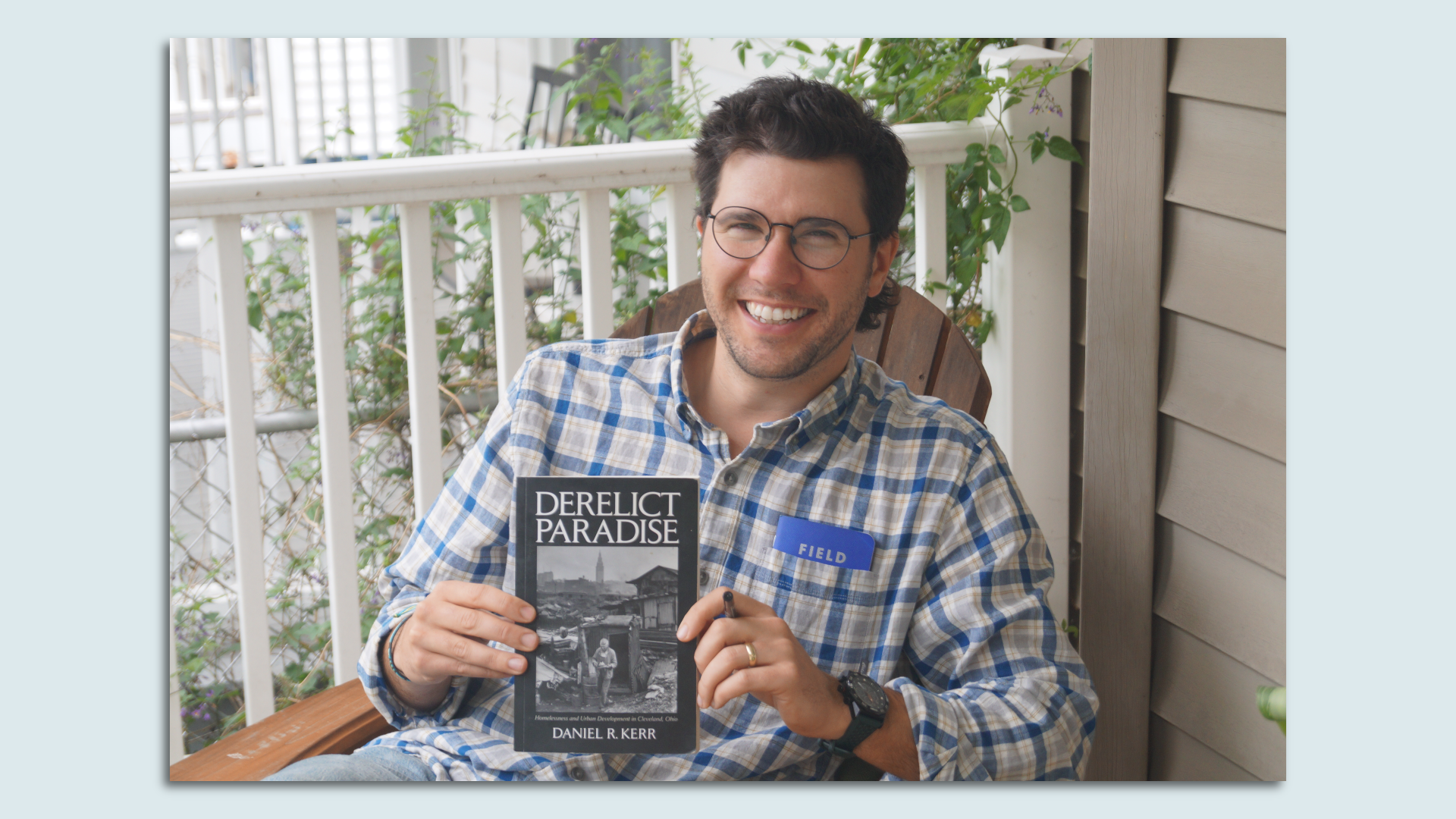
Cannot get enough of "Derelict Paradise." Photo: Grace Heffernan
Homelessness in Cleveland is not caused by "abstract and distant forces," Daniel Kerr argues in his 2011 book "Derelict Paradise."
Reality check: "[It's] a result of the accumulated decisions made by real actors in the public and private sectors over a century and a quarter," he writes.
Why it matters: Cleveland remains the second-poorest big city in the United States. Kerr's book, a lively and rigorously sourced local history, positions the city's enduring poverty as the product of social policies designed by and for elite institutions.
It's also a crash course in some of Cleveland's pivotal 20th-century moments and movements.
You can watch a livestream at noon at the City Club website or tune in to WKSU (89.7 FM).
💭 Sam's thought bubble: I'm a professed Kerr acolyte and am honored to be moderating the conversation — my first-ever invite to the City Club.
I plan to ask Kerr about the structural factors entrenching homelessness in Cleveland and to tease out the book's central question: Who benefits from it?
The latest: This week, Cleveland City Council approved $2 million for the city's new "Home for Every Neighbor" program, which seeks to rehouse 150 people sleeping on Cleveland's streets by year-end.