North Carolina bill would eliminate parking minimums statewide

Add Axios as your preferred source to
see more of our stories on Google.
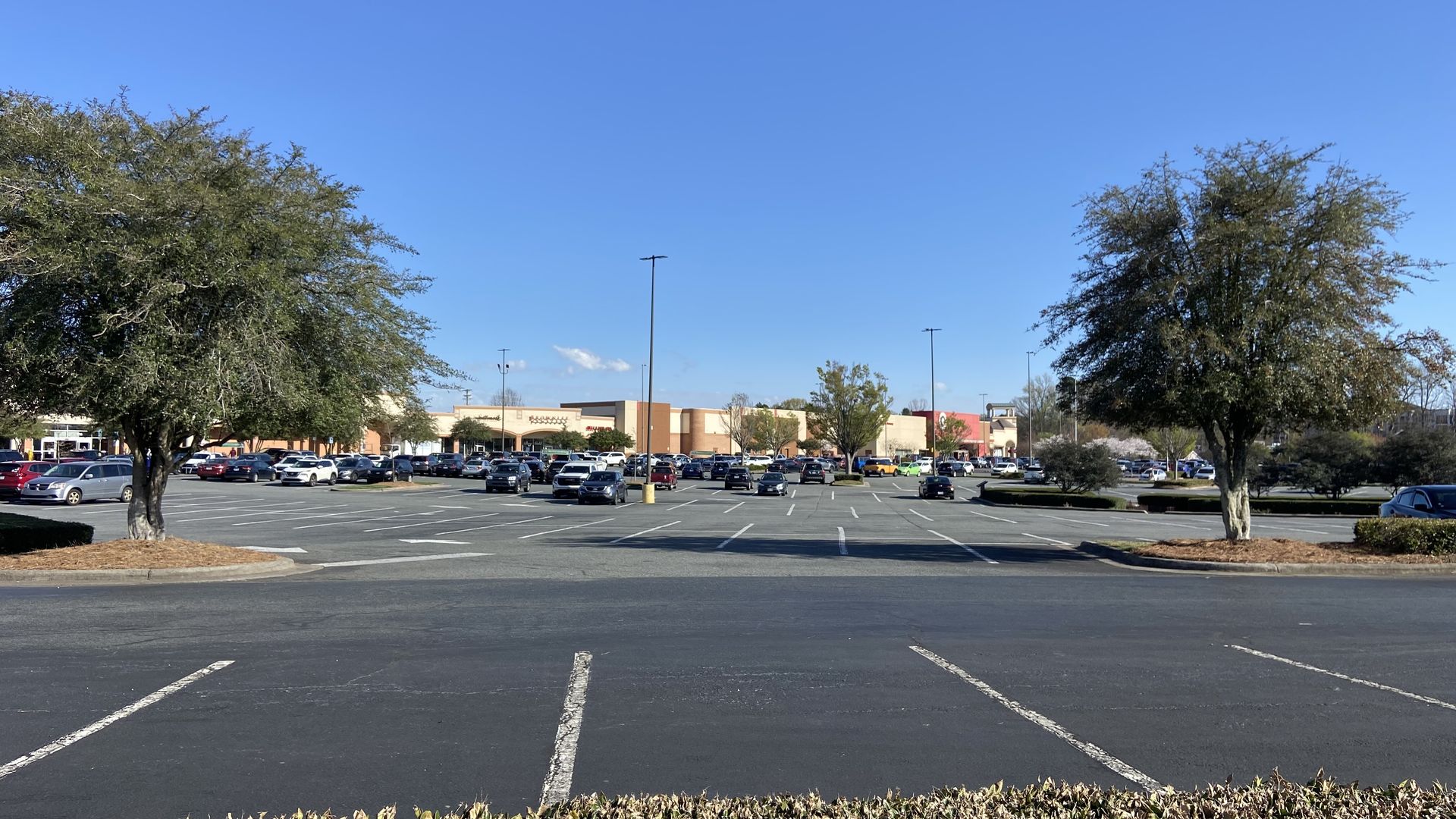
Photo: Ashley Mahoney/Axios
A new North Carolina bill could eliminate off-street parking minimums — the number of spaces local governments require for new developments.
Why it matters: Charlotte has considered ending these requirements as the city aims to be less car-dependent. This state bill, however, would override the local rule and effectively settle any debate.
- The legislation is gaining broad support across North Carolina, from rural farmers to business leaders to environmental activists.
"This is an affordable housing issue, farmland preservation issue, sprawl issue — there's a lot of components to it," says Ryan Carter, policy director at Catawba Riverkeeper.
Context: Catawba Riverkeeper, the nonprofit dedicated to protecting the Catawba-Wateree River Basin, has worked on this legislation for years, intending to reduce stormwater runoff.
- Just one inch of rainfall on an acre of parking lot generates 27,000 gallons of runoff, according to Catawba Riverkeeper. That rainwater carries pollutants into waterways, including the Catawba-Wateree River Basin and downstream to farmlands.
- Others see ending parking minimums as a way to promote attainable housing. When developers are forced to build parking, the number of spaces often exceeds the market demand, driving up construction costs and making housing less affordable.
- A surface parking spot, on average, costs about $5,000 to $10,000, while a parking deck space can run around $50,000, according to Strong Towns.
Case in point: Gastonia eliminated parking minimums in recent years — a move that made the 200-unit Fairhaven Place workforce housing development more financially viable, according to assistant city manager Quentin McPhatter.
- "It certainly helped move things along and move the needle in terms of our revolution of downtown," McPhatter says.
Zoom out: Nationwide, cities are moving away from parking minimums. A mix of red and blue states — including Washington, Illinois, Oklahoma and Montana — are considering statewide legislation similar to North Carolina's.
Zoom in: House Bill 369, the Parking Lot Reform and Modernization Act, would also ban coal tar sealants and other toxic pavement products that are harmful to humans and the environment.
- Already, Mecklenburg County has banned coal tar products, and Lowes, Home Depot and Ace Hardware no longer carry products containing the chemical.
- The bill also reverses a state law that prevents local governments from requiring storm runoff deterrents for redevelopment sites.
What they're saying: Rep. Mark Brody, a Republican sponsoring the bill, says he often looks at unused portions of Walmart or big shopping center lots and asks: "Why have all this wasted space?"
- Carter says the bill would encourage infill development, spur revitalization in western North Carolina after Hurricane Helene and promote the reimagining of corporate business parks.
The other side: Unlike Raleigh, Durham and Gastonia, Charlotte still mandates a set number of spaces per development, even for a bar near the light rail, if it's close enough to a single-family home.
- Charlotte has hesitated to drop parking minimums. Over the years, officials have voiced concerns that the city's transit system is too inadequate to make such a change. They worry limited parking would lead to more on-street parking, disrupting quiet neighborhoods.
- However, the city is beginning to address its parking demand by implementing residential parking permit programs in the fast-growing neighborhoods of Dilworth and Wilmore.
What's next: Catawba Riverkeeper expects legislators to review the Parking Lot Reform and Modernization Act in the coming weeks.