‘Losing ground’: Charlotte’s affordable housing gap widens


Add Axios as your preferred source to
see more of our stories on Google.
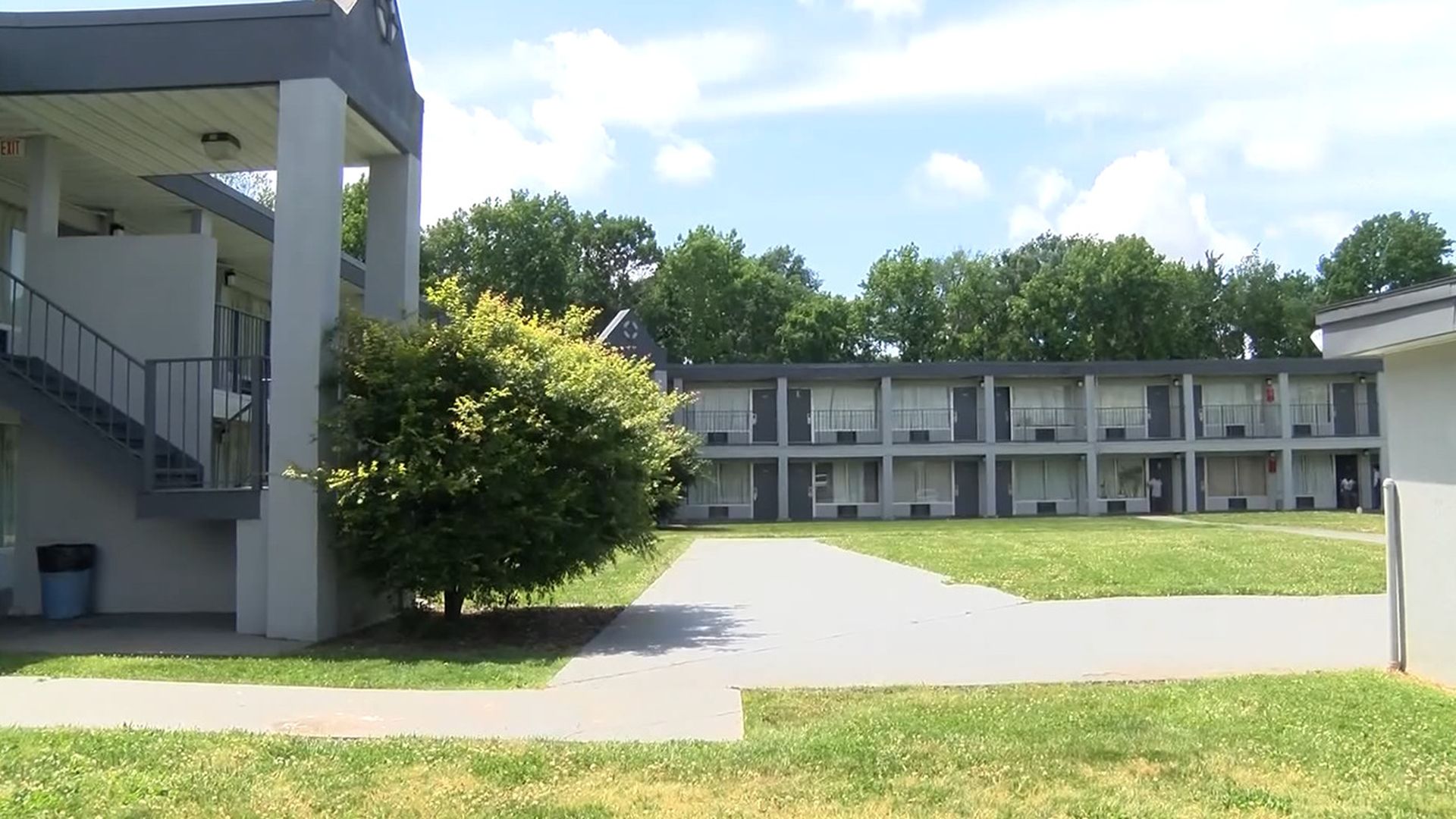
The Southern Comfort Inn. Image courtesy of WBTV.
Charlotte’s affordable housing efforts can’t keep pace with the city’s growing need.
Driving the news: The past few weeks have been busy on the housing front:
- On Tuesday, June 14, the nonprofit organization that manages Charlotte’s three-year-old private affordable housing fund released a progress report, saying the $53 million in private capital raised since 2019 had created or preserved 1,047 housing units.
- Last Thursday, June 9, multiple organizations involved in a sweeping new initiative to reduce homelessness here announced that they’d selected United Way of Central Carolinas to quarterback the effort.
- Meanwhile, the new owner of Brookhill, a 70-plus-year-old low-income community on South Tryon Street, is set to demolish 20 vacant buildings as part of a 36-acre redevelopment.
- And late last month, the new owner of the Sterling community off of South Boulevard near the Pineville border told dozens of families there they have to leave, WSOC first reported. The remaining residents have to be out by June 30.
Why it matters: Despite our best efforts, we’re not meeting the need, especially for the city’s poorest residents, a recent Axios analysis found.
- There’s a shortage of about 23,000 units for those earning up to 30% of the Area Median Income, or around $26,000 for a family of four. That’s the widest gap of any income level.
Context: In the wake of the 2016 police killing of Keith Lamont Scott and a 2014 study that ranked Charlotte last among major metros for economic mobility, politicians and corporations alike galvanized support for affordable housing.
- Voters approved raising the city’s Housing Trust Fund, which uses bond money to subsidize affordable housing, to $50 million.
- And private companies, led by the Foundation For the Carolinas, pledged to match that figure. Some of the biggest names in town, like Atrium and Novant, Wells Fargo, U.S. Bank, Ally and Bank of America, donated to the fund.
State of play: The private money is in a bucket called the Charlotte Housing Opportunity Investment Fund (CHOIF), and that’s managed by a national nonprofit organization named Local Initiatives Support Corporation (LISC).
- CHOIF is on track to create 1,500 units, per the LISC report released Tuesday.
- Plus, CHOIF’s investment has led to $167 million worth of development. 93% of housing units have been reserved for households earning 80% or less of Charlotte’s Area Median Income (AMI), and a quarter are affordable for those making 30% of the AMI or less.
Yes, but: Despite that progress, the affordability gap is still widening.
- Only 1% of apartments in Mecklenburg County rent for under $1,000, the average one-bedroom costs $1,288 per month, and the salary needed to rent an apartment here is $56,268, per a Mecklenburg County study.
- That leaves a lot of people out in the cold, or in this case, the heat. The median salary for elementary school teachers, firefighters and hotel desk clerks, bartenders or maids all fall below that figure at $45,860, $32,590 and $21,000 respectively.
One example of the growing problem is in the Sterling community, where another group of residents are being forced to relocate after a developer purchased their homes. And that’s just the latest in a string of displacements.
- Danielle recently profiled the Countrywoods Mobile Home Park, where residents say the landlord pushed them to leave after the park was sold.
- The Southern Comfort Inn, an extended stay motel in west Charlotte, told the city it plans to close, our news partners at WBTV reported this month. The hotel houses over 100 low-income families.
While those people are being displaced, the homelessness numbers are also increasing going into summer. More than 3,000 people are now experiencing homelessness in both sheltered and unsheltered locations, each night in Charlotte-Mecklenburg, according to the most recent Charlotte-Mecklenburg housing data snapshot.
- That’s more than during the first year of the pandemic, when the encampment known as “Tent City” sprawled out along 12th Street near Uptown.
The big picture: In an interview with Axios last week to discuss the new strategy for homelessness, county manager Dena Diorio talked about how development, affordability and homelessness are all intertwined.
- “Just in the last 60 days, look at the situation in the Sterling community. We’re seeing the buildings at Brookhill torn down. We have the hotel on Freedom Drive (the Southern Comfort Inn),” Diorio said. “It concerns me, actually, because a lot of the affordable housing that we have for folks are going away. We’re continuing to lose ground.”
What they’re saying: George Ashton, president of LISC Fund Management LLC, tells Axios that the CHOIF’s biggest priority is preserving existing affordable housing, because there is so much demand for those properties from investors who want to purchase them and raise rents.
- “Otherwise, you feel like you’re in quick sand,” he says.
- About 60% of the just over 1,000 units outlined in the LISC report are existing affordable homes that were preserved.
The bottom line: Our city’s identity is wrapped up in its growth, but that also comes with rising costs and people being forced out of the communities they’ve called home for decades.
In a column last week, the Observer’s former affordable housing reporter noted that her career began with writing about mass displacement at Lake Arbor Apartments, and ended with it at Sterling.
- “Even as Charlotte invests millions to build and preserve affordable housing, and Mecklenburg County overhauls its strategy to address homelessness, these displacements continue largely unfettered,” she wrote.
Danielle’s thought bubble: How much longer can we keep doing this? How many more times can I sit with an elderly homeowner who can’t afford their property taxes, or a renter in a community like Brookhill, who has watched development encroach on them, waiting for the day that they will be next?
- What becomes of our city when we’ve pushed out everyone who doesn’t make a six-figure salary? People make up the fabric of a city, not shiny high-rises and luxury apartments.
Where to help: Pineville Neighbors Place is providing financial assistance to the Sterling families for rent, utilities, moving expenses and food. Visit this link to donate.