Charlotte still isn’t building enough affordable homes for the poor

Add Axios as your preferred source to
see more of our stories on Google.
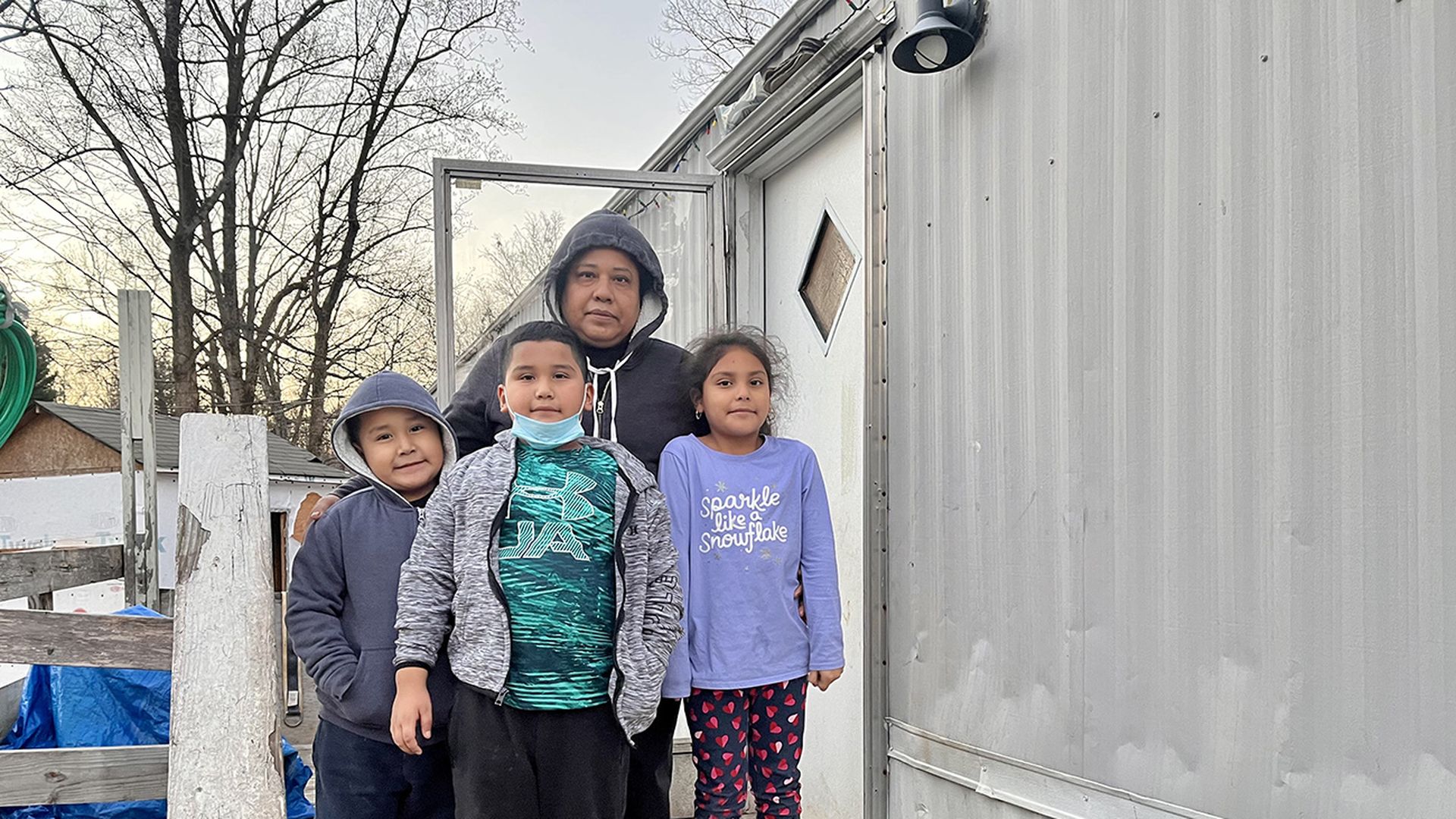
Nohelia Estudillo and three of her children outside of their home at Countrywoods Mobile Home Park. Photo: Danielle Chemtob/Axios
Editor’s note: Interviews with tenants from the Countrywoods Mobile Home Park have been translated from Spanish.
In a mobile home park less than 20 minutes north of Uptown, you wouldn’t know that Charlotte has spent millions to build thousands of affordable housing units around the city.
Before the park was sold in August, around 25 families called the dilapidated trailers home. Now, the tenants who are still there say the landlord has been pushing them to leave quietly, though no formal evictions have been filed.
Nohelia Estudillo has lived in the community for 14 years, since she moved to the United States from Mexico.
Now, she doesn’t know where she’ll go — all of the two-bedroom apartments the mother of four has looked at for her and children are at least $1,300 per month, which is more than she can afford with the $1,400 to $1,600 she brings in monthly working at McDonald’s.
- She’s already spending more than half of her income on rent and utilities for her trailer.
- “My kids cry because they say they don’t want to change [schools],” Estudillo says. “Whenever I mention something about moving they cry, ‘No Mommy, no.’”
What’s happening: Charlotte’s key affordable housing effort has not reached most of the city’s poorest residents like Estudillo.
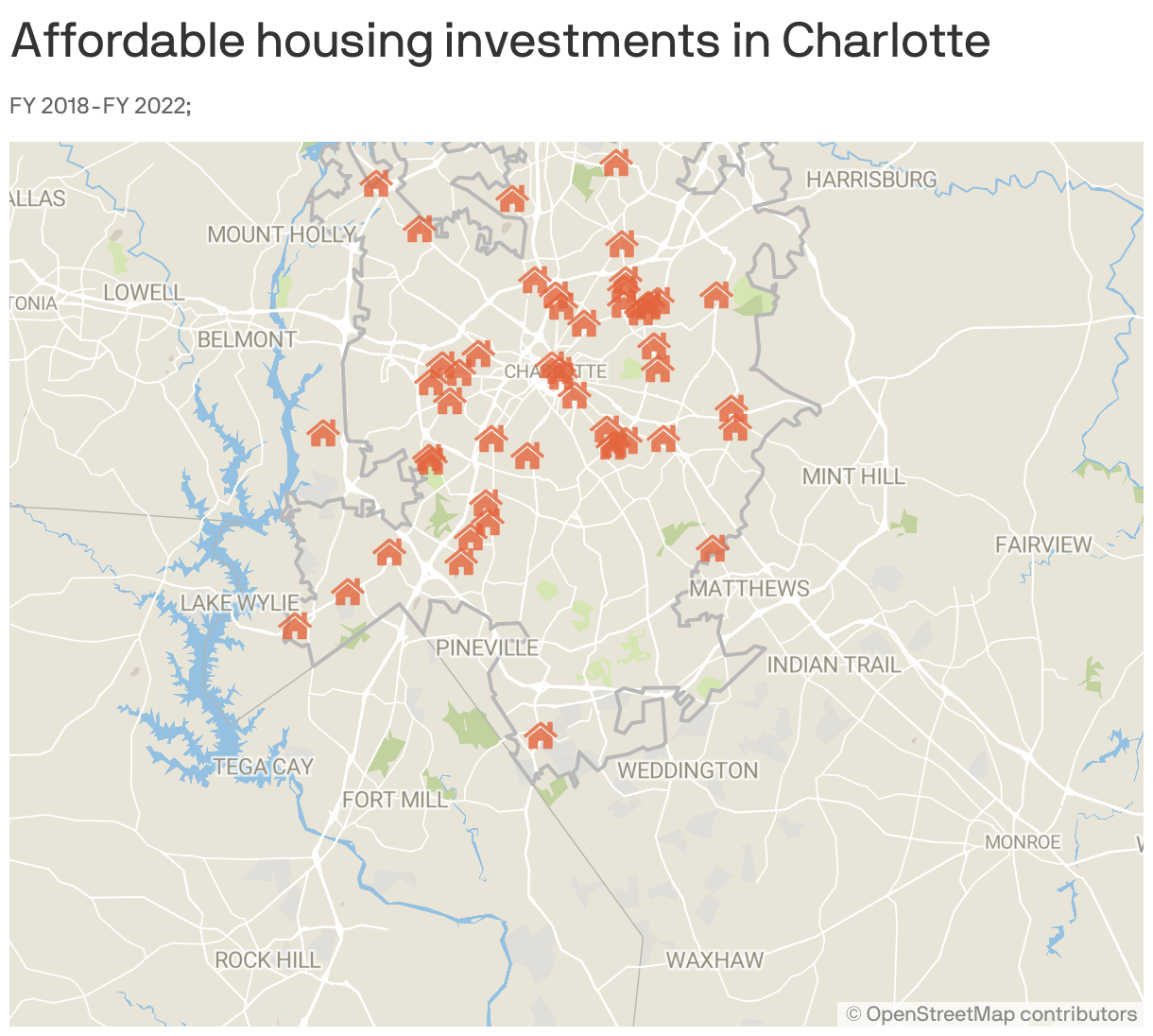
- The city has raised $100 million over the last two bond cycles and poured it into subsidizing affordable housing construction, new and renovations.
- But less than a quarter of the units that have been built since mid-2018 are for the lowest-income earners, an Axios analysis found.
Now some leaders admit that spending the money on new construction is unlikely to meet the need for housing for our city’s neediest residents.
State of play: The Housing Trust Fund is Charlotte’s primary tool for investing in affordable housing. It uses money from bond referendums to subsidize developers who build housing to be rented below market rate.
- Basically it helps covers the gap.
- Voters approved an increase in the trust fund from $15 million to $50 million in 2018, sending a statement that affordable housing was among the community’s top local priorities.
Axios analyzed the HTF’s investments since the fiscal year that started just before that bump, and found that:
- 24% of the just under 4,800 homes built since then have been for the lowest income bracket, which is defined as those making up to 30% of the area median income. That comes out to around $26,000 for a family of four.
- About 72% of the units, meanwhile, have gone to those who make between 60-80% AMI — or between $50,520 and $67,350 for a family of four.
- That’s despite the fact that there’s a shortage of about 23,000 rental units needed for those earning up to 30% of the AMI, the widest gap of any income level.
“We know that these are members of our community, we know that housing is critical, foundational, to a meaningful human life, and yet we have affordable housing policy that doesn’t really have an avenue to produce enough units for these members of our community,” Liz Clasen-Kelly, CEO of Roof Above, tells me.
Why it matters: Charlotte’s expansion has benefited those who can afford to enjoy it, but has left others struggling to get by. The pandemic that plunged tens of thousands of residents into housing insecurity in Mecklenburg County has laid that reality bare.
- The longer we wait to address that 23,000-unit shortage, the more people are at risk of homelessness, and the more it costs our city as a whole.
The conflict: For a long time, the solution was to build as much as possible. But the data suggests that strategy is producing so few units for the poor that it would take decades to fulfill the need.
Even some of the biggest advocates for the trust fund bump in 2018 say the current number is insufficient to make up for such a substantial deficit on its own.
- “We’re never going to solve it at 24,000 units, that is probably a challenge that is too large for any one community to completely solve,” said Brian Collier, executive vice president of the Foundation for the Carolinas, which led the effort to raise a $50 million private match to the bond money called the Housing Opportunity Investment Fund.
- “But if we’re ever going to take a big bite out of that number, we have to be much more realistic about the implications for the community, and what we need to do to get there.”
The backstory: The Housing Trust Fund has been around since 2001. After the 2018 increase, more than three-quarters of voters supported adding another $50 million in 2020.
- The initial push to pump more funding into affordable housing came on the heels of protests over the police killing of Keith Lamont Scott and the city’s ranking as last among major U.S. cities for economic mobility.
By the numbers: The fund has subsidized 10,814 affordable housing units since its formation — 6,031 between fiscal years 2002 and 2018, and 4,783 over the last 3.5 years. So we’ve certainly ramped up building.
But the share dedicated to those earning the least has been declining.
- Between fiscal years 2002 and 2018, 43% of the homes built were for those in the lowest income bracket.
City officials note, of course, that the increase has resulted in more overall units produced per year for those at 30% AMI.
- But at the pace that the city is currently building, it would take more than 70 years to solve the 23,000-unit deficit. And that’s assuming the need doesn’t multiply, which it almost certainly will.
Context: To put the need into perspective, someone earning 30% of the AMI can afford to pay $442 to rent a one-bedroom apartment in order to spend no more than 30% of their income on housing. But the fair market rent for the Charlotte metro area, according to the U.S. Department of Housing and Urban Development, is $1,010 for a one-bedroom.
- That means that person would spend nearly 70% of their income on rent alone.
- Someone making minimum wage falls into that category (and assuming they have one, 40-hour per week job, would actually be below that income threshold).
Between the lines: Residents paying such an unsustainable share of their income on housing are especially vulnerable to falling into homelessness.
Courtney LaCaria, Housing and Homelessness Research Coordinator with Mecklenburg County, compares homelessness to an iceberg.
“What you see above the water, that’s just a small piece of it,” she tells me. “That’s unsheltered homelessness; it’s what you see in the tents and on the streets.”
- “But what’s kind of lurking beneath the surface are all the other households who might be what’s called hidden homeless, where they’re couch surfing or doubled up, also in shelters. And then everyone who is just one paycheck away or one crisis away from losing their housing. And at some point they’re going to end up coming up to the surface, too.”
From the development side, affordable housing is one big math equation.
Mark Ethridge, operating partner with the privately-financed Housing Impact Fund, has been trying to produce more units for the poor in his developments. The fund works to renovate older apartment complexes that were already considered to be “naturally occurring affordable housing,” or NOAH, and keeps the rent affordable.
The issue, Ethridge says, is that it costs $600 to $700 per month just to break even on costs like property taxes and maintenance on a unit. But people making 30% of AMI can’t afford that.
- So to make the math work, developers also have to offset those with some units that produce revenue, which is why affordable housing developers include more units for those at 60% and 80% of AMI.
- “I think sometimes there’s a perception out there that every dollar in rent paid is a dollar of profit to a housing provider,” Ethridge tells me. “It’s just not the case.”
Of course, developers could build more 30% AMI units with larger government subsidies. But therein lies the trade-off for the city: build more units overall, with a smaller percentage of them for the poorest residents, or build fewer units overall, but targeted at a greater proportion to the lowest-income earners.
City officials evaluating projects also have to balance that with prioritizing development in areas with economic opportunity.
- "It's quantity and quality, right?" says Shawn Heath, special assistant to the city manager and interim director of Housing and Neighborhood Services. “There’s a real emphasis on how can you bring as many units to the marketplace as possible. But that’s really just part of the equation.”
The city requires that projects financed by the trust fund make at least 20% of the units affordable to those at 30% AMI.
Robert Dawkins, political director with Action NC, pushed for a greater percentage of the units to be allocated to the very poor when officials were looking to raise the trust fund allocation. But activists received pushback from developers, he says, who argued it was not economically feasible.
Dawkins, who spent his childhood in public housing in Spartanburg, S.C., said the trust fund has been more effective for those with higher incomes than those who need housing the most.
"We’re putting up a good faith effort," he said, "but we’re not making a dent."
/2024/01/06/1704507547351.jpg)
The bottom line: Charlotte’s boosters regularly promote the city’s relative affordability compared to places in the North and West as a reason to move here. At some point though, they caution, without intervention, that will no longer be the case.
But for many residents, like the Countrywoods Mobile Home Park families, the city has already reached a tipping point.
The property manager at Countrywoods did not return multiple messages from Axios.
- Gabriela Gonzalez moved to Charlotte from Guatemala four years ago as a single mother to have a better life for her and her children, but instead, she’s living in fear.
- Lately, she’s been thinking about grabbing her passport and moving back to her country.
- "So then you think to yourself that you brought your kids here because there are supposedly better opportunities for them, but the reality is, no. It’s really scary."