Update: The new strategy for reducing homelessness in Charlotte


Add Axios as your preferred source to
see more of our stories on Google.
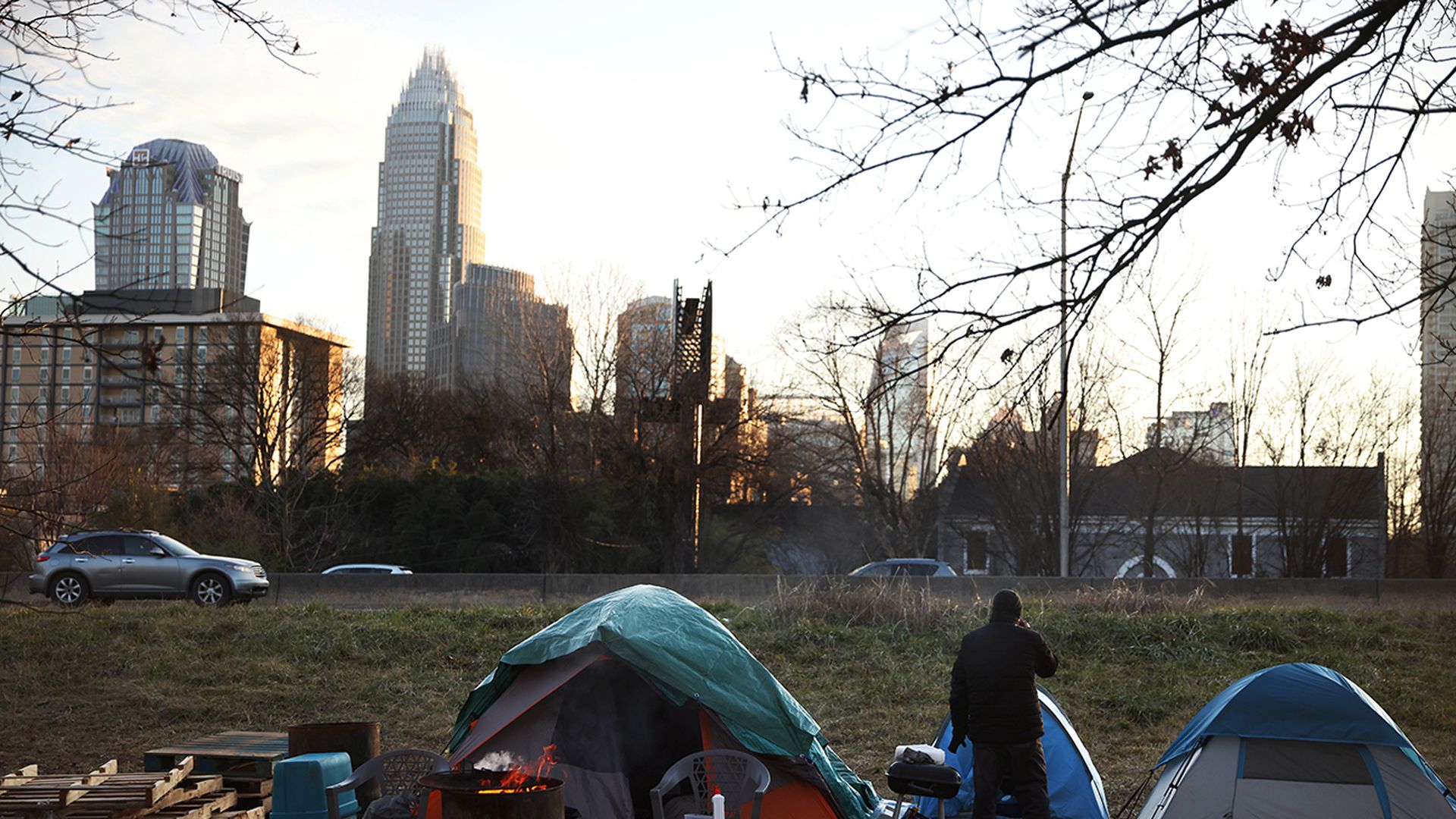
Photos: Travis Dove for Axios Charlotte
Editor’s note: This story was originally published on Jan. 26, 2022, and was updated June 9, 2022 with new information about the plan’s progress.
A sweeping effort to reduce homelessness in Mecklenburg County now has a nonprofit to run point: United Way of Central Carolinas.
- The organization will receive $788,000 from Mecklenburg County to staff up and carry out strategies that community leaders have been working on for more than a year.
- The Mecklenburg County and Charlotte Mecklenburg Housing and Homelessness Strategy Initiative made the announcement on Thursday, June 9, along with details of what they’re calling an Enduring Structure, which creates a visual for how organizations will work together.
Why it matters: More than 3,000 people experience homelessness, in both sheltered and unsheltered locations, each night in Charlotte-Mecklenburg, according to the most recent Charlotte-Mecklenburg housing data snapshot.
- That’s more than during the first year of the pandemic, when the encampment known as “Tent City” sprawled out along 12th Street near Uptown.
The big picture: Government agencies and nonprofit organizations have tried numerous strategies to address the issue over the past 20 years, but often the efforts have been disconnected. Officials say this is the closest they’ve been to creating a real structure for all organizations to work with — from organizations that provide transitional housing to those offering food and clothes to those helping with transportation and childcare.
- “It’s not just about providing homeless services or shelter. This strategy is much broader than that,” county manager Dena Diorio tells Axios. “It takes all the organizations in our community that can provide various support.”
Context: The CMHHS initiative began in April 2021 when 50 corporate and nonprofit leaders signed on.
- Over the next year, 250 people representing more than 115 organizations joined, including representatives from Atrium Health, Bank of America, Charlotte Center City Partners, Charlotte-Mecklenburg Continuum of Care, City of Charlotte and Mecklenburg County.
- In January 2022, they released “A Home for All: Charlotte-Mecklenburg’s Strategy to End and Prevent Homelessness.”
- The plan focuses on major objectives and ways to achieve them in nine areas: prevention, shelter, affordable housing, cross-sector support, policy, funding; data, communications and long-term strategy.
- Recommendations included:
- Center racial justice and equity.
- Invest in ways to help landlords take in people with challenging backgrounds.
- Explore campground shelters or other similar models to serve people with pets or resistant to traditional shelter models.
- Encourage hotel/motel acquisition strategies house people making 30-60% of the area’s median income.
- Expand access to public transit.
Now United Way will carry out that plan, under the county manager’s office and community support services.
What’s next: Diorio tells Axios that United Way is searching for a consultant to help guide implementation. And the organization will hire at least three new staff members.
- Going forward, Diorio says, the county will allocate housing and homelessness dollars to organizations whose work aligns with the initiative.
- “The strategies will be the guiding principles for how those dollars are invested,” Diorio says.
State of play: When CMHHS released its strategy outline in January, it said that more than 10,535 households were at high risk of eviction due to the pandemic, per UNC Charlotte Urban Institute.
- Over 5% of the population pays over 50% of their income for housing-related expenses.
- Nearly 4,000 Charlotte-Mecklenburg School students do not have a regular nighttime residence, which can lead to lower educational outcomes.
- Over 500 people experience chronic homeless in Mecklenburg County.
Here are three other key points from that January report, as Ashley reported at the time:
1. It aims to clearly differentiate between housing instability and homelessness.
Housing instability is defined as “living in overcrowded and/or substandard housing; difficulty paying rent or mortgage; experiencing frequent moves due to economic or affordability reasons; doubling up with family or friends; or living in hotels/motels.”
Homelessness is defined as “loss of housing. Homelessness can occur when a household lacks a fixed, regular, and adequate nighttime residence,” including staying with family and/or friends or other temporary shelters.
- Why this matters: The city’s government makes most of our local decisions on housing, while Mecklenburg County’s government leads homelessness response.
2. It changes the approach.
What makes this different from what has already been done? Collaboration.
Again, the county and city governments focus on different areas of housing instability. Nonprofits like Roof Above also play an outsize role. This plan aims to bring them all to the same place, so they’re not working in silos.
- “It’s not the first time that our community has had a plan. But this is the first time in our community that the public and private sector have come together to address the full continuum from housing instability and homelessness,” Courtney LaCaria, Housing and Homelessness Research Coordinator with Mecklenburg County, told Axios’ Danielle Chemtob. “Not just chronic homelessness, not just veteran homelessness, not just youth homelessness, not a piece of the puzzle but the whole puzzle itself.”
- “We put kind of upfront and center wanting to have the voice of people who had lived experience of housing instability and homelessness,” LaCaria said. “The solution has got to work for the folks who need it.”
3. It defines the affordable housing gap.
Voters approved an increase from $15 million to $50 million in the city’s biennial allocation of the Housing Trust Fund. Over $327 million in public-private funds have been committed to supporting affordable housing since the campaign began in 2018.
Yet affordable housing remains an issue, as does overall housing inventory in Charlotte.
- Units renting for less than $800 accounted for 22% of all units in Charlotte-Mecklenburg in 2019, a 23% drop from 2011.
- The report states there is a 23,000-unit gap in affordable housing units for extremely low-income households.
The bottom line: For years, Charlotte residents and leaders have talked about “fixing” homelessness in Charlotte, but Diorio says the goal here is to make it “rare, brief, and non-recurring.”
- “I don’t want to say we’re solving homelessness,” Diorio says. “It’s nice to know we have a structure and a strategy.”