How Paxton vs. Talarico compares to Cruz vs. O'Rourke

Add Axios as your preferred source to
see more of our stories on Google.
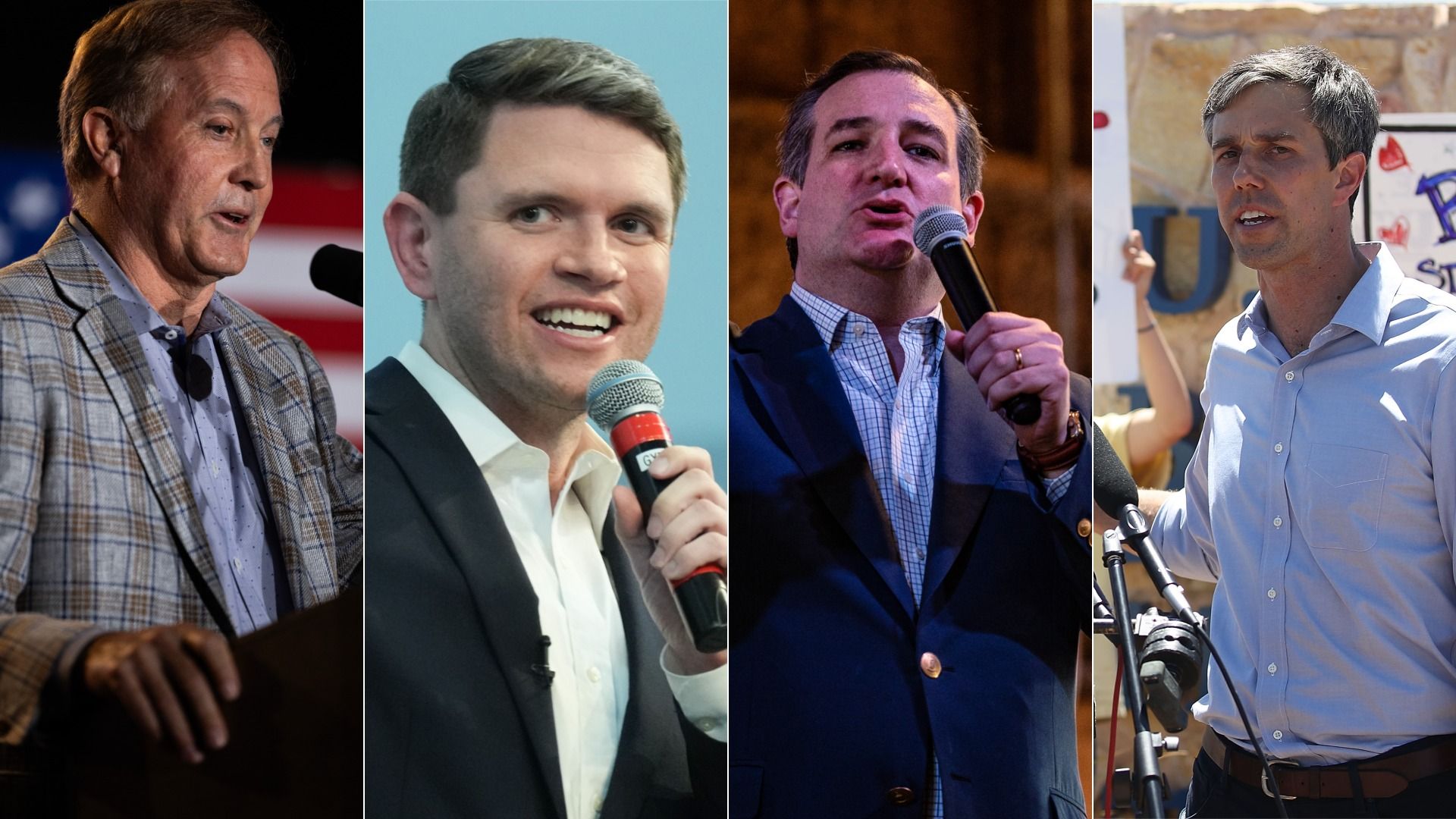
From left to right, Ken Paxton; James Talarico; Ted Cruz (in 2018); Beto O'Rourke (in 2018). Photos: Antranik Tavitian/Getty Images; Elizabeth Conley/Houston Chronicle via Getty Images; Sergio Flores/Bloomberg via Getty Images; Joe Raedle/Getty Images
With polls showing a tight U.S. Senate race between Democrat James Talarico and Republican Ken Paxton, we decided to see how this year matched up against 2018, the last time a Texas statewide election came down to the wire.
Why it matters: Democrat Beto O'Rourke lost that year to U.S. Sen. Ted Cruz by 2.6 percentage points, or about 215,000 votes, in a race that broke fundraising records and raised (and dashed) Democratic hopes of turning Texas blue.
The similarities
O'Rourke was running his first statewide campaign and was relatively unknown outside his hometown of El Paso, allowing him to introduce himself to most voters for the first time. Talarico, a state legislator from Austin, was relatively unknown outside of Central Texas before he launched his Senate bid.
Cruz first won election to the Senate as a tea party insurgent who defeated a better-funded, establishment-backed candidate in a primary runoff. Paxton, a three-term state attorney general, was endorsed by President Trump and won his Senate primary in a runoff against an establishment incumbent with far more campaign cash.
2018 was a Trump midterm year that saw energized Democrats eager to check presidential power. Ditto this year.
- In many ways, the U.S. Senate race — then and now — could essentially be viewed as a referendum on Trump.
- The president himself said "pretend that I'm on the ballot" at the GOP midterm convention in Dallas.
By the numbers: In October 2018, Trump had a 48% approval rating among respondents to a University of Texas/Texas Politics Project poll. 45% disapproved.
- In August 2026, 51% disagree with the job he's doing and 43% approve.
What they're saying: "In 2018, Trump was generally unpopular, but his handling of the economy was a strength," Nicholas Long, a St. Edward's University political science professor, tells Axios. "Today, it's a weakness. … This is a stiff headwind that Republican candidates weren't facing in 2018."
The differences
Campaign style: O'Rourke campaigned in every one of Texas' 254 counties, seeking to connect with voters even in deeply red areas.
- Talarico has also traveled widely, but his campaign is most closely associated with social media, which launched him to record fundraising heights.
- "While there was more excitement for Beto among Democrats in 2018 than for Talarico in 2026, Talarico may have a broader appeal to independents and especially leaning Republicans," Long says.
- And while Talarico polls well among Black voters, his primary opponent U.S. Rep. Jasmine Crockett (D-Dallas) hasn't campaigned for him. Billy Monroe, a political science professor at Prairie View A&M University, a historically Black institution, tells Axios: "I remember seeing the students at PVAMU being very enthusiastic about Beto in 2018, and I have not seen that this time around."
The other side: Cruz, who was an incumbent in 2018 and is much more comfortable on the stump than Paxton, told the "Texas Take" podcast that he barnstormed in 2018 — and implied that Paxton had not yet done so. (Paxton spent the Fourth of July in England.)
- "We drove turnout, ringing the bell, in particular going into deep East Texas, West Texas, the Panhandle, the Valley — [for] a lot of rural Texans, who historically don't show up in a midterm," Cruz told podcast host Jeremy Wallace, "saying, 'If you don't show up, Texas is going to go blue.' … Similarly in 2026, that's the job Ken Paxton needs to do."
- But Paxton campaign spokesperson Madison Cercy tells Axios, "Attorney General Paxton has been doing exactly that … meeting Texans from every corner of our great state."
Scandals: Paxton was impeached by the Republican-dominated Texas House (and then acquitted by the Texas Senate).
- He was the subject of a federal corruption investigation, faced state securities fraud charges and the State Bar of Texas sought to sanction him for his attempt to overturn the results of the 2020 presidential election. The federal investigation ended without charges, prosecutors dropped the securities fraud case after Paxton agreed to pay nearly $300,000 in restitution, and the State Bar dropped its lawsuit against him.
- Paxton's wife, Republican state Sen. Angela Paxton, accused him of adultery and filed for divorce last year.
- Cruz had avoided scandal.
Demographics: The Texas Demographic Center pegs the state population at 32 million people — up from the 28.6 million in 2018.
- 15.25 million Texans were registered to vote in the March 2018 primary.
- 18.68 million Texans were registered to vote in the March 2026 primary. (The registration deadline for this year's general election is Oct. 5.)
Stunning stat: Republicans enjoyed a huge advantage in the sheer number of voters in the March 2018 primary ahead of the November election. This year, Democrats have an advantage.
- 1.5 million Texans voted in the GOP U.S. Senate primary in March 2018, and 1 million cast ballots in the Democratic U.S. Senate primary that year.
- 2.32 million Texans voted in the Democratic U.S. Senate primary this year, and 2.16 million cast votes in the Republican U.S. Senate primary.
What we're watching: The turnout and direction of the Latino vote.
- Talarico notched big victories among Latinos in the March primary, and they would be key to a winning coalition should he prevail in November.
- The Texas Latino vote nearly went for Trump in 2024, but in the wake of immigration crackdowns and a turbulent economy, that bloc of voters appears to be shifting back toward Democrats.