UT researchers develop sensitive robot hands

Add Axios as your preferred source to
see more of our stories on Google.
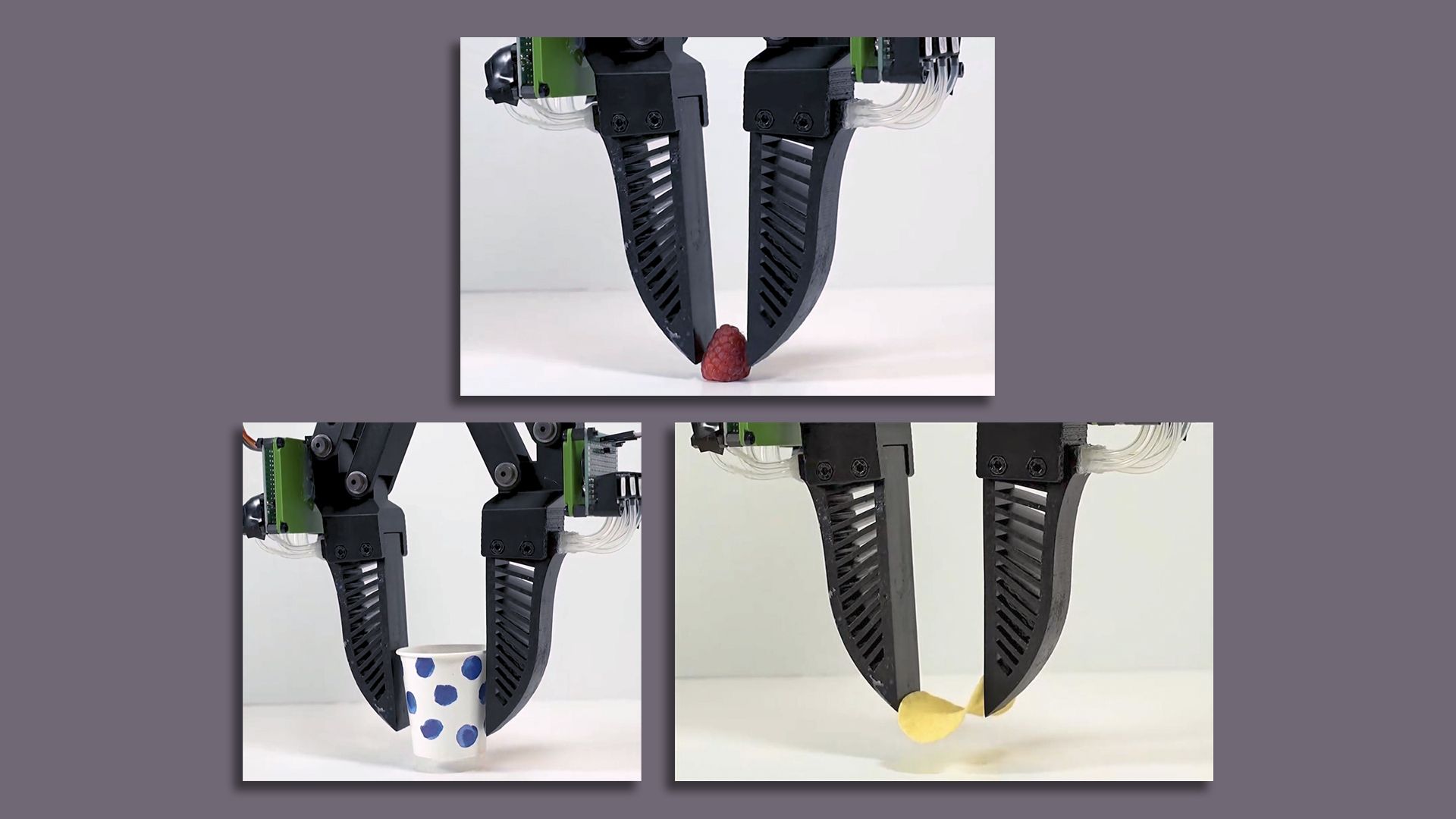
A robot handles a raspberry, a cup and a potato chip. Photos: Courtesy of University of Texas at Austin
A new type of robotic hand developed at the University of Texas can grasp objects as fragile as a potato chip or a raspberry without crushing them.
Why it matters: The technology could bring robots closer to imitating the sensitive touch of humans, with implications for manufacturing and health care.
- And very few robotic gripping technologies have the sort of slip detection this one deploys, the researchers note in a new paper published in the journal IEEE Robotics and Automation Letters.
The big picture: Fine-tuning robot touch has big money implications as major firms invest in humanoids.
- Elon Musk said he expects Tesla to begin selling its Optimus humanoid to the public by the end of 2027. "Everyone on Earth is going to have one and want one," he said in January.
- Lillian Chin, an assistant professor of electrical and computer engineering at UT and one of the lead researchers on this project, tells Axios the technology is the basis for an upcoming $750,000 grant from the Toyota Research Institute, which she said is "explicitly interested in adapting this technology to humanoid fingers."
How it works: The robot fingers are equipped with sensors that can detect air pressure changes and provide real-time force feedback to let the robot know whether the object it's holding is slipping.
- The researchers tested the grippers on 31 objects, including fragile items such as raspberries and potato chips, slippery ones such as jam jars and billiard balls and everyday items such as soup cans and apples. Also — a marshmallow.
- "We had to run the experiments with the raspberries quickly to make sure they didn't go moldy," Chin tells Axios.
What they're saying: Robots have long lacked the sensitivity of human touch, Chin says. "You can run your hand across a counter, feel a piece of paper," she said of human beings.
- "Humans pick up objects with just the right amount of force; too much and you'll crush it, but too little and it'll slip out of your hand," Chin said in a news release. "Most current force sensors aren't fast or accurate enough to provide that Goldilocks level of detail."
The researchers say some robots can fold a shirt but generally struggle with fine, delicate movements, like unpacking fruit from groceries.
- "We believe sensing signals will give robots a sense of touch to handle these objects carefully," Siqi Shang, a doctoral student at UT's Cockrell School of Engineering and the paper's lead author, said in the news release.
The intrigue: The researchers have publicly released the hardware designs and algorithms behind the construction of the robot hands to encourage other scientists and engineers to build upon their work.
What's next: The researchers want to make the sensors less sensitive to temperature changes and improve the robot's hands' ability to catch objects that are slipping.