Where new Austinites come from

Add Axios as your preferred source to
see more of our stories on Google.
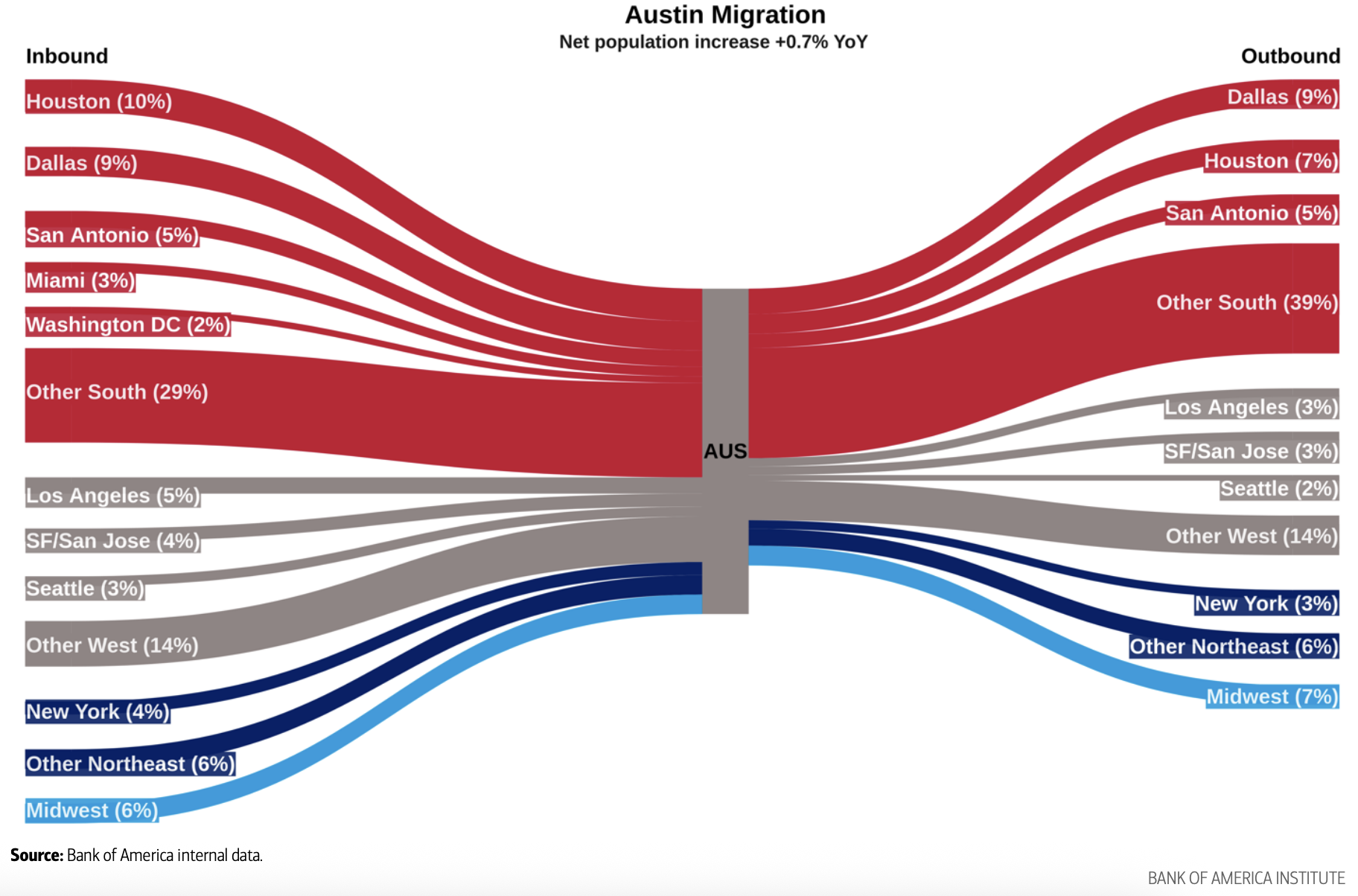
In 2025, nearly 1 in 4 of Austin's new residents came from other major metros in the Lone Star State, per a recent analysis of urban migration from Bank of America.
Why it matters: The analysis, based on private banking data of 45 million customers, provides a comprehensive snapshot of migration trends in our city.
Zoom in: A third of Austin's new residents came from elsewhere in the South, with some notable inflows from Miami and Washington, D.C.
- About 25% came from the West, especially Los Angeles, the Bay Area and Seattle.
How it works: The analysis was based on internal Bank of America data — the bank didn't share raw numbers with Axios — based on checking and savings account and credit card information and changes in customer home addresses.
What they're saying: "In our view, Austin is likely a target locale for people looking for a growing city that retains a small town feel with comparatively less expensive housing," the report, chiefly authored by Bank of America Institute economist Joe Wadford, says.
- The institute acts as a think tank within the bank, analyzing trends and offering insights.
Between the lines: The "unusual equilibrium" to Austin's migration — with nearly equal numbers coming and leaving the city — suggests that many new Austin residents could soon head to another city to fit their personal lives, budgets or job opportunities, the authors write.
- A significant share of outflows went to smaller cities in the South — suggesting "that even Austin isn't immune to people leaving to seek more affordable locations."
- But "the South" is a catchall term, Wadford tells Axios, and much of that migration is to smaller cities orbiting Austin, such as Kyle, Buda or New Braunfels, where they seek cheaper housing.
The intrigue: "Additionally, while Austin may have once served as an exit plan for tech workers coming from LA, San Francisco/San Jose, and Seattle — it appears traffic now runs both ways, possibly as the city has matured into a peer rather than just an escape," the authors write.
- "Austin is now supplying (tech) talent nationally," Wadford tells Axios. "That's a cool thing."
Reality check: In the early post-pandemic period, more people moved out of Travis County than in, per U.S. Census data.
- Austin Realtor Lilly Rockwell, on her Texit site, which helps clients relocate, has pointed to the "unrelenting heat, the state politics, the rising costs" as reasons her clients aim to leave the state.
Zoom out: Denver, Austin, and Philadelphia have been seeing some of the nation's largest population increases in absolute terms, but momentum slowed in the fourth quarter of 2025, per the Bank of America analysis.
- Denver has been drawing in people from the Sunbelt and Philadelphia from New York, as Americans make decisions based on affordability and climate, according to the analysis.
What's next: After double-digit rent increases during the pandemic, rent in Austin decreased year-over-year by 5% as of October, Wadford tells Axios.
- "Easing affordability is going to be fuel for the fire for people moving to Austin," he tells Axios, "contingent on whether the labor market holds up."