Scoop: Texas super computing center in jeopardy

Add Axios as your preferred source to
see more of our stories on Google.
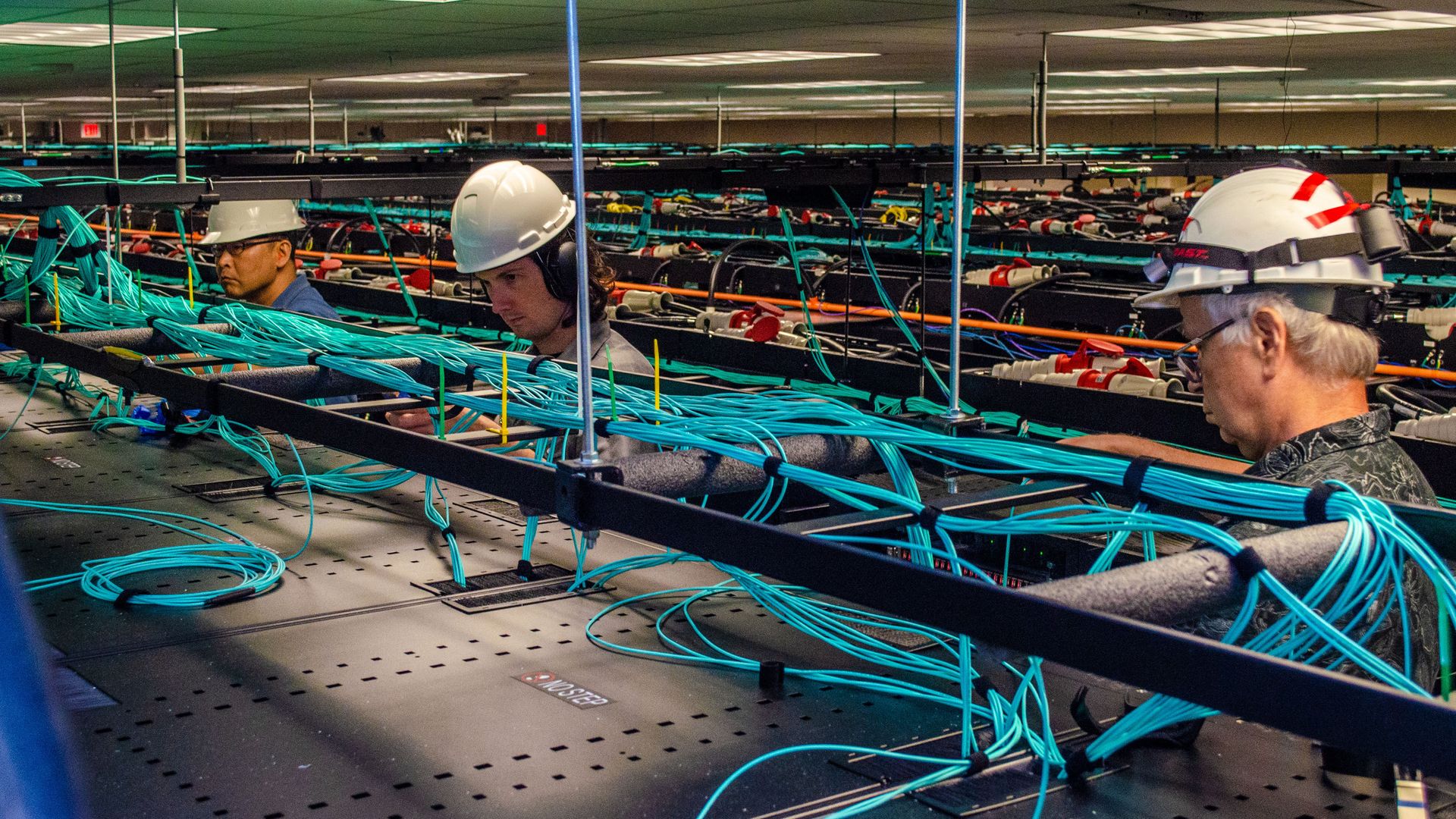
Workers tending to one of Texas' current supercomputers. Photo: Courtesy of Texas Advanced Computing Center
The fate of a planned University of Texas supercomputing center is now in limbo following the Trump administration's plan to cut National Science Foundation money, Axios has learned.
Why it matters: Supercomputers are key to medical research, weather modeling, advancements in artificial intelligence and for solving any number of scientific and engineering problems.
- UT researchers have used the university's existing supercomputers to model the coronavirus in the early stages of the pandemic, confirm the existence of gravitational waves and increase the speed and accuracy of storm surge forecasts in hurricanes.
Zoom in: Last year, UT won a four-year, $457 million grant from the National Science Foundation (NSF) to underwrite the construction of a new computing center — known as a leadership-class computing facility.
- The facility was to begin operations next year, powered by computers with 10 times the performance power for simulations of current best-in-class supercomputers — and 100 times the power for artificial intelligence applications.
Flashback: "This facility will provide the computational resources necessary to address some of the most pressing challenges of our time, enabling researchers to push the boundaries of what is possible," then-NSF Director Sethuraman Panchanathan said in 2024.
- At least $50 million has already been poured into the facility, now under construction in Round Rock, not far from Dell's headquarters.
Catch up quick: President Trump's proposed FY 2026 budget massively slashes funding for key science and tech agencies, including a $4.9 billion cut for the NSF, or a 56% decrease.
- The Trump administration says its cuts to science agencies are aimed at waste and inefficiency and are necessary for tackling the nation's debt.
What they're saying: The facility "could potentially just stay a shell," Dan Stanzione, executive director of the Texas Advanced Computing Center, tells Axios.
- While the NSF has funneled nearly $100 million to the project this fiscal year — which ends Sept. 30 — the next fiscal year "is filled with uncertainties," Stanzione says.
- "It makes it very difficult to execute an efficient project when you have to tell your vendors, 'Hey, we may or may not be able to pay for the stuff that we're ordering.'"
The big picture: Research performed on the planned computers is key for advances in science, medicine and engineering.
- Eliminating funding for the computing center "cuts off our supply of PhD students," Stanzione says. "Ten years from now, it's devastating — and we may pay for it for 50 years or 100 years. Because you just can't forecast where some of the basic research will eventually be applied."
The intrigue: Thirteen universities have filed a lawsuit seeking to stop the Trump administration from carrying out cuts to federal research funding provided to academic institutions by the NSF.
- UT is not among the plaintiffs.
The bottom line: Stanzione says he's worried about the almost 200 people working at the Texas Advanced Computing Center.
- "None of these cuts actually touch the drivers of the deficit ... The deficit will continue to climb despite all the damage they inflict."