How UT's president has endured campus unrest

Add Axios as your preferred source to
see more of our stories on Google.
Illustration: Axios Visuals
Even as university presidents, under political pressure, have resigned their posts over their handling of protests over the Israel-Hamas war, the chief of the University of Texas remains in as strong a position as ever.
Why it matters: The durability of UT president Jay Hartzell speaks to the long-standing political relationship between the Texas Capitol and the UT tower.
Driving the news: Columbia University's president resigned Wednesday, the third Ivy League president to do so amid criticism of their management of student protests.
- As students return to colleges across the country, administrators are preparing for a resurgence in activism over the war, which continues.
Flashback: More than 130 people were arrested over two pro-Palestinian protests at UT in April, as Hartzell called in state troopers, drawing outrage from students and faculty.
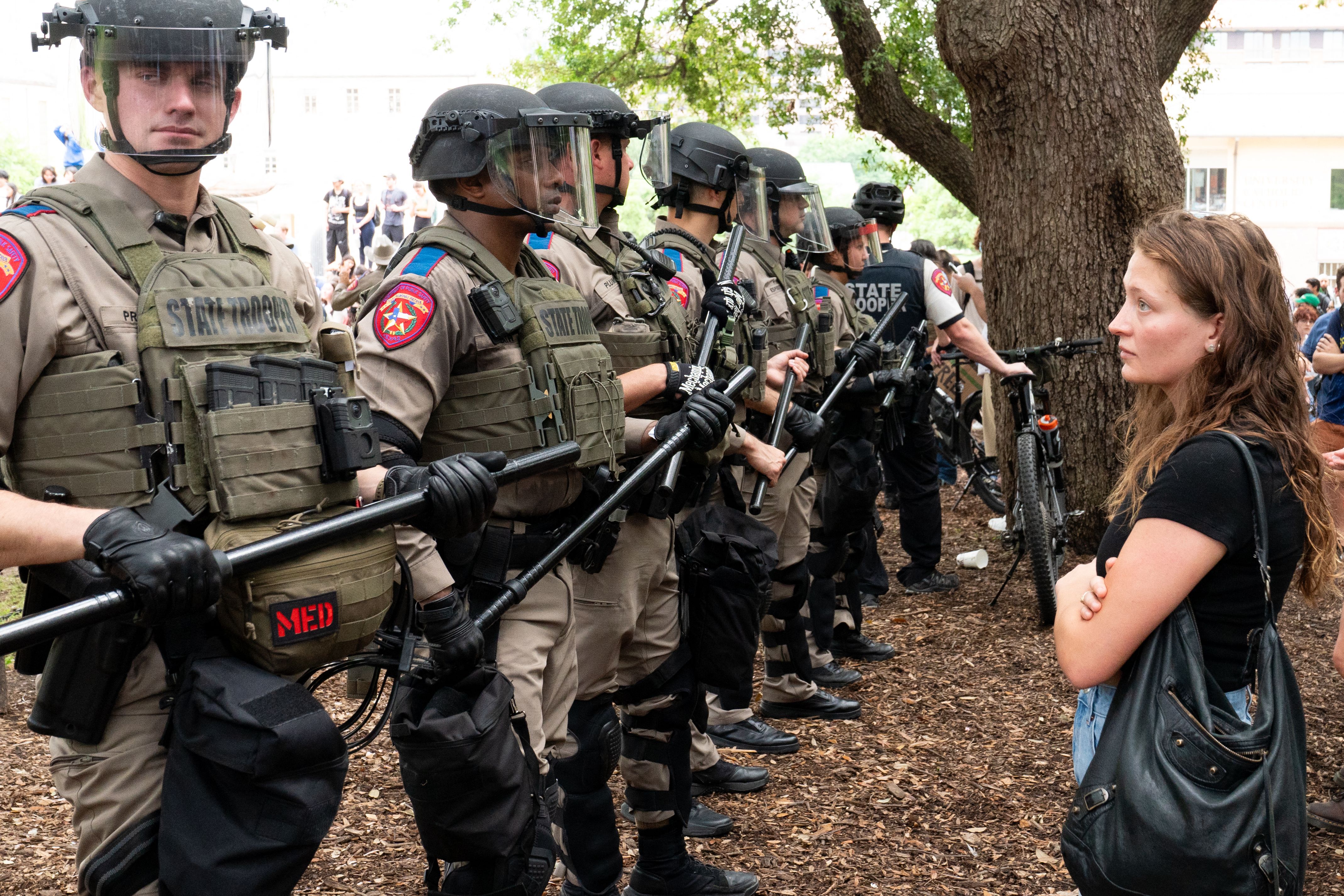
- More than 600 faculty members signed a letter of no-confidence in Hartzell, accusing him of having "needlessly put students, staff and faculty in danger" by calling law enforcement to campus and said he "has violated our trust."
- A Muslim advocacy group sued Gov. Greg Abbott and university leaders over the arrests.
Yes, but: Hartzell won support from lawmakers — who control the purse strings at the public university — as well as the key donors and UT System Board of Regents, which rejected protesters' demands for the university to divest from companies doing business in Israel.
- Gov. Greg Abbott applauded the arrests. He had directed university presidents in March to stiffen penalties for antisemitic speech.
What they're saying: "While some of the University of Texas faculty have declared their lack of confidence in you, let us offer our perspective: We have no confidence in them," read a letter to Hartzell signed by about 50 Texas House Republicans.
- "The Texas House is putting all state-funded university professors on notice: return to the original purpose of higher education or find another state to employ you," House Republican Cody Harris, who represents parts of East Texas, wrote on X at the time.
Zoom in: By late May, with classes wrapped up and students heading home, things had calmed enough on campus that commencement went smoothly, with the university choosing to beef up security guidelines issued to the public, per records obtained by Axios.
Hartzell did not respond to an interview request with Axios.
- In a text in late April to state Sen. Sarah Eckhardt, D-Austin, he explained that protesters "indicated their desire to mimic what happened at Columbia and elsewhere, which we are doing our best to avoid for obvious reasons. Our police force couldn't handle it alone," per reporting by the Austin American-Statesman.
Catch up quick: Over the summer, UT administrators offered academic probation to students arrested at the protests and suspended at least one student, per KUT.
- Meanwhile, Travis County prosecutors dismissed criminal trespass arrests against 79 protestors arrested at the April 29 protest. They previously dropped charges against 46 people arrested at the April 24 protest, saying the cases lacked sufficient probable cause.
- The university said in a statement it was "deeply disappointed" by the dismissals, adding that the school "will continue to use the law enforcement and administrative tools at our disposal to maintain safety and operational continuity for our 53,000 students who come to campus to learn, regardless of whether the criminal justice system shares this commitment," per the AP.
Between the lines: Texas has, for the moment, pivoted to the perennial preoccupation as fall approaches — football — with its big entrance to the SEC.
- Axios asked the Palestine Solidarity Committee at UT for an interview about if and how its strategy and goals are set to change this fall but did not get a response.
What's next: UT starts classes Aug. 26.