Why Israel divestment demands are likely to fail in Texas

Add Axios as your preferred source to
see more of our stories on Google.
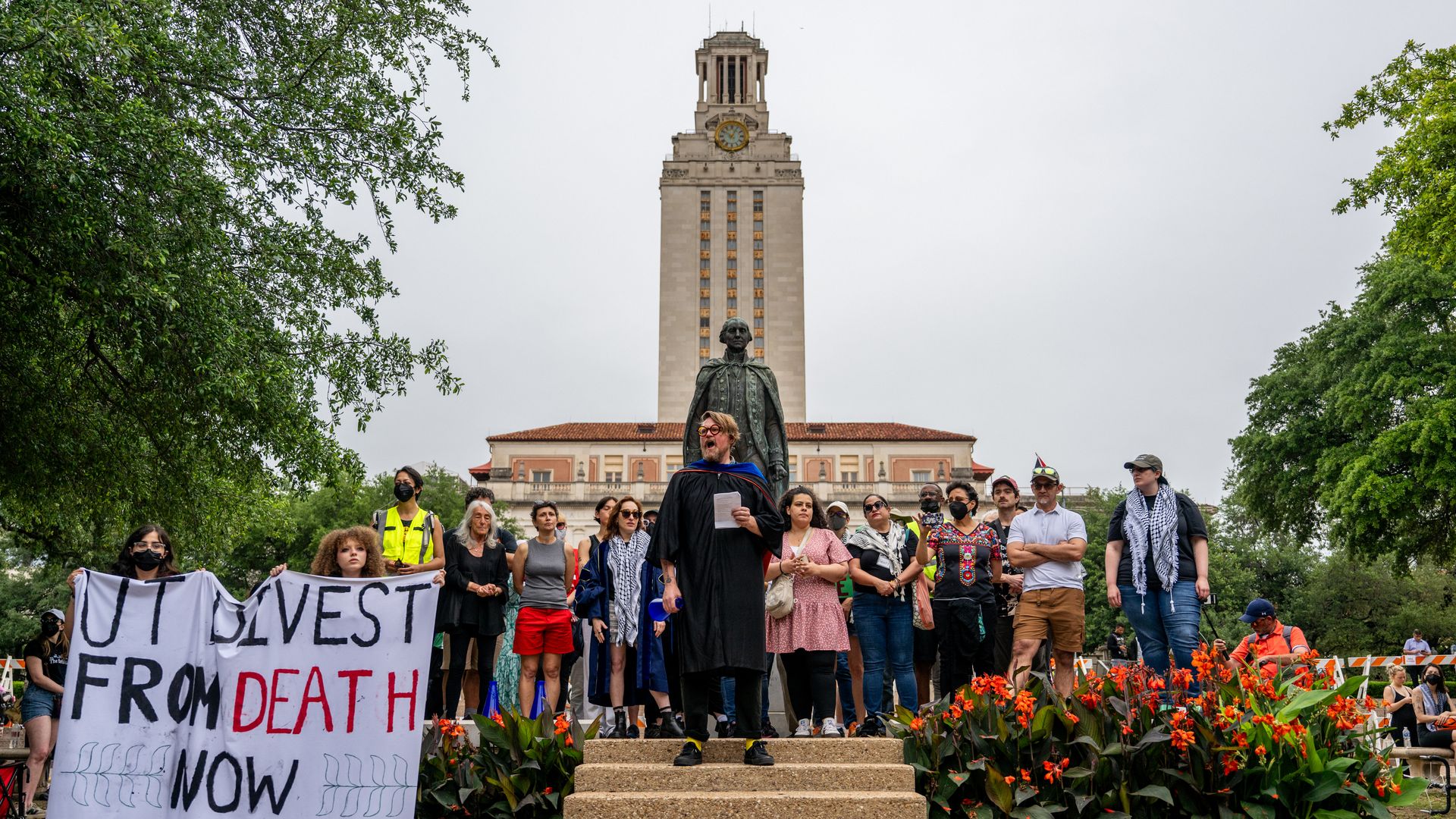
University of Texas professor Craig Campbell speaks at a demonstration this month calling on the university to divest from Israel. Photo: Brandon Bell/Getty Images
Pro-Palestinian protesters on the University of Texas campus have made a specific request of university officials that's very unlikely to be entertained — divest from weapons manufacturing companies selling arms to the Israeli military.
Why it matters: Apart from whether divestment makes sense as a fiduciary or moral matter, the university's unwillingness to bend on its portfolio is overdetermined by state politics.
- UT is a public institution overseen by a board of regents appointed by Gov. Greg Abbott and confirmed by state senators.
The big picture: Protests at UT and campuses across the country have sought to use divestment as a tool to put pressure on Israel, whose assault on Hamas has killed tens of thousands of Palestinians, including many civilians.
- Israel is responding to the Oct. 7 Hamas attack that killed some 1,200 people and during which around 240 were taken hostage.
Dig in: The UT System's investments are handled by the nonprofit University of Texas/Texas A&M Investment Management Company (UTIMCO).
- The not-for-profit corporation's governing board is dominated by the UT System Board of Regents.
State of play: UTIMCO manages $74.6 billion in assets for the UT and Texas A&M systems. Among the investments are companies that produce weapons and ammunition that go to Israel, per a list compiled by the Quaker organization American Friends Service Committee. They include:
- Northrop Corp., with UT shares valued at roughly $1.4 million, per UTIMCO's annual audit report.
- Lockheed Martin Corp., with UT shares valued at almost $1 million.
- RTX (formerly Raytheon), with UT shares valued at nearly $600,000.
- General Dynamics Corp, with UT shares valued at about $500,000.
What they're saying: "These companies are not only profiting from the genocide of Palestinians but are directly responsible," according to a "University of Texas at Austin Student Statement of Solidarity with Palestine" that has been signed by dozens of organizations.
The other side: "This will NEVER happen," Abbott wrote on X about the protesters' divestment demand.
- Abbott's office declined an Axios interview request. A spokesperson for the UT System did not respond to an interview request about UTIMCO.
- A Washington Post analysis of nationwide university investments in Israel found that UTIMCO had little direct exposure to Israel — save an investment of $4 million to $8 million in a Tel Aviv-based venture capital fund run by TLV Partners.
Between the lines: "Colleges and universities have long been a target of Republican lawmakers due to the perception of liberal biases among faculty, staff, and students," Joshua Blank, research director of the Texas Politics Project at UT, tells Axios.
- "Given that Republican voters are unlikely to be reacting positively to the protests taking place on college campuses … the governor is likely operating in a safe space among his partisans."
Catch up quick: A 2019 law bars the state's public agencies — including UT — from entering into contracts worth $100,000 or more with companies with 10 or more full-time employees that boycott Israel.
Behind the scenes: When Abbott signed an initial version of the law barring public contractors from boycotting Israel, a major Texas trading partner, he said "anti-Israel policies are anti-Texan policies."
- In 2016, Lt. Gov. Dan Patrick was baptized in the Jordan River while visiting Israel.
- Abbott journeyed to the Middle East in November to show his support for Israel.
Flashback: In the 1980s, UT officials shrugged off calls by students to divest from companies with holdings in apartheid South Africa.
- Former UT president William Cunningham told KUT that such a move could have cost the university roughly $30 million.
- He added that "over time … the corporations that we had invested in had largely begun to pull out … and I think it's a result of what happened at UT Austin and all the other schools around the country."
Zoom out: As of this year, at least 38 states have passed bills and executive orders aimed at discouraging boycotts of Israel, per the American-Israeli Cooperative Enterprise, which describes the boycotts as antisemitic.
What's next: Expect Texas' top policymakers to tighten their embrace of Israel as campus protests continue.