What the end of affirmative action means for Texas

Add Axios as your preferred source to
see more of our stories on Google.
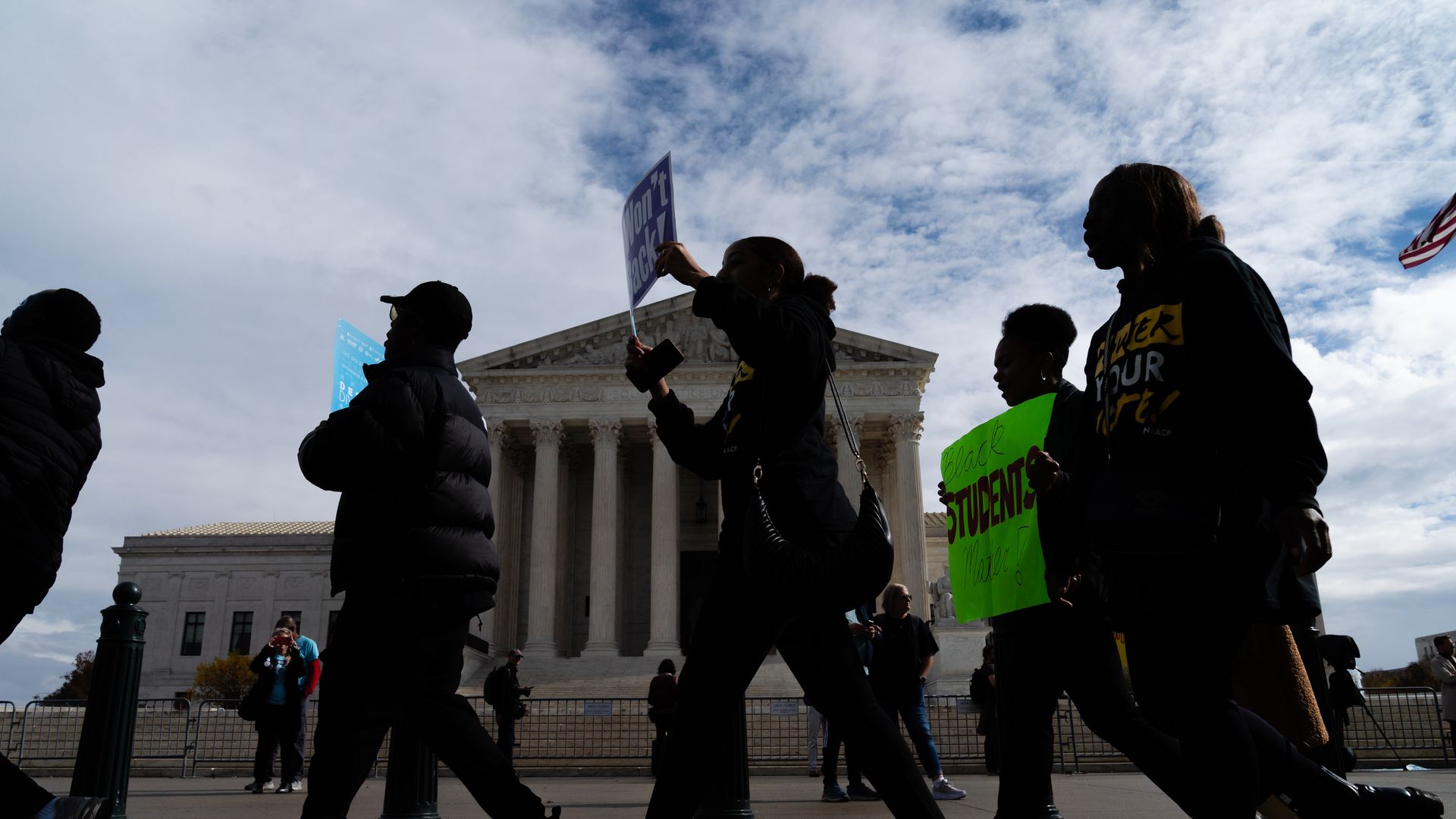
Supporters march during a rally in support of affirmative action policies outside the Supreme Court on Oct. 31, 2022. Photo: Eric Lee for The Washington Post via Getty Image
The Supreme Court's ruling Thursday barring affirmative action in college admissions upended processes at the University of Texas and private universities across the state.
Why it matters: The court ruled that colleges can't explicitly consider applicants' race in admissions, forcing colleges to reimagine long-standing hallmarks of the admissions process and likely jeopardize the representation of Black and Latino students on campuses nationwide, Axios' Erin Doherty and April Rubin report.
Zoom in: The University of Texas at Austin is the only public university in the state that uses affirmative action in undergraduate admissions, where many applicants to the state's flagship university receive a so-called holistic review.
- Private schools like Rice University in Houston and Southern Methodist University in Dallas also consider race in their admission process.
Yes, but: State law guarantees admission to all state universities for students who graduate in the top 10% of their Texas high-school class.
- By guaranteeing admission to students from all parts of the state, including from high schools that are chiefly Black or Latino, proponents of the law say it has helped increase geographic and racial diversity in the admissions process.
- The rule is now limited to the top 6% at UT Austin because of the large number of applicants.
What they're saying: In a statement Thursday, UT officials said the university will "make the necessary adjustments to comply with the most recent changes to the law" and "remains committed to offering an exceptional education to students from all backgrounds."
The big picture: The court has historically backed affirmative action programs at colleges, including in 2016 when the Supreme Court rejected a challenge to a race-conscious admissions program at UT.
- Some colleges have already had to scrap their affirmative action programs, including the University of Michigan, where Black undergraduate enrollment dropped precipitously after a state ban.
- “Since the Supreme Court’s 2016 ruling in Fisher v. University of Texas, (UT) has continued to recruit and enroll consistently stronger classes composed of students from diverse backgrounds and perspectives, and improved graduation rates among all students, especially those who are underrepresented or first-generation," UT said in a statement. "While doing so, the University has lawfully been considering race among many factors as part of its comprehensive and holistic admissions process."
Meanwhile: Texas' public colleges are in the process of evaluating their diversity, equity and inclusion programming to comply with a newly signed state law banning DEI offices on their campuses.
- That law goes into effect Jan. 1.
By the numbers: UT's 52,384 undergraduate and graduate students in the fall were 34.6% white, 24.8% Hispanic, 21.1% Asian and 5.3% Black.
What to watch: How the shift changes UT and other Texas schools' demographics.
Dig deeper: What the ruling means for HBCUs