Tuesday's health stories


Health care stocks rocked by proposed Medicare Advantage rates


Health care stocks plummeted Tuesday after the Trump administration proposed keeping federal payments to private Medicare plans roughly flat in 2027 — far below what insurers had expected.
Why it matters: The proposal threatens revenue and margins in a core profit engine for major health insurers — and signals tough policy headwinds for the industry ahead.

Fear of ICE is driving patients away from medical care

The escalation of ICE activity in Minnesota is disrupting care at hospitals and clinics that already were navigating shifting legal standards on immigration enforcement in their facilities.
Why it matters: Health workers say many patients aren't coming in for necessary care out of fear they'll be detained by federal agents.
- "This has become a public health crisis," Janell Johnson Thiele, a nurse and union leader at Hennepin County Medical Center in Minneapolis, told Axios.
Doctors offer rival childhood vaccine schedule to Trump administration's
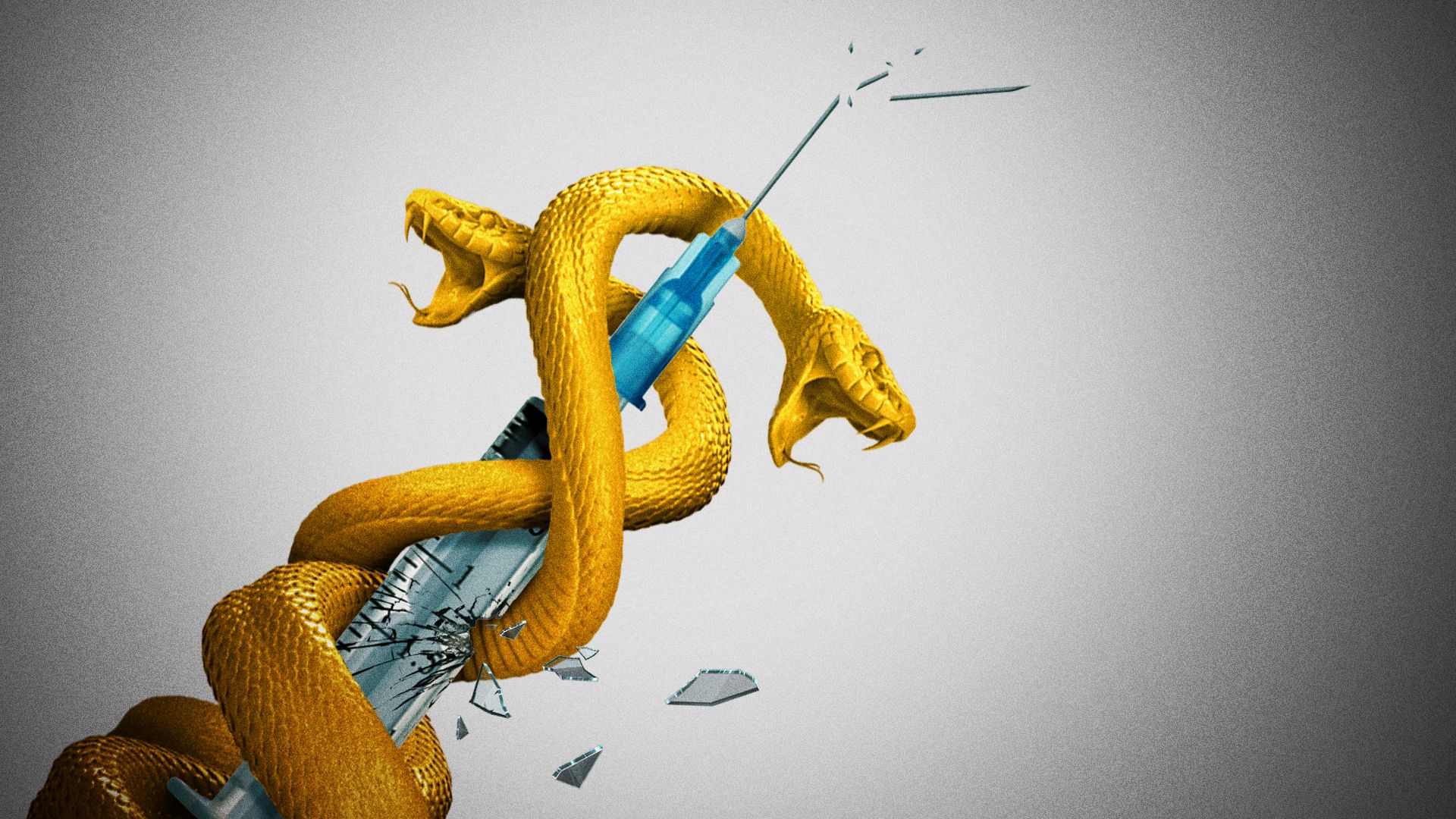
The medical association representing pediatricians broke with the Centers for Disease Control on childhood immunizations Monday, issuing revised recommendations against 18 diseases that contrast with the Trump administration's recently slimmed-down vaccine schedule.
Why it matters: The American Academy of Pediatrics' guidance is largely unchanged from 2025 but reflects the deepening rift between the federal government and medical establishment over inoculating kids.
- A dozen medical and health care organizations endorsed the group's recommendations.
What's inside: The pediatricians' schedule continues broad endorsements of vaccines targeting RSV, hepatitis A and B, rotavirus, influenza, meningococcal disease, measles and pertussis.
- It also stresses the importance of measles vaccines in light of recent outbreaks, noting more than 2,200 measles cases and three associated deaths in the past year.
What they're saying: "It is important that we have a stable, trusted, evidence-based immunization schedule to follow," said Pia Pannaraj, a member of the AAP Committee on Infectious Diseases and a professor of pediatrics at the University of California San Diego.
The other side: A Department of Health and Human Services spokesperson said: "AAP is angry that CDC eliminated corporate influence in vaccine recommendations by reconstituting the Advisory Committee on Immunization Practices."
- "The updated CDC childhood schedule continues to protect children against serious diseases while aligning U.S. guidance with international norms," the spokesperson said.
The Trump administration early this month dramatically overhauled the federal childhood vaccination schedule, cutting the number of recommended shots to 11 to reflect what it called "consensus among peer nations."
- CDC now recommends that parents consult with physicians before vaccinating children for rotavirus, COVID-19, influenza, meningococcal disease, hepatitis A and hepatitis B.
- It continued to recommend that all children be vaccinated against diphtheria, tetanus, whooping cough, influenza type B, pneumonia, polio, measles, mumps and rubella, as well as human papillomavirus and chickenpox, or varicella.
The AAP has sparred with the administration before, joining a lawsuit last July challenging Health Secretary Robert F. Kennedy Jr.'s changes to COVID-19 vaccine policy and his decision to replace the CDC's vaccine advisors.

Axios House: Trust presents the biggest challenge in health care AI, industry leaders say

DAVOS, Switzerland — Leaders in the health care and tech space said transparency, feedback and narrative play a crucial role in building provider and patient trust in AI, during a Jan. 20 Axios event.
Why it matters: Health care AI has the potential to help improve patient outcomes and lower the risk of physician burnout.
Axios' Courtenay Brown moderated the Expert Voices conversation, which was sponsored by Philips.
What they're saying: Trust in health care AI is particularly low, said Vanessa Parli, managing director of programs and external engagement at the Stanford Institute for Human-Centered AI (HAI).
- Using the word "productivity" about AI can be a deterrent to providers because it may imply less time seeing patients, according to Eric Cioè Peña, Northwell Health vice president and the founding director of its Center for Global Health.
- "Trust is a narrative problem first, and a technology problem second," added Hugh Taggart, CEO of Weber Shandwick's EMEA region.
By the numbers: A survey from Philips found a gap between providers (63%) and patients (48%) when it came to optimism about AI improving patient outcomes.
Yes, but: Keeping humans in the loop has been key to successful implementation strategies at Mayo Clinic, said Matthew Callstrom, physician lead of AI and strategy at Mayo Clinic.
- "When you start to explain to patients how we're using AI, they're like, put me in," Callstrom said.
- This has helped on the provider side as well, he said. For instance, a volunteer innovation team at Mayo built and tested an AI-driven handoff tool for the transition between nurse shifts. It has since been adopted by 75% of the nurses, generating hundreds of thousands of summaries.
What's next: The industry should "think about it in terms of what we know, from research, drives trust: accountability [and] transparency," American Psychological Association CEO Arthur Evans said.
- Anthropic's Claude for Healthcare is "building connectors to key data sources that we know are trusted, like the CMS coverage database or the National Provider identification registry," said Elizabeth Kelly, head of beneficial deployments.
- "The systems should be very forthcoming with what they will not do," Peloton CTO Francis Shanahan said.
- "You need to design [the technology] in a way so that the consumer understands what the implications of the technology are," Parli added.
Content from the sponsor's remarks:
"Three out of every four patients say they wait over two months for specialty care," Philips chief innovation officer Shez Partovi said. "Of those, a third of them — while they're waiting — end up in a hospital."
- "We're putting AI into everything … from toothbrushes to MRI scanners and angio equipment, because it actually helps automate the procedure and … improve access."
The health care hiring boom is losing steam

The health care job growth that's powered the labor market since the COVID pandemic is stalling out.
Why it matters: Republican cuts to federal health programs, AI automation and rising costs are making health systems and other employers level off hiring — including for jobs requiring a professional license like nurses or physical therapists.