How Christian and nonreligious voters plan to vote in the midterms: Poll

Add Axios as your preferred source to
see more of our stories on Google.
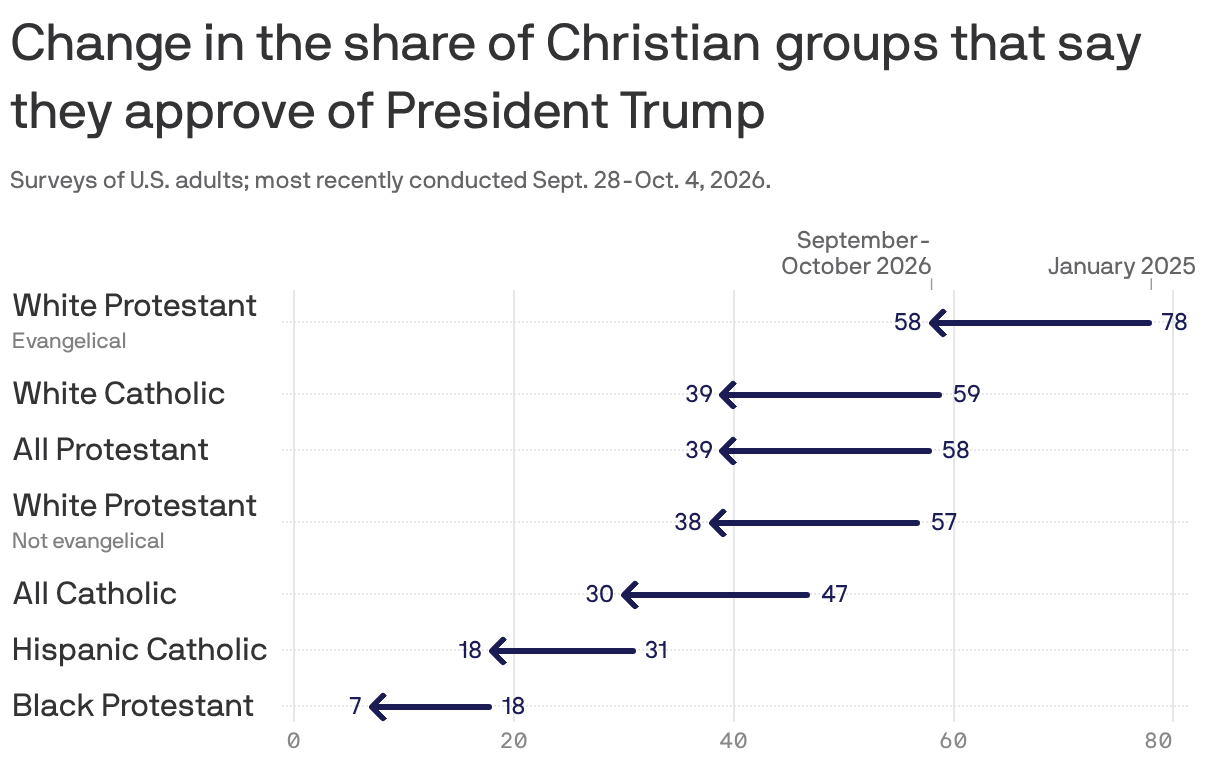
White evangelical Protestants and white Catholics favor Republican House candidates, while other Christian and nonreligious groups are more divided or favor Democrats, recent Pew Research Center polling finds.
The big picture: President Trump's approval has fallen sharply among white evangelical Protestants and white Catholics, even as both groups continue to favor Republican House candidates.
By the numbers: White evangelical Protestants remain staunch GOP supporters, with 73% saying they'd vote for the Republican House candidate in their district.
- Half of white Catholics say they'd vote for the Republican if the election were today, while 32% would back the Democrat — and 18% say they'd pick another candidate or are not sure.
- Other groups are more divided. White nonevangelical Protestants are split 45% to 37% between Republicans and Democrats, a gap Pew says is not statistically significant.
- Black Protestants, Hispanic Catholics, atheists, agnostics and those who describe their religion as "nothing in particular" are far more supportive of Democrats.
Between the lines: The midterms are often seen as a referendum on the party in power, making Trump's declining approval among religious groups particularly relevant.
- Trump's approval fell 20 percentage points among both white evangelical Protestants and white Catholics between January 2025 and the September–October poll — from 78% to 58% and from 59% to 39%, respectively.
- White evangelical Protestants are the only religious group surveyed in which more people still approve than disapprove of Trump's job performance.
What they're saying: White House spokesperson Taylor Rogers defended Trump's record on religious freedom, citing his pardons of anti-abortion rights activists and actions on parental rights and transgender health care, while accusing Democrats of undermining Christians' religious freedoms.
- "There has never been a greater president for Christian Americans than President Trump, and his strong record proves it," Rogers said in a Tuesday email.
Context: The White House has championed Trump as the "most pro-faith" president, but he's also found himself at odds with some religious leaders, including Pope Leo XIV, over key issue areas like immigration, foreign policy and technological development.
- Trump won a majority of Catholic voters in 2024, per Pew's post-election analysis, taking 55% to former Vice President Kamala Harris' 43%.
- Catholics appear split in Pew's midterm polling: 42% say they'd choose the Democratic candidate, while 39% would go for the Republican.
State of play: While turning out white evangelicals and more conservative voters of faith is key for Republicans, some Christian clergy have played a prominent role in grassroots resistance under the Trump administration.
- Democrats have also emphasized religion ahead of the midterms, with candidates like Texas' James Talarico and Kansas' Adam Hamilton highlighting how their faith informs their politics.
- That has created friction with more conservative Christians who have rejected their opponents' interpretations of the faith.
Methodology: Pew Research Center surveyed 5,062 panelists from Sept. 28 to Oct. 4, 2026, with an 87% response rate. The margin of sampling error for the full sample is plus or minus 1.6 percentage points.
Go deeper: Trump's pope spat risks feud with crucial Catholic swing voters
