Trucking costs getting elevated on 2 fronts

Add Axios as your preferred source to
see more of our stories on Google.
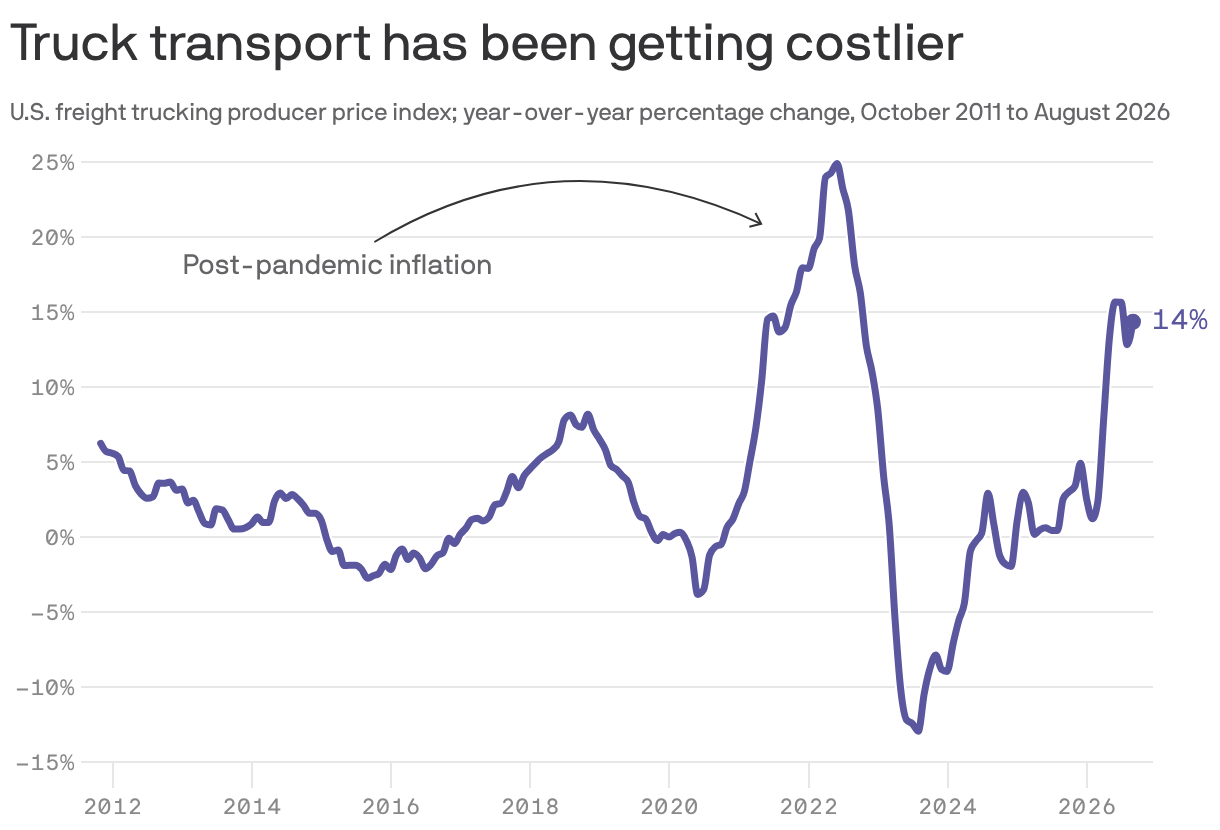
It's not just diesel. The Trump administration's regulatory clampdown on truckers is adding to surging transportation costs.
Why it matters: Trucking is a major way that price shocks get transmitted through the economy.
- And limits on available drivers could amplify the impact of the spike in fuel costs, with diesel now averaging $6.32 a gallon — up over 70% from last year.
The latest: The "prices paid" component of the September services reading from the Institute for Supply Management released Monday registered another sizzling reading (74), indicating still-building price pressure in the system. (Above 50 indicates rising prices; below 50 indicates falling.)
- That's the highest reading on prices since July 2022 amid the post-COVID inflation.
- Chatter from the survey of supply chain managers was chock-full of transportation-related complaints.
Between the lines: Most were about diesel. But trucking industry executives and analysts have also pointed to a reduction in truck driver capacity — which they attribute to the Trump administration's crackdown.
Catch up quick: In April 2025, President Trump issued an executive order outlining the administration's plan to significantly ramp up enforcement of federal English-language requirements for drivers.
- The Department of Transportation has subsequently shut down scores of commercial driver's license training programs throughout the country.
- In March 2026, the DOT's commercial trucking subagency put new licensing requirements for non-domiciled commercial driver's licenses into force.
- The rules limited several categories of non-citizens or non-permanent residents — such as refugees, asylum seekers or most other temporary immigrants with work permits — from getting or renewing these licenses.
Stunning stat: The DOT's Federal Motor Carrier Safety Administration estimates that there are roughly 200,000 people with non-domiciled CDLs in the market.
- That's roughly 5% of the 3.8 million interstate CDL holders in the country.
- The FMCSA expects roughly 194,000 of them to "exit the freight market."
What they're saying: "The supply side has tightened materially, driven by federal enforcement actions and stricter safety rules," Jared Weisfeld, chief strategy officer of logistics firm RXO, told analysts after its August earnings.
- "Supply attrition has been faster than we initially expected and is removing the most irrational capacity from the marketplace," James Filter, the CEO of trucking firm Schneider National, told analysts in late July.
Yes, but: For trucking companies, the supply issues and higher diesel could create opportunities to charge their customers higher shipping rates.
- "With the ongoing regulatory enforcement, reduced effective capacity in truckload is improving [truck-load] rates, and rates could continue to improve, should freight demand inflect more meaningfully," Goldman Sachs trucking analysts wrote last month.
The other side: Investors seem slightly less sanguine.
- Shares of C.H. Robinson Worldwide tanked Monday, after the announcement of its $5.8 billion cash-and-stock acquisition of RXO, suggesting that investors are leery of betting big on the industry.
The bottom line: From the trucking regulation push to the Iran war-driven diesel price surge, the U.S. government's actions continue to be a big factor in creating higher prices, and for some trucking companies, additional profits, at least for now.
