Bond market zig zags threaten S&P 500's smooth ride

Add Axios as your preferred source to
see more of our stories on Google.
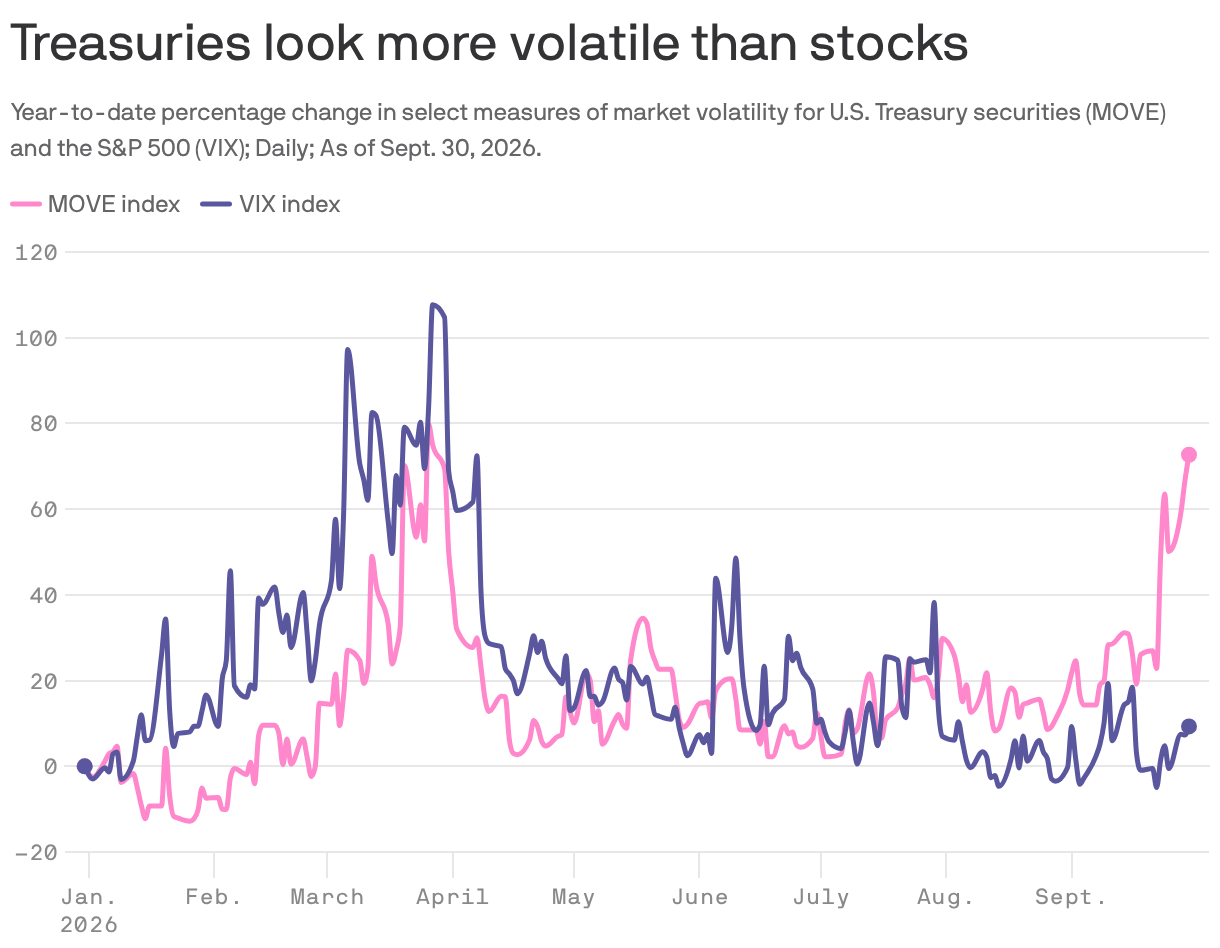
Equity investors expect big volatility, and Treasury investors typically don't. But like so much else in the current market, that truism has been flipped on its head.
Why it matters: Analysts have flagged jagged trading in the Treasury market — which translates into sharp moves in interest rates — as a potential risk for stocks.
Why does the bond market affect stocks? Good question! Here are few theories — in no particular order.
🤔 Theory 1: Higher yields on super safe Treasury bonds mean investors can make more money on them.
- All else equal, they become more attractive compared to stocks. Et voilà, money flows from stocks to bonds, and stock prices fall.
🧐 Theory 2: Treasury yields are, basically, a key component in the denominator in the most widely used formulas used to value stocks. (The top number is expected earnings.) So, as a simple matter of math, when bond yields go up, the number the formula spits out gets smaller — again all else equal. That number is basically the estimate of what a stock is worth.
- And since that smaller number equals a lower price, and virtually everybody is making more or less the same calculation, they all decide stocks are worth less when rates rise. Et voilà, stock prices fall.
🤨 Theory 3: Treasury yields are the foundation for important borrowing costs across the economy. When they go up, costs rise for everybody and can eventually slow economic growth.
- Since the economy drives corporate profits, and corporate profits drive stock prices, the forward-looking stock market sees the rise in rates and factors those lower future earnings in. Et voilà, stock prices fall. Or at least that's what theory suggests they should do.
Yes, but: That hasn't been the case over the last month. The S&P 500 has been relatively quiet in terms of its volatility and is still only about 2% away from its record high, despite the sharp rise in Treasury yields.
- Much of that comes down to earnings. Wall Street analysts expect earnings for S&P 500 companies will be up 29% for the just completed third quarter, compared to the prior year. They were up a giant 51% in Q2 — though a large chunk of that came from giant investment gains Alphabet and Amazon booked on stakes in other tech companies.
What they're saying: "The big offset now is that earnings have been accelerating at a rapid pace," Morgan Stanley U.S. equity strategist Andrew Pauker told Axios Thursday. "So that's why the S&P 500 has been quite resilient."
The bottom line: "Equities can tolerate 5% yields if growth is strong," Pauker said, while warning that stocks could have trouble dealing with another fast, volatile move higher in long-term interest rates. "The scenario we would want to avoid, or equities would want to avoid, is an accelerated move higher in the long end."
