For policymakers, markets prove to be a tough crowd

Add Axios as your preferred source to
see more of our stories on Google.
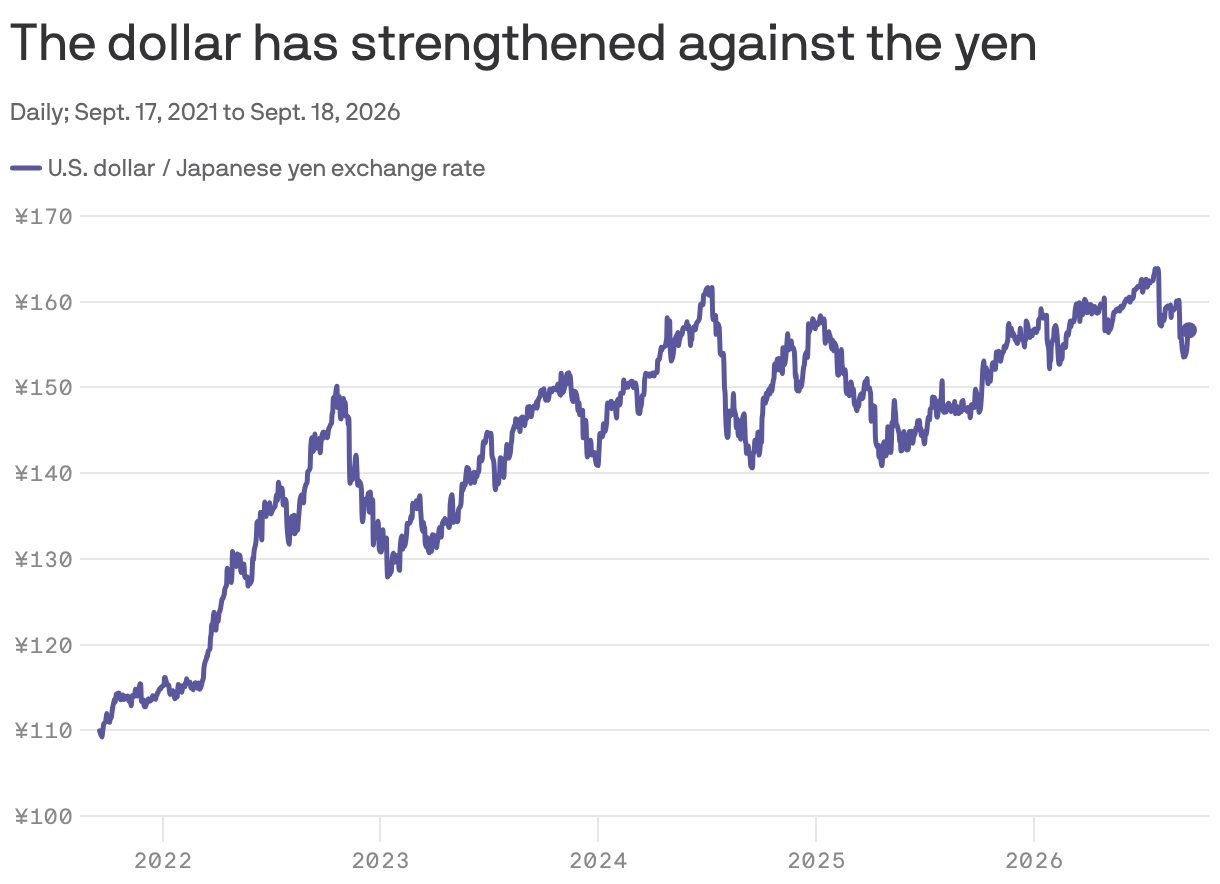
Currency traders largely shrugged off the Bank of Japan's decision to raise its key interest rate to a 31-year high Friday.
Why it matters: It's the latest example of the challenge economic officials face in managing markets that are increasingly jumpy about inflation and large government debts in what seems to be a new, higher-interest-rate environment for the world economy.
Zoom out: In recent months, the U.S. government bond market panned a major press conference of recently installed Federal Reserve chairman Kevin Warsh in late July, contributing to a sharp uptick in Treasury yields. (Warsh's performance as part of last week's Fed rate hike seemed to receive more positive reviews from the markets.)
- Likewise, U.S. Treasury Secretary Scott Bessent's unusual approach to buying back long-term U.S. Treasurys — widely seen as an effort to push down yields — also failed to move the market for more than a moment or so.
The latest: The Bank of Japan raised its key interest rate to 1.25% in part to cool inflation and bolster the strength of the yen, which is down more than 5.5% against the U.S. dollar over the last 12 months.
Reality check: That's a big move for the currency of one of the world's largest economies.
- The weakness of the currency worsens inflation for an import-reliant economy like Japan.
- It hit a 40-year low against the U.S. dollar in July.
- The weakness prompted Japan's Ministry of Finance to intervene in currency markets earlier in the year, including an unusual joint coordination with the U.S. on July 31.
How it works: All else equal, higher central bank interest rates are supposed to attract global capital to a country. That can also help stabilize a weakening currency.
Yes, but: The yen still stumbled after the decision was announced last week, as comments from Bank of Japan governor Kazuo Ueda weren't definitive enough to convince traders that the BoJ would make the hard decisions — that is, keep raising rates when they are already at multi-decade highs — to shore up the yen, if required to do so.
What they're saying: "Ueda was as usual too balanced to send an unequivocally hawkish message," wrote Evercore ISI analyst Krishna Guha. "The result was that while the BoJ certainly did shift hawkish, it was not enough to meet market expectations."
The bottom line: For economic policymakers trying to face down jumpy markets at the moment, everybody's a critic.
