Scoop: NRSC spends $46.5 million on coordinated campaigns

Add Axios as your preferred source to
see more of our stories on Google.
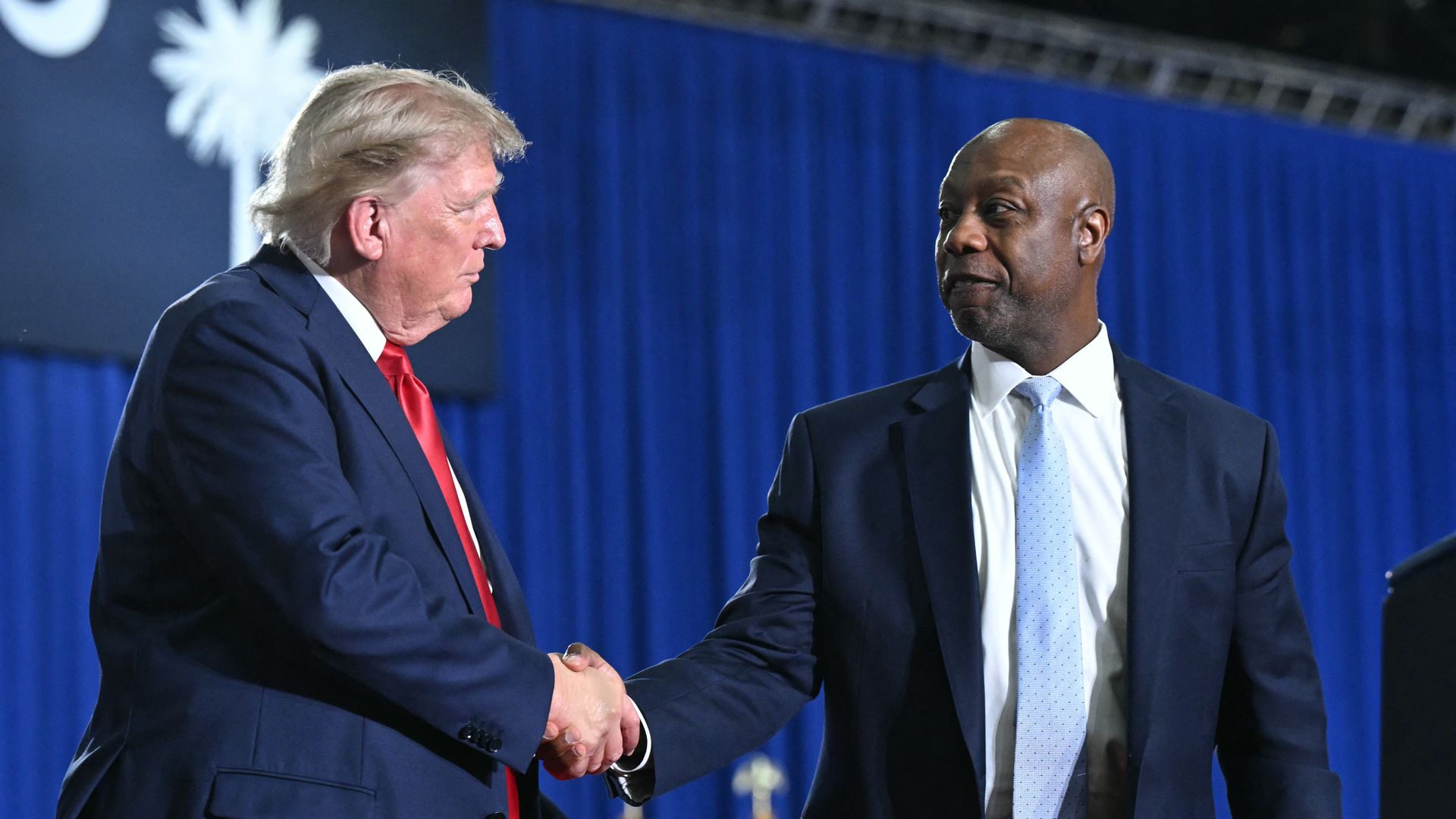
President Trump and National Republican Senatorial Committee chair Tim Scott at an August rally for Sen. Darline Graham. Photo: Saul Loeb / AFP via Getty Images
The National Republican Senatorial Committee is taking full advantage of the Supreme Court's ruling striking down limits on coordinated party spending, pumping $46.5 million into eight states, Axios has learned.
Why it matters: Republican committees, which entered the campaign's final stretch with a financial edge over their Democratic counterparts, have aggressively embraced the new rules allowing parties to coordinate unlimited spending with their candidates.
- The NRSC estimates that coordinating directly with campaigns can make its advertising dollars stretch three to 10 times further than last cycle, according to a person familiar with the matter.
- That's because candidates and coordinated party campaigns can generally secure substantially cheaper TV ad rates than super PACs and other outside groups, which are also flooding the airwaves.
The $46.5 million figure will be disclosed in the committee's monthly filing with the Federal Election Commission, due Sunday.
- The NRSC had $17 million more in cash on hand at the end of July than the Democratic Senatorial Campaign Committee.
Zoom in: The spending will defend Republican-held seats and target Democratic-held seats.
- The biggest defensive investment is in Ohio, where the NRSC is spending $11.2 million to support Sen. Jon Husted (R).
- Next is Iowa, where the committee is spending $8.8 million on behalf of Rep. Ashley Hinson (R).
On offense, the NRSC is coordinating $5.3 million in spending with former Sen. John Sununu in New Hampshire, followed by $4.2 million in Michigan.
- The committee is also spending in Alaska, Georgia, Maine and North Carolina.
- The NRSC quickly moved to capitalize on the Supreme Court's June ruling, closing its independent expenditure operation and planning to shift nearly all of its advertising into coordinated spending.
Zoom out: House Republicans have also aggressively embraced the new rules, with the National Republican Congressional Committee reserving nearly $9 million in coordinated TV advertising across more than 20 races this month.
- Democratic candidates frequently outraise their Republican opponents at the individual campaign level, including in some of the most competitive races.
- The Democratic Congressional Campaign Committee is also taking advantage of the new spending rules, though its coordinated spending has so far been more limited than the NRCC's.
