Wall Street thinks the stock market can handle a few hikes

Add Axios as your preferred source to
see more of our stories on Google.
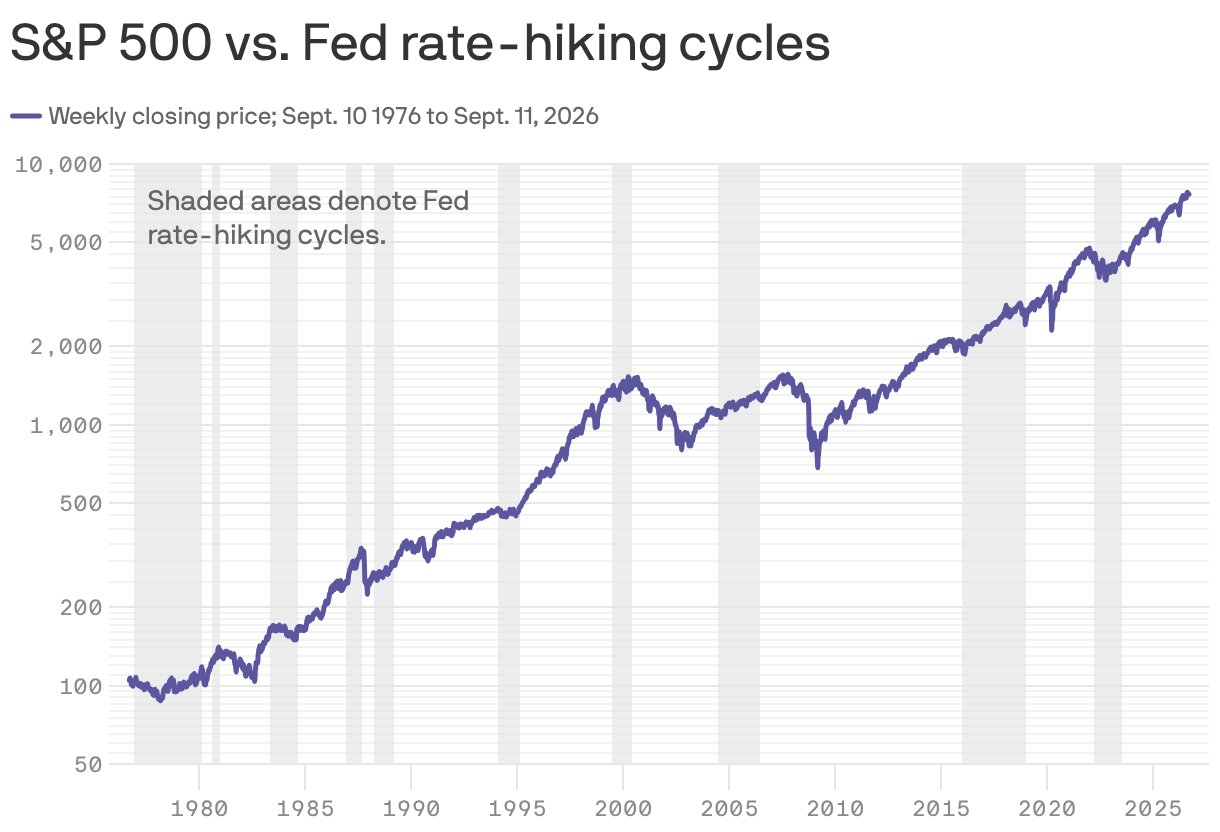
Market watchers think the market should be able to continue to gain altitude despite a headwind from Federal Reserve interest rate hikes.
Why it matters: Rate-hiking cycles have sometimes undermined the market, leaving investors with ugly losses.
Case in point: In 2022, the S&P 500 fell 19.4% — its worst annual performance of the last 17 years — as the Fed rushed to snuff out a nasty bout of inflation that broke out during and after the COVID-19 pandemic.
- The Fed jacked up interest rates sharply in a cycle that lasted from March 2022 to July 2023.
Driving the news: The Federal Reserve launched what's expected to be a series of interest rate increases Wednesday, with a quarter-point rise.
- Chairman Kevin Warsh justified the move by saying, "The plain fact is that inflation is too high and has been for too long."
- And the S&P 500 added to its string of lackluster recent performances, declining 0.5% Wednesday.
Yes, but: On Thursday, the blue-chip index posted its biggest gain since early August. The rally was broad, including AI-related shares and software stocks as well as fuel-sensitive sectors like airlines and rate-sensitive industries like homebuilding.
Between the lines: The rally seemed driven, in part, by a second consecutive drop in crude oil prices. That cuts costs — and theoretically raises profits — for industries like airlines.
- Some attributed the oil price drop to a Reuters report that Saudi Arabia had asked China to intervene with Iran in hopes that Iran would rein in Houthi fighters after attacks on Saudi diversionary pipelines in recent days. (Beijing apparently made a call to Tehran.)
- Long-term Treasury yields also fell, with analysts suggesting that by raising short-term interest rates — against the explicit preferences of President Trump — the Fed had restored some of the institution's inflation-fighting bona fides.
- That has shrunk the uncertainty premium that helped push yields up after Warsh's widely panned performance in his late July press conference.
The big picture: The combination of falling crude oil prices and declining long-term Treasury yields is tailor-made to give stocks a lift, analysts say.
- If such salubrious market conditions continue, it could mean that the Fed won't have to raise rates too high or too quickly.
- Under such a scenario, the S&P 500 may well avoid the kind of ugly drop it endured in 2022.
- Still, that's a big "if." Especially as such an important variable — energy prices — hinges on developments in the Iran war.
What they're saying: "The key risks are oil and an unexpected inflation shock," wrote Mike Wilson, Morgan Stanley's chief U.S. equity strategist.
- That combination could turn "what currently looks like a more modest policy adjustment that is preemptive in nature into what would be viewed as a more prolonged hiking cycle."
"Twenty-five basis points here and there isn't going to make too much of a difference," Steve Sosnick, chief strategist at Interactive Brokers, tells Axios. "What could go wrong is that this doesn't do enough to curb inflation and we have to really enter into a hiking cycle."
The bottom line: "That could be problematic," he says.
