Ukraine lessons run deep in U.K. defense spending plan

Add Axios as your preferred source to
see more of our stories on Google.
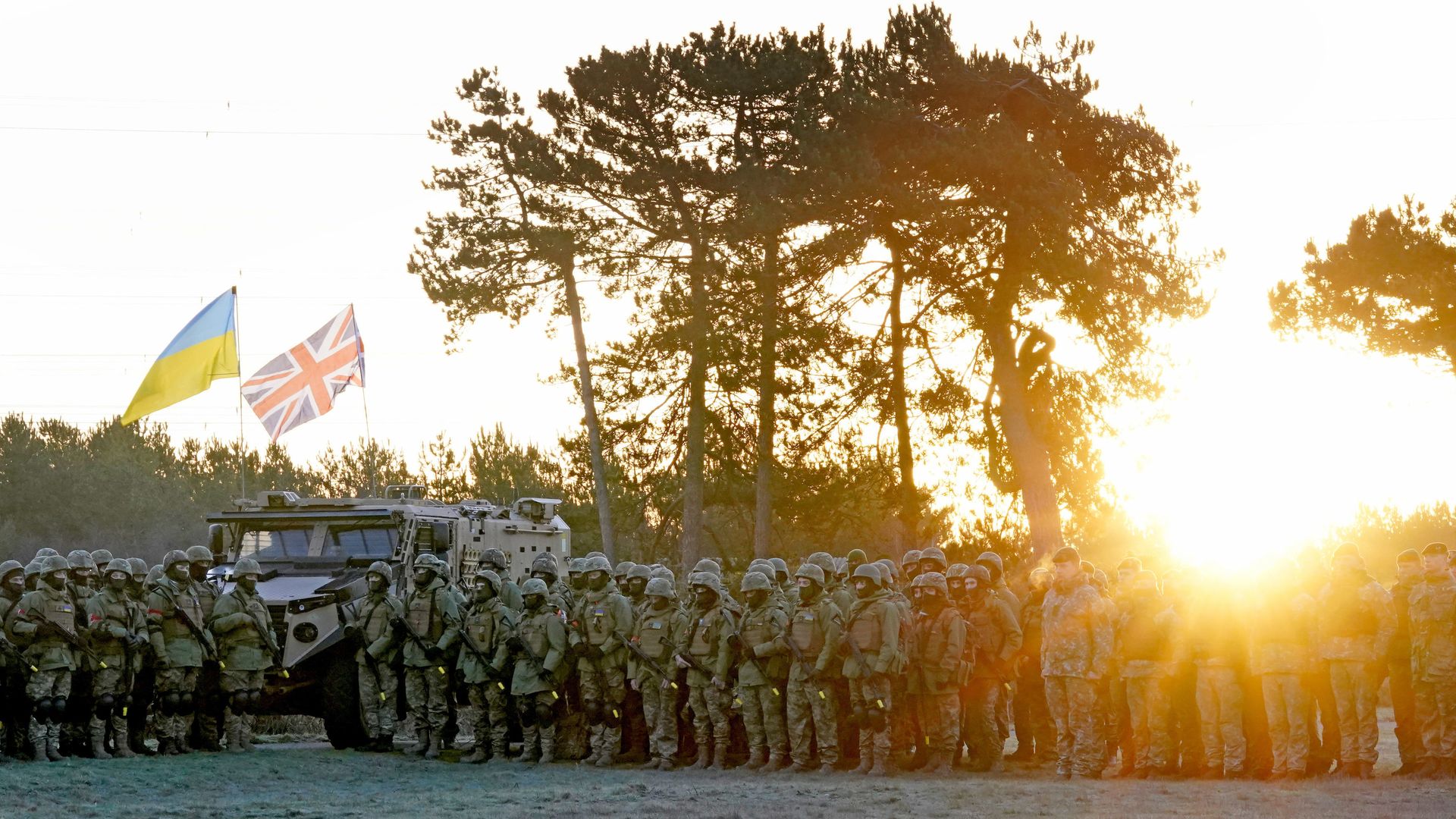
Ukrainian troops and their U.K. instructors gather in the south of England in 2023. Photo: Gareth Fuller/PA Images via Getty Images
The U.K. published, after some delay, its Defence Investment Plan. It's a thoroughly Ukrainian document.
The big picture: The Russia-Ukraine war — now in its fifth year, with casualties surpassing 1.5 million people — has radically changed how conflicts are thought through, stockpiled for and fought.
- Every country is taking notes.
- And reporters around the world are asking the same question of generals and admirals: What lessons have you learned?
Driving the news: Ukraine is name-dropped more than 30 times across the DIP's 81 pages, hitting everything from space connectivity to industrial strength to integrated air defenses to low-cost cruise missiles to procurement reform to civil resilience.
- Russian President Vladimir Putin's "aggression is growing around our shores, in the High North, across Europe and in Ukraine," the plan reads.
- British F-35s recently intercepted a Russian Bear-F that was flying over and dropping sonobuoys near the HMS Prince of Wales in the Norwegian Sea.
What's inside: The DIP is bankrolled by £298 billion (almost $400 billion) over four years, including more than £63 billion for the nuclear arsenal, £5 billion for autonomous systems, £2.5 billion for cyber and electronic warfare and £790 million for homeland air defenses.
Other, more granular items of interest include:
Kickstarting a Collaborative Combat Aircraft program, similar to the U.S. Air Force's robo-wingman effort spearheaded by Anduril Industries and General Atomics.
Committing £220 million to Project NYX, which seeks to build drones to fly alongside Boeing-made Apache attack helicopters.
Retiring early Wildcat battlefield reconnaissance helicopters.
Axing the Type 83 destroyer, set to replace Type 45, in favor of a hybrid fleet consisting of manned and unmanned vessels.
Upgrading and sustaining Eurofighter Typhoons to the tune of more than £1.1 billion.
Pivoting toward a next-generation of lower-cost cruise missiles and away from MBDA-made Storm Shadows, which trace back decades.
What they're saying: "There's a whole range — in all branches, frankly — of autonomous and counter-autonomous systems," a senior U.K. official told Axios.
- "That's definitely recognizing what we've seen happening in Ukraine," the official added.
- "We want to make sure that we're working with the Ukrainians, as we have been, to make sure that we're getting cutting-edge technology."
Zoom out: More than 50,000 Ukrainian personnel have been trained on British soil as part of Operation Interflex. London has also committed billions of pounds of security aid to Kyiv.
- Plus, a U.K.-Ukraine combo topped the Pentagon's first Drone Dominance challenge.
The bottom line: "Ukraine shows that we must rethink warfare: cheap, massed, precise systems now dominate," the DIP reads.
- "Speed is decisive."
